
Editorial disclosure: This article includes a contextual reference to Tapvid as part of a content collaboration. It does not imply a product integration, endorsement, or joint technical offering.
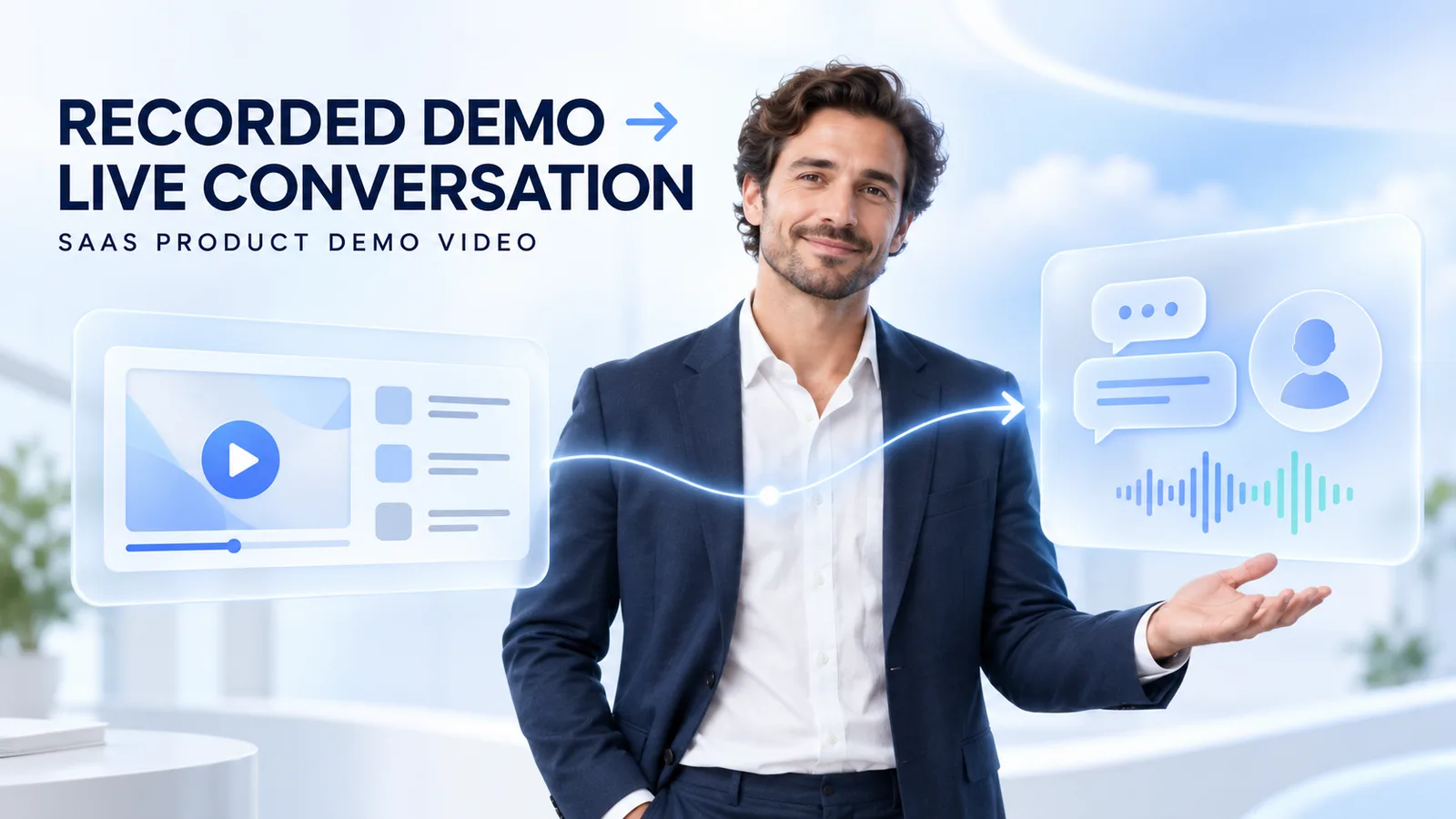
A SaaS product demo video should show one buyer-relevant workflow clearly enough that a viewer can decide whether it is worth a closer look. Keep that proof recorded when the same evidence works for every viewer. Make the next step a live conversation only when the buyer needs to ask a context-specific question, explore a branch, or complete a guided task.
A product demo video and a live conversation have different jobs
Teams often ask whether a polished demo video should be replaced with an interactive experience. Usually, that is the wrong starting point. A recorded asset and a real-time interaction answer different buyer needs.
A recorded demo is useful when the message is stable: show the product state, show the action, then show the outcome. A live layer earns its place after that proof, when a person needs an answer that depends on their role, current setup, or intended next step.
| Buyer need | Better first format | Why |
|---|---|---|
| “What does this workflow do?” | Recorded product demo video | A concise, repeatable sequence makes the product evidence easy to inspect. |
| “Does this apply to my team?” | Live conversation after the video | The answer may depend on the buyer’s role, goals, and product context. |
| “Can I explore the product myself?” | Guided walkthrough or sandbox | The buyer needs to click through a controlled experience, not watch another video. |
| “What should I do next?” | Live conversation or a clear CTA | The buyer needs a contextual handoff, not more generic product footage. |
The distinction also prevents a category mistake. A guided walkthrough can be valuable, but it is not automatically a better video; it is a different format with a different job.
Use a recorded SaaS product demo video for repeatable proof
Start with the question a buyer should be able to answer after watching. It might be “How does the workflow begin?”, “What does the user see?”, or “What changes once the task is complete?” If the answer can be shown reliably in the same sequence, recording it is usually the clearest choice.
Decide which product state is safe to show, remove distracting paths, and make the outcome legible without narration that overpromises.
For a practical production outline, see Tapvid’s guide to planning a SaaS product demo video. Tapvid describes an explainer-video workflow that can start from a prompt, script, link, document, or product assets; its public guidance is a useful reference for turning a real workflow into a reviewable buyer-proof sequence.
Keep the recording focused on what is observable. Do not add unverified performance claims, imply that a general workflow is available in every plan, or treat a polished video as evidence that a customer will obtain a particular business result.
Add conversation when the buyer needs a branch, not a replay
A video cannot ask a follow-up question. It cannot tell whether a viewer is a trial user, an evaluator, or an existing customer whose account state changes the answer. That is the point at which a controlled live interaction can be more useful than another recorded clip.
For example, a feature page can keep a short recorded demo, then offer a live guide when the buyer needs to choose a setup path or clarify a technical constraint. The video establishes common ground; the conversation handles variation.
A live experience needs a defined scope: what it can explain, which information it may use, what the user can do next, and how the user can leave or reach a human. The Spatius guide to piloting an AI avatar in a SaaS product explains why a narrow, measurable product moment is a better starting point than an “avatar everywhere” rollout.
Keep ownership boundaries clear
If a SaaS team adds a real-time visual guide, the team still owns the product and conversation decisions. In a Spatius implementation, the application or its existing agent stack remains responsible for speech recognition, language-model behavior, text-to-speech, knowledge, context, permissions, tools, workflows, analytics, and handoff. Spatius Motion Server converts approved avatar speech audio into motion data, while AvatarKit renders the avatar locally in the client. The current Spatius developer docs map documents that boundary.
A generated product demo ends as a reusable asset. A real-time avatar layer is evaluated when a product needs an application-controlled spoken interaction after the buyer reaches the relevant moment. For the broader technical distinction, read AI Avatar API vs. AI Video Generation API.
Design the handoff deliberately
The most useful buyer journey is often simple:
- Show a recorded SaaS product demo video that proves one workflow.
- Give the buyer a visible next action: explore a guided environment, read the technical details, or ask a question.
- Start a live conversation only where a context-specific answer will help the buyer advance.
- Preserve controls to interrupt, leave, choose another route, or contact a person.
The same logic keeps acquisition content in its place. An AI UGC or campaign video may earn attention before a click; a product demo establishes workflow proof after it. A real-time conversation belongs later, when an application can safely respond to the buyer’s context. See AI UGC avatars for video ads versus real-time workflows for that boundary.
Frequently asked questions
Is a SaaS product demo video the same as an explainer video?
Not necessarily. An explainer can introduce a problem or category. A product demo should show concrete product behavior and an outcome a buyer can inspect.
Should every demo video become interactive?
No. Use an interactive walkthrough when the buyer needs to explore. Keep a video when a stable, repeatable proof sequence is the clearest format.
When is a real-time avatar useful after a demo?
When the next answer depends on the buyer’s context and your application can govern the knowledge, permissions, actions, exits, and handoff involved.
Does Spatius generate a finished product demo video?
No. Spatius is a real-time avatar interaction layer, not a finished-video generator. See the developer docs map for the documented product boundary.
What should we test before expanding a live demo guide?
Test one product moment, the permitted response scope, user controls, fallback behavior, and whether users reach the intended next action. Do not infer a broader business outcome from a first prototype.
Last verified: September 28, 2026. Product capabilities and documentation can change; confirm the current documentation before implementation.
If you are evaluating a governed, real-time avatar interaction for a SaaS workflow, Request a Demo.