The landscape of conversational AI is undergoing a fundamental shift. Voice-only agents powered by STT, LLMs, and TTS are rapidly evolving into interactive video avatars. For product managers, CTOs, and engineering teams building AI tutors, customer service kiosks, healthcare companions, and in-vehicle systems, adding a visual digital human increases session duration, emotional trust, and user engagement.
However, bringing a digital avatar to life in real-time introduces severe engineering bottlenecks: end-to-end pipeline latency, server infrastructure cost, video streaming bandwidth overhead, and client device rendering constraints.
Two prominent platforms offer radically different technological solutions to this problem: Spatius and LemonSlice.
-
LemonSlice utilizes a cloud server-side 20B parameter Video Diffusion Transformer model (
LemonSlice-2) that generates every video pixel from scratch on cloud GPUs and streams 1080p video to client devices via WebRTC. -
Spatius utilizes a Cloud-Edge Hybrid Architecture that processes audio in the cloud, streams a lightweight approximately 10–15 KB/s control payload, and renders photorealistic 3D avatars locally on supported client devices (phones, laptops, kiosks).
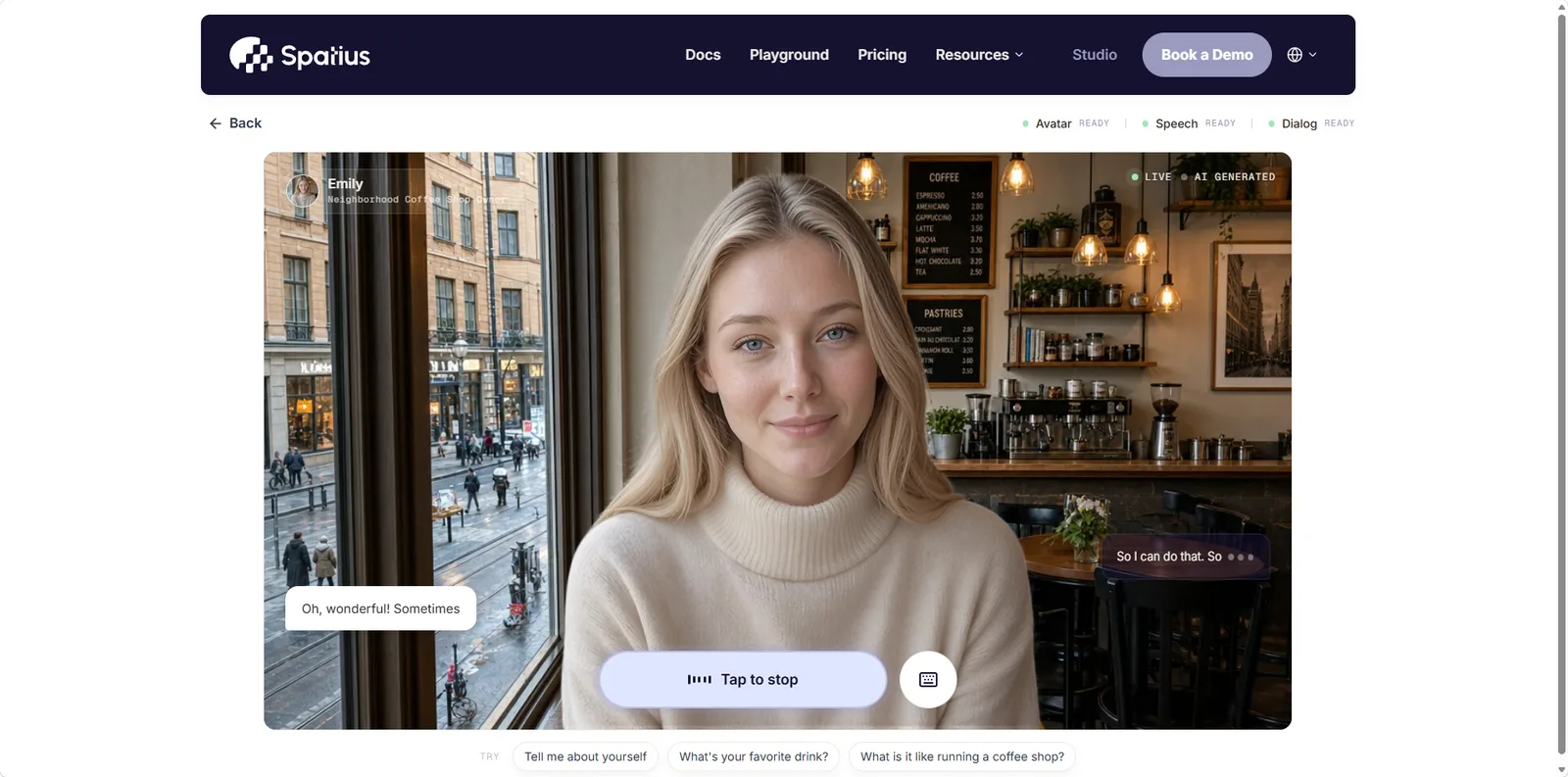
This article provides a head-to-head technical comparison of Spatius vs LemonSlice across five critical developer criteria: rendering architecture, pipeline latency, unit economics, client device compatibility, and avatar customization options.
Executive Summary: Spatius vs LemonSlice At a Glance
Before diving into architectural deep dives, the matrix below summarizes how the two platforms compare across key technical dimensions:
| Dimension / Feature | Spatius | LemonSlice (LemonSlice-2) |
|---|---|---|
| Core Architecture | ||
| Rendering Model | Cloud-Edge Hybrid (On-device WebGL, Metal, Vulkan) | Cloud Server Diffusion Transformer (20B parameters) |
| Streaming Bandwidth | Approximately 10–15 KB/s (Motion data) | 2–5 Mbps (Full 1080p WebRTC video stream) |
| End-to-End Latency | Depends on the complete voice and client path | 2.0s – 6.0s (Full STT + LLM + TTS + Video diffusion) |
| Unit Economics / Cost | $0.42 / hour ($0.007 / minute) predictable flat rate | Cloud GPU container costs (Modal) + WebRTC video egress |
| Client Hardware Load | Local rendering on supported devices; validate target hardware | Low client GPU load (WebRTC player), heavy cloud GPU load |
| Avatar Customization | Stock 3D digital humans + Custom 3DGS avatar models | Zero-shot single 2D image (photos, illustrations, mascots) |
| Target Integration | Web, iOS, Android Native SDKs (@spatius/avatarkit) | Developer API + Embeddable Web Widget |
Criterion 1: Rendering Architecture & Network Bandwidth Physics
The fundamental architectural difference between Spatius and LemonSlice centers on where pixel rendering takes place.
LemonSlice (Cloud Diffusion):
[ASR + LLM + TTS] --> [Cloud GPU (20B Diffusion Model)] --> [WebRTC Video Stream (2-5 Mbps)] --> Client Player

Spatius (Cloud-Edge Hybrid):
[ASR + LLM + TTS] --> [Cloud Audio-to-Avatar Engine] --> [Control Payload (10–15 KB/s)] --> Client Local SDK (WebGL/Metal/Vulkan)
LemonSlice: Cloud Video Diffusion Streaming
LemonSlice relies on LemonSlice-2, a proprietary 20-billion-parameter video diffusion transformer. When a user speaks, the audio is processed through STT, LLM, and TTS engines before being fed into a server container (typically hosted on cloud GPU providers like Modal).
The 20B diffusion model generates avatar video frames frame-by-frame at ~20 fps. These frames are compressed into an H.264/VP8 WebRTC video stream (orchestrated via Daily.co or Pipecat) and sent over the public internet to the user’s browser or mobile app.
While this allows LemonSlice to animate arbitrary 2D static images without client-side rendering capabilities, it introduces high network bandwidth requirements. A 1080p WebRTC video stream consumes 2 to 5 Megabits per second (Mbps) per active call. On mobile connections or enterprise Wi-Fi networks with high concurrency, streaming full video creates network congestion, packet loss, and video frame dropping.
Spatius: Cloud-Edge Hybrid Architecture
Spatius eliminates server-side video rendering entirely. Instead of generating heavy video pixels in the cloud, Spatius operates as a cloud-edge hybrid system.
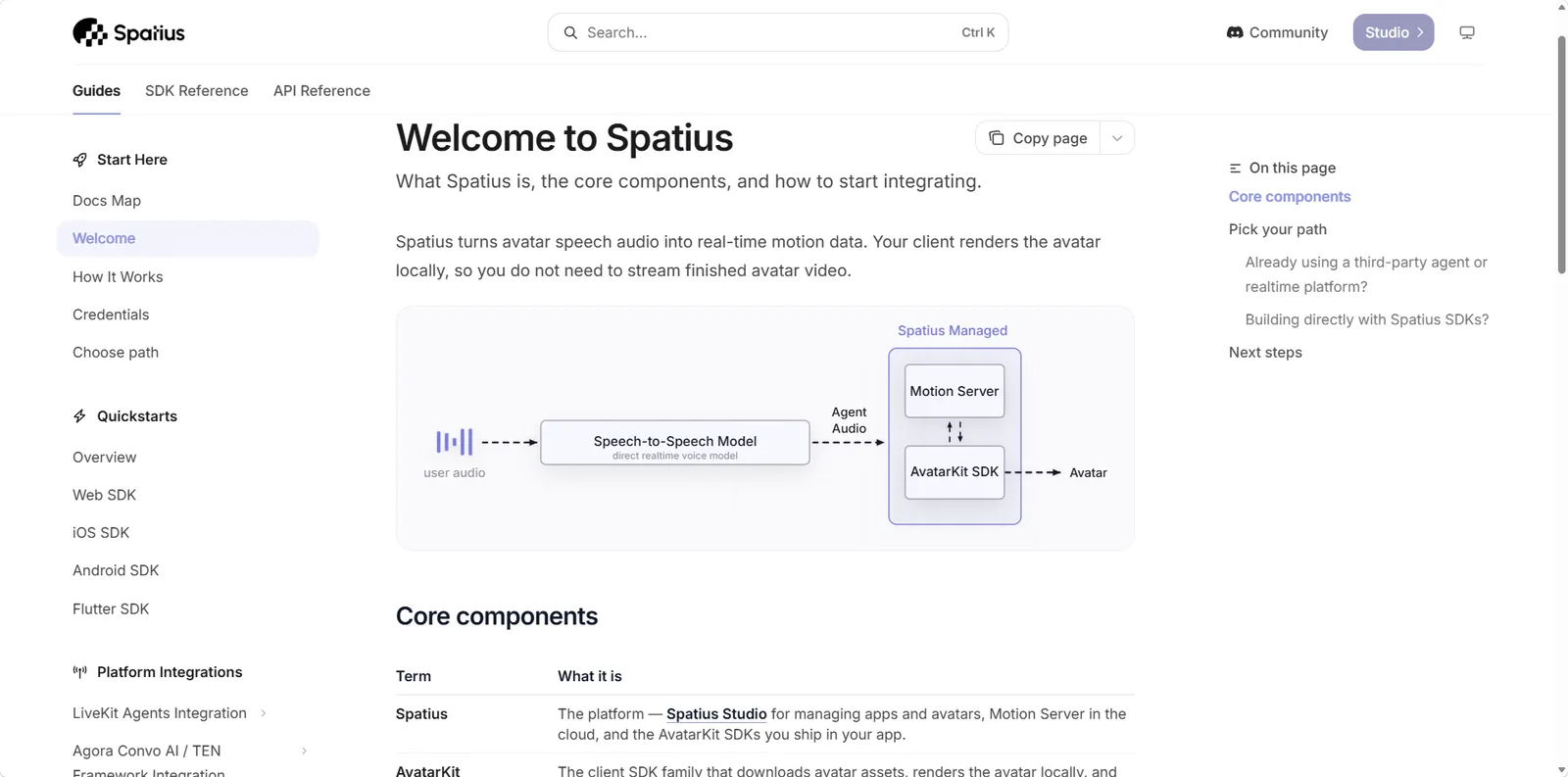
The cloud infrastructure ingests input speech audio and runs a lightweight Audio-to-Avatar Engine that extracts lip-sync control data and facial animation coefficients. This control stream requires only ~100 kilobits per second (kbps) of bandwidth—reducing network data overhead by over 95% compared to full WebRTC video streaming.
On the client side, the Spatius SDK (AvatarKit) uses native graphics APIs—WebGL/WebGPU on the Web, Metal on iOS, and Vulkan on Android—to render photorealistic 3D avatars directly on supported device GPUs. To learn more about how this architecture reduces bandwidth overhead, read the detailed on-device edge rendering vs cloud video streaming breakdown.
Key Takeaway: LemonSlice streams heavy video frames generated on cloud GPUs (2–5 Mbps). Spatius streams lightweight motion signals (approximately 10–15 KB/s) and renders pixels locally, eliminating network bandwidth constraints.
Criterion 2: End-to-End Latency & Jitter Resilience
In conversational AI, latency is the single greatest driver of user churn. If an avatar takes 3 to 5 seconds to react after a user finishes speaking, the interaction feels unnatural and awkward.
End-to-end conversation latency is cumulative across four distinct stages:
-
STT (Speech-to-Text): ~200ms – 400ms
-
LLM Time-to-First-Token: ~300ms – 800ms
-
TTS (Text-to-Speech): ~200ms – 400ms
-
Avatar Inference & Frame Transport: Variable
LemonSlice Latency Profile
LemonSlice’s Flash diffusion model achieves an impressive 471ms time-to-first-byte on GPU containers. However, because video frames must be generated sequentially by a 20B parameter diffusion model and transported across WebRTC media servers, production deployments (such as Pipecat / Daily pipeline integrations) report end-to-end user-input to avatar-output latency between 2.0 seconds and 6.0 seconds.
Furthermore, because WebRTC video streams depend on continuous frame delivery, network jitter on cellular networks can cause frozen video frames or out-of-sync audio.
Spatius Latency Profile
Spatius is optimized specifically for real-time conversational responsiveness. The Spatius Audio-to-Avatar Engine accepts streaming audio buffers directly from TTS pipelines (such as ElevenLabs, OpenAI Realtime, or Deepgram) and outputs synchronized 3D facial animation data in near real time.
By avoiding cloud video diffusion cycles, Spatius reduces total end-to-end pipeline latency to latency that depends on the full voice pipeline. Furthermore, because the approximately 10–15 KB/s driver stream contains built-in payload redundancy, minor packet loss on mobile networks does not cause video stutter; the client SDK interpolates facial motion smoothly across dropped packets.
Criterion 3: Infrastructure Cost & Unit Economics ($0.42/hr vs Cloud GPU)
For commercial AI applications scaling to thousands of concurrent users, unit economics determine business viability.
LemonSlice Cost Model
Generating real-time video with a 20B parameter diffusion model requires dedicated server-side GPU instances (e.g., NVIDIA A100, H100, or L40S GPUs). On autoscaling container platforms like Modal, running GPU inference containers per active user session incurs substantial compute costs.
When combined with WebRTC video bandwidth egress charges from Daily.co or AWS, the server cost for running cloud video diffusion typically ranges between $3.00 and $10.00+ per hour of active streaming. While LemonSlice offers subscription tiers starting at self-serve monthly pricing, high-volume production applications face variable runtime expenses tied directly to GPU cloud capacity.
Spatius Cost Model
By offloading pixel rendering to edge devices, Spatius drastically cuts infrastructure overhead. Cloud servers only need to process lightweight audio-to-motion data streams rather than rendering video frames.
Spatius passes these infrastructure savings directly to developers with transparent, flat-rate pricing:
-
Scale Plan: $0.42 per hour (equivalent to $0.007 per minute).
-
Starter Plan: $0.009 per minute (~$0.54 per hour).
For a product running 100,000 active session minutes per month, Spatius costs approximately $700/month, compared to thousands of dollars in cloud GPU compute and video bandwidth fees required for server-side diffusion. For a comprehensive comparison across top industry providers, consult the AI avatar unit economics breakdown.
Pro Tip: When modeling unit economics for voice and video AI agents, calculate your per-minute compute cost at scale. Edge rendering decouples your margin from cloud GPU pricing spikes.
Criterion 4: Client Device Compatibility & Edge Deployments
When choosing an avatar framework, consider where your application will be deployed.
Spatius in action — watch demo on YouTube
WebRTC Web Players vs Native SDKs
Because LemonSlice outputs a standard WebRTC video stream, any device capable of running an H.264/VP8 video player can display the avatar. This makes LemonSlice easy to integrate into simple web pages via an embeddable widget or API. However, it requires a continuous high-speed internet connection and cannot operate in bandwidth-constrained or offline environment scenarios.
Spatius provides cross-platform SDKs for Web (@spatius/avatarkit), iOS (AvatarKit.xcframework via Metal), and Android (ai.spatius:avatarkit via Vulkan).
The Spatius rendering engine is designed for supported hardware, including mid-range smartphones, iPad tablets, desktop monitors, self-service interactive kiosks, and in-vehicle infotainment chipsets. Validate frame rate and GPU requirements on the devices you plan to ship.
Criterion 5: Avatar Customization & Visual Fidelity
Avatar creation workflows differ significantly between the two platforms.
LemonSlice: Zero-Shot 2D Image Animation
LemonSlice’s greatest strength is its zero-shot image animation capability. Developers or creators can upload a single 2D photograph, illustration, cartoon, or brand mascot, and LemonSlice-2 instantly generates a living, conversational video avatar from that image.
It automatically predicts head turns, eye blinks, facial expressions, and hand gestures. This makes LemonSlice ideal for applications that require generating dozens of unique characters on the fly from arbitrary image uploads without prior 3D modeling or training.
Spatius: Photorealistic 3D Digital Humans & 3DGS Models
Spatius focuses on photorealistic 3D digital human avatars designed for long-form, multi-session application usage. Spatius provides a library of free stock 3D digital humans built with lifelike facial geometry, realistic lighting, and precise lip-sync alignment.
For enterprise brands and custom characters, Spatius supports 3D Gaussian Splatting (3DGS) model integration. By training custom 3DGS models, developers can deploy hyper-realistic, brand-exclusive digital humans that maintain perfect 3D consistency, volumetric lighting, and natural camera perspectives across all user sessions.
Decision Framework: When to Choose Which Platform
To summarize your selection decision, use the scenario guidelines below:
1. **You need zero-shot 2D photo animation**: You want users to upload an arbitrary photo, cartoon, or illustration and immediately start a video call without 3D model creation. 2. **You prioritize server-side simplicity**: You prefer receiving a pre-rendered WebRTC video stream and do not want to integrate native client graphics SDKs. 3. **Your users are strictly on high-bandwidth desktop connections**: Your audience has unconstrained Wi-Fi or high-speed wired internet where 2–5 Mbps video streaming bandwidth is not a bottleneck.
1. **You need a client-rendered real-time interaction**: Measure the full voice and avatar path under your target conditions. 2. **You need predictable unit economics**: Compare current plan pricing and equivalent workloads before deployment. 3. **You deploy on mobile, web, kiosks, or edge devices**: Validate native Web, iOS, and Android SDK behavior on representative hardware and networks. 4. **You want photorealistic 3D digital humans**: You require high-fidelity stock avatars or custom **3D Gaussian Splatting (3DGS)** avatar models.
Getting Started & Next Steps
Ready to evaluate real-time AI avatar rendering for your application stack?
-
Test live latency in your browser: Test stock avatars running edge rendering directly in your browser on the Spatius interactive playground.
-
Explore the developer docs: Follow quickstart integration guides for Web, iOS, and Android on the Spatius SDK documentation.
-
Review technical benchmarks: Evaluate public latency numbers and performance metrics using developer benchmark utilities.
Start building with Spatius — free tier included, no credit card required. Native Web, iOS & Android SDKs. Get started free, or ,或View pricing, or ,或Talk to sales.。
Frequently asked questions
What's the main difference between Spatius and LemonSlice?
The fundamental difference is where pixels are rendered. LemonSlice uses a 20B parameter video diffusion model that generates every video frame on cloud GPUs and streams full 1080p video (2–5 Mbps) to the client via WebRTC. Spatius uses a cloud-edge hybrid architecture: the cloud processes audio and extracts lightweight animation control data (approximately 10–15 KB/s), and the client device renders the avatar locally using native graphics APIs (WebGL, Metal, Vulkan). This architectural difference impacts every other metric — latency, cost, bandwidth requirements, and deployment flexibility.
Which platform has lower latency?
Spatius avoids cloud video diffusion cycles, but end-to-end latency still depends on the voice pipeline, region, network, and client device. The Audio-to-Avatar Engine accepts streaming audio buffers directly from TTS pipelines and outputs synchronized 3D facial animation data in near real time. LemonSlice production deployments (Pipecat / Daily pipeline integrations) report end-to-end latency between 2.0 and 6.0 seconds due to sequential video frame generation across the 20B diffusion model and WebRTC media server transport. Additionally, Spatius’s control stream includes built-in payload redundancy, so minor packet loss does not cause video stutter.
How much does each platform cost?
Spatius offers flat-rate pricing at $0.42/hour ($0.007/min) on the Scale plan and $0.009/min on the Starter plan — predictable costs that stay constant regardless of usage volume. LemonSlice’s costs are variable: cloud GPU compute time (A100/H100/L40S instances on platforms like Modal) plus WebRTC video bandwidth egress fees. Server-side cloud video diffusion typically ranges from $3.00 to $10.00+ per hour of active streaming. For 100,000 active session minutes per month, Spatius costs approximately $700/month versus thousands of dollars in GPU compute and video bandwidth for cloud diffusion.
Can LemonSlice run on mobile or low-bandwidth connections?
LemonSlice requires a continuous high-speed internet connection because it streams full 1080p WebRTC video at 2–5 Mbps per active session. On mobile or congested networks, this leads to packet loss, frozen frames, or out-of-sync audio. Spatius operates over connections as narrow as approximately 10–15 KB/s — approximately 95% less bandwidth — making it suitable for mobile deployments, rural clinics, factory floors, in-vehicle systems, and any environment where reliable Wi-Fi is not guaranteed.
What avatar customization options does each platform support?
LemonSlice excels at zero-shot 2D image animation — you upload a single photo, illustration, or cartoon, and the platform instantly generates a conversational avatar with predicted head movements, blinks, and expressions. This is ideal for applications needing many unique characters from arbitrary images. Spatius focuses on photorealistic 3D digital humans with lifelike facial geometry for long-form, multi-session use. It provides a library of free stock 3D avatars and supports custom 3D Gaussian Splatting (3DGS) model integration for enterprise-branded, hyper-realistic digital humans with perfect 3D consistency.
Which platform is better for edge deployments like kiosks or embedded devices?
Spatius is purpose-built for edge deployments. Its native Web, iOS, and Android SDKs render avatars locally on supported hardware. Because only approximately 10–15 KB/s of control data is streamed from the cloud, Spatius can fit deployments where a continuous video stream would be impractical; validate the target network and device before shipping. LemonSlice is designed for the web browser paradigm with cloud dependency and is not suited for hardware deployments requiring offline tolerance or constrained connectivity.