
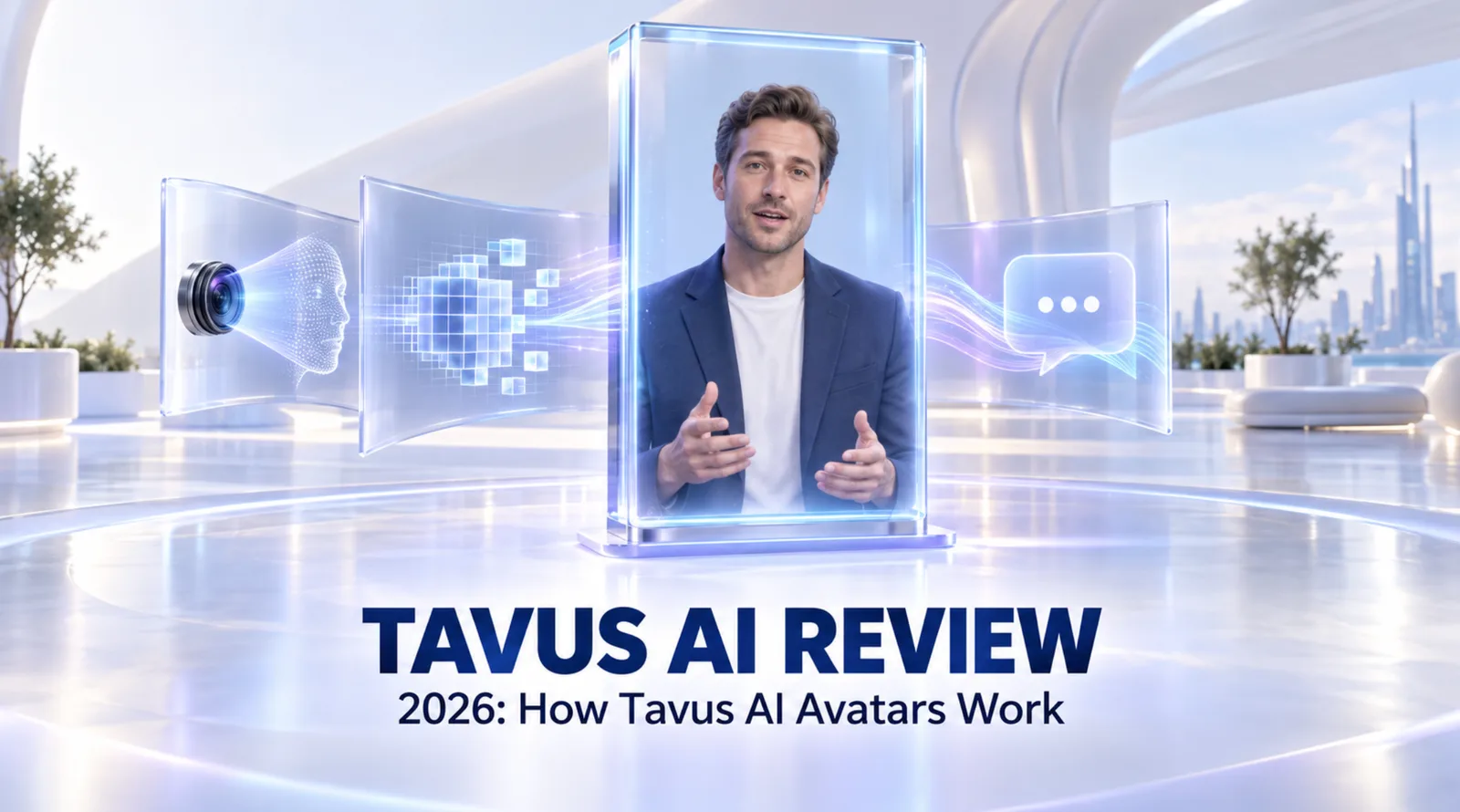
Tavus AI is an end-to-end conversational video platform for building real-time AI humans. Its Conversational Video Interface combines a persona, replica, conversation session, perception, speech, language-model orchestration, and face rendering. It is strongest when a team wants a managed video-agent stack; teams that already own the agent stack may prefer a separate avatar layer.
Last verified: September 15, 2026. Confirm checkout before purchasing because plans can change.
What is Tavus AI?
Tavus is a developer platform for interactive AI humans. Its core product is the Conversational Video Interface, or CVI. A developer creates a persona to define behavior and knowledge, selects a replica for the face and voice presentation, and starts a conversation that users join as a real-time video session.
Unlike a conventional talking-avatar generator, CVI is not limited to a finished clip. It can listen, reason, speak, and animate during a live interaction. Tavus also offers generated video, but buyers should budget that separately from conversational video.
How Tavus AI works
Tavus presents CVI as a coordinated pipeline rather than a single avatar model.
| CVI layer | What it does | Buyer question |
|---|---|---|
| Persona | Sets the agent’s instructions, tone, context, and behavior | Can it use your preferred LLM, tools, and knowledge? |
| Replica | Provides the visual AI human used in a conversation | Do you need a stock face or trained custom replica? |
| Raven | Processes visual and conversational perception signals | Which inputs are available to your application? |
| Sparrow | Manages conversational flow and turn-taking | How does interruption behavior work under real usage? |
| Speech and LLM pipeline | Converts speech, reasons over input, and produces speech | Which components are included, replaceable, or separately billed? |
| Phoenix | Generates the real-time face video | What resolution, concurrency, and device behavior do you need? |
The Tavus API manages personas, replicas, and conversations. Tavus supports selected plug-in components, but “bring your own” boundaries may differ by layer, so validate the exact configuration in a proof of concept.
Tavus AI pricing in 2026
Tavus pricing currently publishes four developer tiers for CVI and generated video.
| Plan | Public price | Included conversational video | Custom replicas | Concurrency |
|---|---|---|---|---|
| Free | $0 | 25 minutes | None listed | 1 stream |
| Starter | $59/month | 100 minutes | 3 trainings/month | Up to 3 streams |
| Growth | $397/month | 1,250 minutes | 7 trainings/month | Up to 10 streams |
| Enterprise | Custom | Custom | Custom | Custom |
Starter lists pay-as-you-go access at $0.37 per conversational-video minute. The pricing page contains duplicated or older modules, so confirm checkout. Conversations have a 30-second minimum charge and are rounded to six-second increments.
See the AI avatar pricing comparison for normalized costs and the Tavus alternatives guide for full-stack and rendering-layer options.
Who is Tavus best for?
Tavus fits teams that want one vendor to provide most of the conversational-video experience, especially when a custom replica and video-call interaction are central. A team that already has a production voice agent, tools, safety controls, and observability should ask whether each component can remain in place and whether billing covers the whole conversation or only the visual layer.
Tavus AI versus Spatius
Tavus and Spatius overlap at the visible avatar, but they are not identical products.
| Decision area | Tavus CVI | Spatius |
|---|---|---|
| Product scope | End-to-end conversational video platform | Real-time avatar layer for an existing AI stack |
| AI stack | Managed pipeline with configurable components | Bring your own STT, LLM, TTS, tools, and orchestration |
| Rendering | Real-time video generated through the service | Motion data streams back and pixels render on the client |
| Best fit | Teams wanting a managed AI-human stack | Teams protecting an existing agent architecture and unit economics |
| Pricing unit | Conversational-video minutes and plan limits | Avatar minutes, concurrency, and plan limits |
Spatius supports Web, iOS, Android, kiosk, and embedded paths through its client-rendered architecture. Teams using a LiveKit voice agent can review the Spatius LiveKit integration. This is an architecture choice, not a universal ranking.
What should buyers test?
Run the same test with every vendor: measure first visible response and interruption recovery; test noisy audio, pauses, short sessions, and reconnects; confirm ownership of STT, LLM, TTS, transport, and rendering; price minutes, concurrency, minimum billing, and retries; verify replica rights, moderation, and retention; and use customers’ actual devices.
Tavus AI FAQ
Is Tavus AI a video generator or a real-time avatar platform?
Both. CVI powers live conversations; Tavus also generates video. Confirm which minute pool and API your workload consumes.
How much does Tavus AI cost?
Plans are Free, Starter at $59 monthly, Growth at $397 monthly, and custom Enterprise. Starter and Growth include 100 and 1,250 conversational-video minutes.
Can Tavus use my own LLM or voice stack?
Tavus documents configurable components. Validate exact boundaries in a proof of concept because support and billing can depend on the configuration.
What is the main alternative to a full Tavus CVI stack?
If you already own the conversational agent, use a dedicated real-time avatar layer that accepts your audio and returns synchronized visual motion.
Choose the architecture before the avatar
Tavus is compelling when a managed conversational-video stack matches the product. If your team already has the agent, voice, tools, and transport, compare the avatar layer separately.
Compare a client-rendered avatar layer using your expected minutes, concurrency, and target devices. Request a demo, or ,或Review Spatius pricing.。