
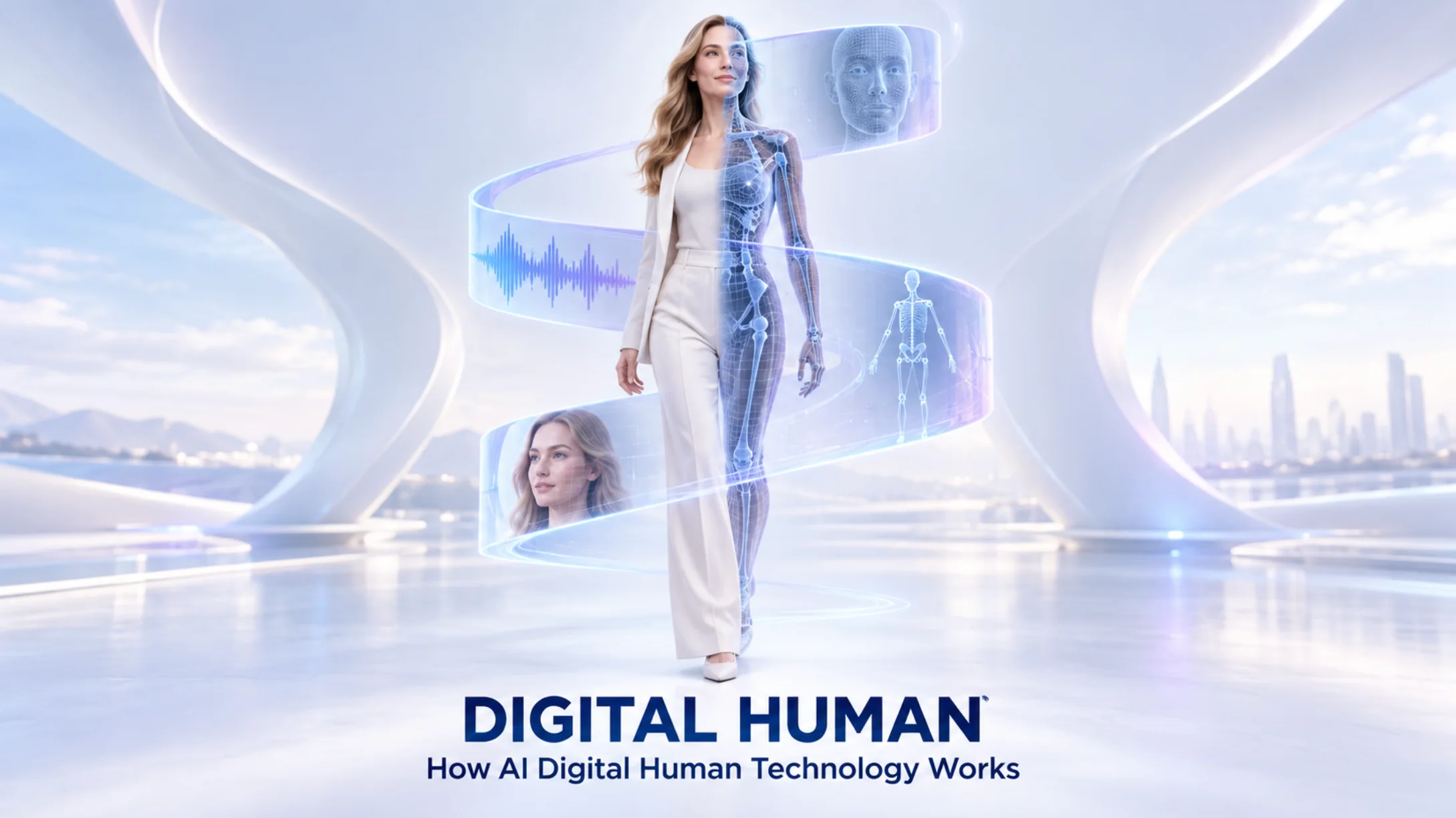
A digital human is a computer-generated human character designed to communicate or behave in human-like ways. An AI digital human combines that visual interface with speech and intelligence, but it is not automatically a complete AI agent. In a real-time system, separate technologies usually handle listening, reasoning, speaking, animation, rendering, and delivery.
What is a digital human?
The term describes both a visual character and the experience built around it. Unreal Engine defines digital humans as computer-generated 3D representations animated to act like people. In business software, the phrase often extends to photorealistic or stylized characters that speak with users, respond to questions, and appear inside web, mobile, kiosk, game-engine, or spatial interfaces.
“Digital human” does not specify one rendering style or one level of intelligence. A character can be two-dimensional or three-dimensional, realistic or branded, live or prerecorded. It may read a fixed script, follow a workflow, or connect to an agent that uses retrieval and tools.
The useful question is therefore not whether a product has a digital human. It is which layers are included, where they run, and what the character can do during a real interaction.
Digital human, avatar, chatbot, and generated video
| Term | What it usually describes | What it does not guarantee |
|---|---|---|
| Digital human | A human-like digital character and its presentation experience | Real-time interaction or a complete AI stack |
| Avatar | Any visual representation of a user, character, or agent | Human realism, speech, or intelligence |
| AI agent | Software that reasons, uses context or tools, and takes actions | A face, voice, or visual presence |
| Chatbot | A conversational interface, commonly text-first | An autonomous agent or visual character |
| Generated avatar video | A rendered clip created from a script or media input | Live response, interruption, or two-way conversation |
These categories overlap without being interchangeable. A real-time digital human may be the face and voice of an AI agent. A generated video may show the same character but never participate in a live conversation. A chatbot may use the same LLM and business tools without any visual layer.
How does AI digital human technology work?
A complete system typically has five layers:
- Perception: ASR transcribes speech, while optional camera or application events provide additional context.
- Intelligence: an LLM, RAG pipeline, workflow, or business system determines what to say or do.
- Speech: TTS turns the response into audio with the selected voice and language.
- Animation: an avatar model converts speech timing and acoustic signals into facial, lip, eye, and body motion. NVIDIA’s Audio2Face overview is one example of an audio-driven animation approach.
- Rendering and delivery: a client or cloud service renders the character and synchronizes it with audio for the user’s device.
NVIDIA’s digital-human overview similarly presents the category as a combination of language, speech, animation, and graphics technologies. No single layer makes the entire experience work. A fast model can still feel slow if transcription waits too long, speech is not streamed, rendering stalls, or the avatar cannot stop when interrupted.
Spatius focuses on the animation and rendering side. The current Spatius documentation describes a Motion Server that receives speech audio and returns lip-sync motion data, plus AvatarKit clients for Web, iOS, Android, and Flutter. Teams keep their existing ASR, LLM, tools, and TTS rather than replacing the whole agent.
Real-time and prerecorded digital humans solve different jobs
A prerecorded digital human is built for repeatable media. The creator supplies a script or audio, reviews the result, and publishes a finished video. This is appropriate for explainers, training modules, localized announcements, and marketing content.
A real-time digital human is built for uncertain input. The system does not know the user’s next question or the agent’s exact response. It must generate, animate, and deliver each turn while the session is active. It also needs clear behavior for interruptions, silence, tool calls, errors, and handoffs.
That difference changes the buying criteria. Visual polish and editing features matter for video generation. For a real-time product, teams must also test conversational latency, lip sync, transport, device performance, session recovery, observability, concurrency, and total operating cost.
Where should rendering happen?
Cloud-rendered systems generate final video frames on provider infrastructure and stream them to the client. Client-rendered systems send motion data and let the user’s device draw the avatar. Hybrid designs can split model inference, animation, assets, and rendering across both sides.
The choice affects more than bandwidth. It determines how the digital human can share a scene with product UI, how much control the application has over camera and layers, what hardware the client needs, and which data leaves the device. Read the detailed comparison of on-device and cloud avatar architecture before selecting an SDK.
How to add a digital human to an existing AI agent
Start with the agent boundary, not the character catalog.
- Map the existing path from user input through ASR, reasoning, tools, TTS, and playback.
- Decide whether the avatar receives text, complete audio, or streaming audio.
- Define session ownership, credentials, transport, and which component joins the real-time room.
- Synchronize audio playback with motion and create a single cancellation path for interruptions.
- Expose loading, listening, thinking, speaking, error, and reconnecting states in the UI.
- Test the same workload on representative browsers, phones, kiosks, and networks.
LiveKit’s virtual-avatar model is a useful reference: a voice-agent session sends its audio output to an avatar worker that publishes synchronized media. The Spatius agent architecture guide shows how to keep the visual layer replaceable when an existing agent already works.
What should buyers evaluate?
- Ownership: Identify who operates ASR, reasoning, tools, TTS, animation, rendering, transport, transcripts, and moderation.
- Responsiveness: Measure the complete conversational turn and interruption path, not a single server metric.
- Visual control: Test custom characters, scene composition, branding, gaze, idle behavior, and fallback states.
- Deployment: Verify SDK maturity, browser and device support, asset delivery, GPU requirements, and upgrade policy.
- Data flow: Document every service that receives speech, text, media, motion, identifiers, and analytics.
- Accessibility: Include captions, transcripts, non-audio controls, and an alternative interface. W3C provides planning guidance for accessible media.
- Economics: Model concurrent sessions, idle time, avatar usage, speech services, LLM tokens, networking, storage, and operational labor.
Use the AI avatar platform comparison to build a shortlist, then test the candidates with the same production scenario. You can also meet Spatius digital humans in the playground before integrating an SDK.
Frequently asked questions
Is a digital human a real person?
No. It is a computer-generated character. Products should make its automated nature clear and avoid designs that mislead users about identity or human involvement.
Is every digital human powered by generative AI?
No. Some follow fixed scripts or deterministic workflows. Others use generative models, retrieval, business tools, or a combination of systems.
What makes a digital human real time?
It can produce and present a new response during an active interaction rather than rendering the complete experience in advance. Useful tests include turn latency, interruption, synchronization, and recovery.
Does a digital human replace an AI agent platform?
Not necessarily. A digital-human provider may bundle the full conversation stack or supply only the visual layer. Confirm the boundary before comparing pricing or implementation effort.
Last verified: September 14, 2026. Definitions are stable, but vendor capabilities, SDK support, pricing, and technical limits can change.
Add a real-time digital human to the AI stack you already use Request a demo, or ,或Try the playground.。