
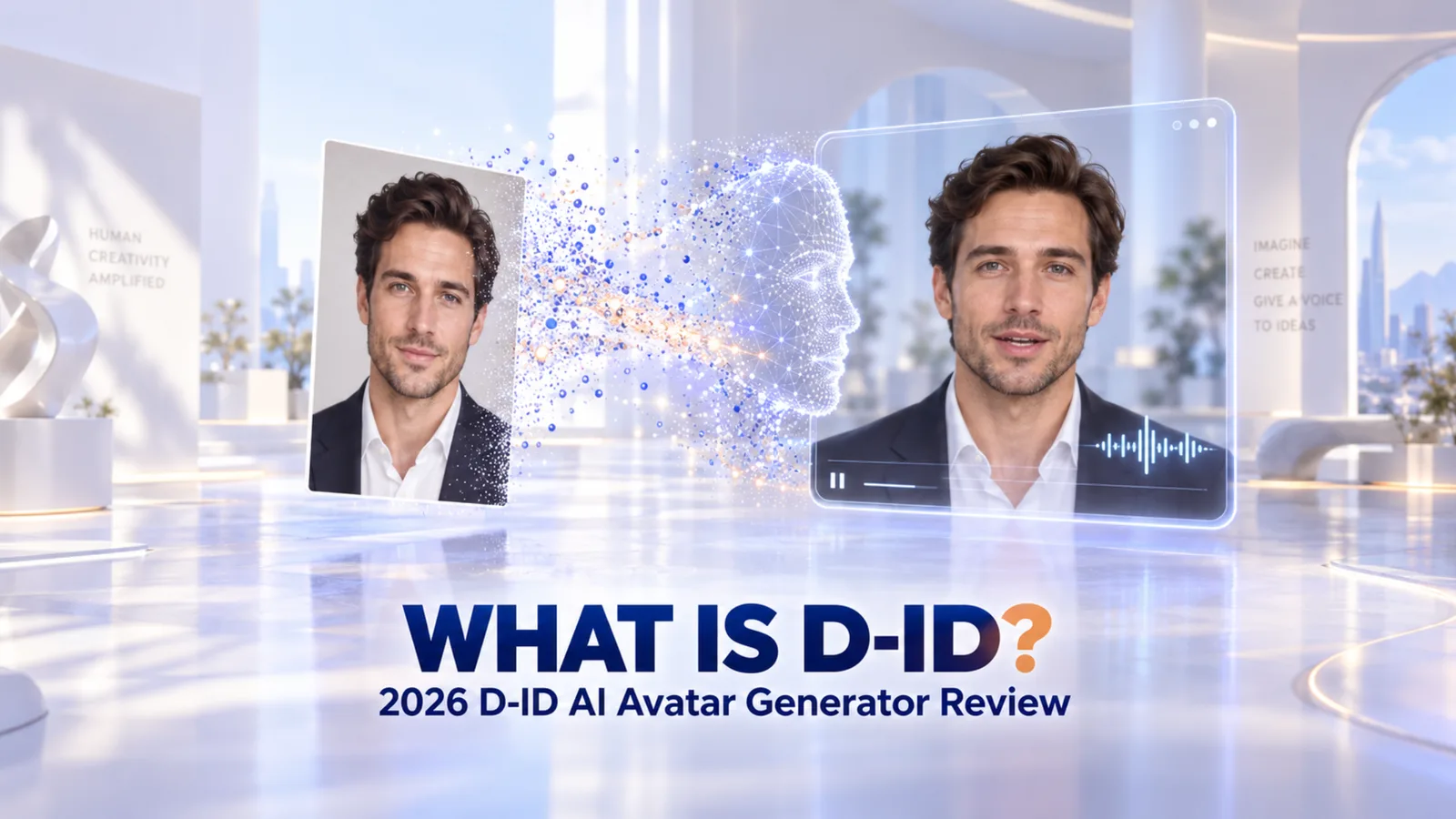
D-ID is an AI-avatar platform with two distinct product paths: asynchronous avatar-video generation and real-time visual agents. It is a strong candidate when a team wants a hosted avatar workflow, an embeddable agent, or both. Teams that already own their conversational stack should compare D-ID’s managed pipeline with a dedicated visual layer before choosing an architecture.
Last verified: September 16, 2026. D-ID pricing, avatar generations, and agent capabilities can change; confirm the official dashboard and contract before purchasing.
What is D-ID?
D-ID turns images, videos, text, and audio into speaking digital people. According to the current D-ID API quickstart, the platform supports both real-time conversational agents and asynchronously generated videos.
The phrase “D-ID AI avatar generator” can therefore mean two different things:
| D-ID product path | Output | Typical buyer task |
|---|---|---|
| Avatar-video generation | A rendered video produced from an image, script, audio, or avatar | Marketing, training, localization, presentations, and repeatable one-way content |
| Real-time visual agents | A live video conversation delivered through an avatar | Customer engagement, guided workflows, support, onboarding, and interactive applications |
If the user must interrupt, ask an unscripted question, or trigger a tool, evaluate the real-time agent path. If the output is a finished clip, evaluate the video APIs instead.
How does the D-ID AI avatar generator work?
For asynchronous video, D-ID’s Photo Avatar quickstart sends a source image and script to the Talks endpoint, then polls until the rendered result is ready. Other documented avatar generations add higher-quality presenters, custom avatars, expressive controls, and video translation.
For live interaction, D-ID’s real-time architecture can include speech-to-text, turn detection, an LLM, an optional knowledge base, text-to-speech, and the avatar. The resulting video is streamed to the user over WebRTC.
| Real-time component | Default responsibility in D-ID’s documented pipeline | Buyer question |
|---|---|---|
| Speech recognition | D-ID | Can the existing voice stack remain in place? |
| Turn detection | D-ID | How does it handle interruption, hesitation, and background speech? |
| LLM and knowledge | Configurable and optional | Can the team use its preferred model, tools, and retrieval system? |
| Text-to-speech | Configurable and optional | Which provider, voice rights, languages, and costs apply? |
| Avatar rendering | D-ID | What stream quality, first-frame time, and bandwidth are required? |
| Client experience | Embed or custom SDK UI | Which states and controls must the product implement? |
The architecture is more flexible than a simple “closed stack” label suggests. D-ID says teams can omit the included LLM and TTS and send audio or text through the real-time connection. Validate that path with the exact avatar generation and SDK you plan to use.
D-ID agents, SDK, and embedding options
The Agent creation API combines a presenter, voice, behavior instructions, and optional knowledge. A product can then create a restricted client key and start a conversation with the D-ID Client SDK.
D-ID also supports an embeddable UI. That can shorten time to market, while the Agents SDK provides more control over the front end. The SDK documentation currently identifies photo-based, video, and expressive avatar types; capabilities and stream options vary by generation.
Teams using an existing voice agent should inspect the integration boundary carefully. D-ID documents an ElevenLabs agent integration, but a named integration should not be treated as proof that every provider, tool, or orchestration pattern is interchangeable.
How much does D-ID cost?
D-ID separates Studio subscriptions, API plans, generated-video usage, and Agent usage. That makes a single headline monthly price misleading. The existing D-ID pricing guide tracks current plan details and normalizes the major billing units.
For Agents, D-ID’s official speaking-time explanation currently states that each generated response of up to 15 seconds consumes 0.5 credits, with each additional 15-second interval consuming another 0.5 credits. The charge follows the agent’s speaking time, not the full wall-clock session.
The D-ID FAQ describes credits for generated video and notes separate treatment for streaming customers. Before comparing D-ID with another avatar vendor, calculate:
- credits per generated minute and per agent speaking minute;
- rounding for short responses;
- included and overage credits;
- concurrency and session limits;
- avatar creation, voice, translation, and knowledge costs;
- cost of retries, reconnects, and failed outputs.
Use the official D-ID API pricing page and the live checkout for the final model. Do not combine Studio and API allowances as if they were one pool unless the account contract explicitly says so.
D-ID’s strengths and limitations
D-ID’s strength is product breadth with a relatively mature developer surface. A team can create video, build a hosted visual agent, embed a prebuilt interface, or use a client SDK. The product map covers both creator and application-development needs.
The same breadth creates scoping risk. “D-ID” may refer to a Studio workflow, a video API, a real-time Agent, a presenter generation, or an SDK. Pricing and capabilities differ across those paths. Buyers should write down the exact avatar type, API, streaming mode, and billing unit before comparing proposals.
Independent customer-review pages such as G2 can provide support and usability context, but production suitability still depends on a test with your own devices, languages, session lengths, and concurrency.
D-ID versus Spatius
D-ID and Spatius overlap in real-time avatars, but their product boundaries differ. See the dedicated Spatius vs D-ID comparison for a full vendor decision and the D-ID alternatives guide for a broader shortlist.
| Decision area | D-ID | Spatius |
|---|---|---|
| Product scope | Generated avatar video plus hosted real-time visual agents | Real-time avatar infrastructure for an existing AI conversation |
| Real-time pipeline | Can bundle STT, turn detection, LLM, knowledge, TTS, avatar, and WebRTC delivery | Driven by the audio pipeline the product team already owns |
| Rendering and delivery | Avatar video is streamed to the client | Compact control data is streamed and the avatar renders on the client |
| Integration path | Studio, API, embed, and web-oriented Client SDK | Web, iOS, and Android SDK paths plus existing-agent integrations |
| Best fit | Teams that want D-ID’s video ecosystem or a managed visual-agent path | Teams preserving their STT, LLM, TTS, tools, orchestration, and client experience |
Spatius is not a replacement for D-ID’s full creative-video suite. It is the more direct comparison when the requirement is the visual layer for a live agent. Teams using LiveKit can review the Spatius LiveKit integration.
What should buyers test before choosing D-ID?
Use one acceptance matrix across D-ID and every alternative:
- Measure first visible response, interruption recovery, and reconnect behavior.
- Test the exact avatar generation because quality and SDK behavior can differ.
- Confirm whether your LLM, TTS, tools, knowledge, and moderation stay under your control.
- Test mobile browsers, low bandwidth, packet loss, backgrounding, and device heat.
- Model short responses because 15-second credit rounding can change effective cost.
- Verify concurrency, rate limits, domain restrictions, retention, consent, and production support.
The avatar SDK evaluation guide provides a reusable test plan.
D-ID FAQ
Is D-ID a video generator or a real-time AI avatar platform?
Both. D-ID provides asynchronous avatar-video APIs and real-time visual agents. The right architecture and pricing model depend on which output you need.
Can D-ID connect to an existing LLM or voice agent?
D-ID documents configurable LLM and TTS options, custom models, direct audio or text input, and a named ElevenLabs integration. Confirm the exact boundary with the chosen avatar generation and API.
Does D-ID have an SDK?
Yes. D-ID provides a client SDK for real-time Agents and an embeddable UI, alongside REST APIs for agent and video workflows.
How is D-ID Agent usage billed?
The current help documentation measures generated speaking time in 15-second blocks at 0.5 credits per block. Plan prices and included credits should be verified on the official pricing page.
Decide whether you need a platform or a visual layer
D-ID is a credible option when generated video and hosted visual agents belong in the same vendor relationship. If your product already owns the conversational stack, compare the avatar layer separately.
Compare the avatar layer using your target devices, speaking-time distribution, concurrency, and integration requirements. Request a demo, or ,或Review Spatius pricing.。