
A real-time AI avatar API is ready for production when it can start predictably, present approved speech with stable motion, recover from ordinary failures, and fit the application architecture your team can operate. Visual realism matters, but it cannot compensate for an unclear ownership boundary or a session that fails whenever the network becomes imperfect.
Key takeaways
- Measure the complete user-visible path instead of relying on a provider’s studio demo.
- Separate agent latency from avatar presentation latency.
- Test recovery, logging, credentials, device load, and cost before comparing visual polish.
- Choose an integration path your team can support after launch.
Evaluate the whole path, not the face alone
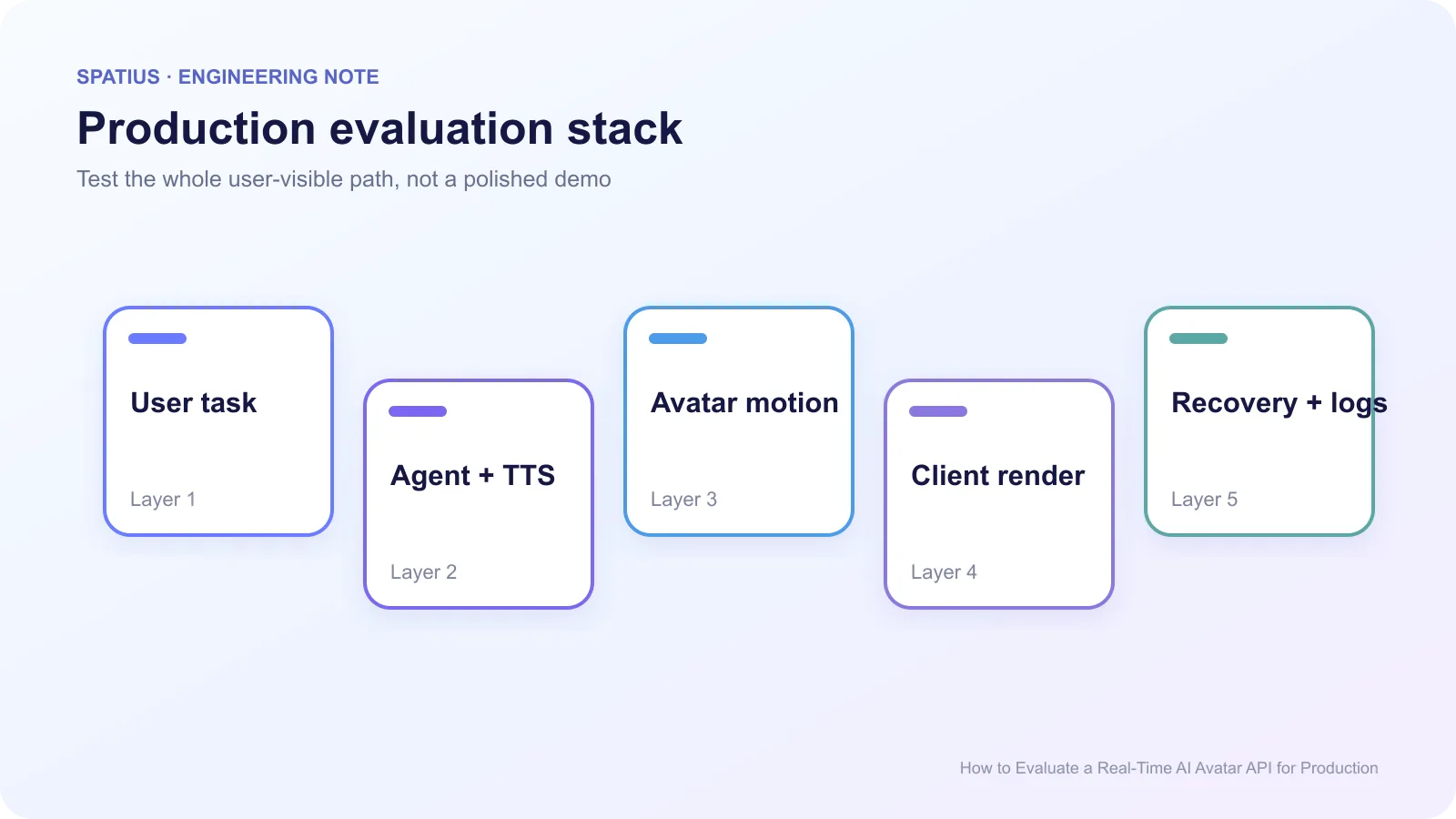
A production session normally crosses microphone input, ASR, agent logic, retrieval or tools, TTS, avatar motion, local or remote rendering, and the product UI. OpenTelemetry’s tracing model is useful here because it treats one request as work moving through several services. Give each test run a correlation ID and record the time at every boundary.
Write the evaluation contract before calling providers. The OpenAPI Specification offers a common way to inspect authentication, request fields, responses, and errors, even when the real-time media path needs a separate SDK.
Do not publish one vague “avatar latency” number. Tavus describes utterance-to-utterance latency as the complete round trip from user speech to replica response. Your internal scorecard should go further: capture time to transcript, first agent token, first audio, first motion, and visible playback. This tells you which layer needs work.
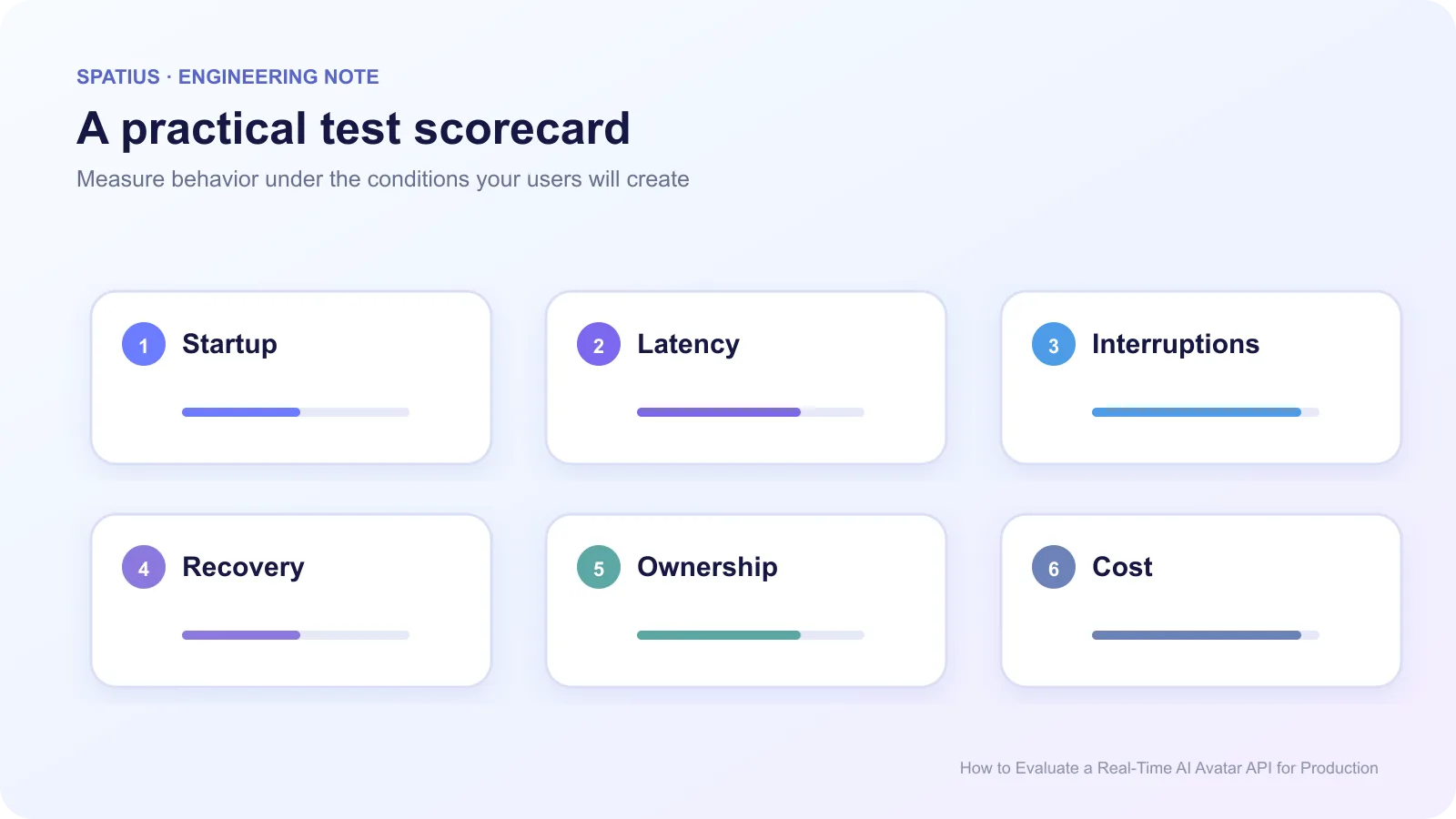
Test six production criteria
Startup. Run cold and warm starts on desktop, mobile, and a throttled connection. Anam’s work on predictable session openings shows why the first seconds need their own product decisions: who speaks first, whether that greeting can be interrupted, and what users see while the session becomes ready.
Conversation timing. Measure medians and p95 values. A smooth best-case clip hides queueing and network variation. Use the browser’s Performance API for client milestones and your server trace for agent and TTS events.
Transport and recovery. Simulate Wi-Fi changes, tab suspension, token expiry, and dropped connections. MDN’s WebSocket close-event reference explains the basic close signals, but your product still needs a retry policy and a user-visible fallback.
Device behavior. Watch main-thread work, memory, GPU pressure, temperature, and battery on the actual minimum device. Chrome’s Performance panel can expose long tasks and rendering stalls that a provider dashboard will not see.
Control and ownership. Write down who owns ASR, LLM, TTS, tools, session state, and handoff. D-ID’s description of real-time visual agents illustrates an integrated approach. A modular avatar layer creates a different operating boundary. Neither is automatically better; the right choice matches the stack you intend to own.
Cost. Model session minutes, concurrency, bandwidth, support work, and fallback traffic. Do not compare a pre-rendered video credit with a live session minute. They represent different workloads.
Run one repeatable production test
Create a 10-minute script with a short answer, a long answer, a user interruption, one tool call, 20 seconds of silence, and a forced network failure. Run it at least five times on each target device and network profile. Save the same milestones for every provider. WebRTC’s statistics API provides transport measurements when RTC is involved; WebSocket paths need equivalent application-level events.
Score behavior, not promises. A clear audio-only fallback can be more useful than a frozen photorealistic face. An API that returns useful error classes is easier to operate than one that reports every problem as “session failed.” Anam’s article on tool-call visibility and debugging is a good example of the operational detail buyers should request.
Review the same surface against the OWASP API Security Top 10 before procurement. A low-latency demo does not answer how credentials, authorization, resource limits, and inventory are managed.
Applying the checklist to Spatius
Spatius converts avatar speech audio into motion data, while AvatarKit renders the avatar locally. Your application or agent framework retains ASR, LLM, TTS, retrieval, permissions, and tools. The Spatius Developer Docs Map is the current source for that boundary.
Use the integration-path guide before testing. Direct Mode, Backend Mode, LiveKit Agents, and Agora Convo AI assign different responsibilities to the client and backend. A fair evaluation instruments the path you would actually deploy, not whichever demo was easiest to open.
Frequently asked questions
Is visual realism the most important criterion?
No. Realism affects perception, but startup, response timing, recovery, device behavior, and control determine whether the experience remains usable.
How many test sessions are enough?
Five runs per condition can expose obvious instability, but production approval should use a larger sample that represents your devices, regions, and traffic pattern.
What should happen after evaluation?
Choose one workflow, define acceptance thresholds, and run a limited pilot. The Spatius pilot framework explains how to keep the experiment narrow enough to produce a decision.