
An enterprise conversational AI platform should be chosen as a production stack, not as a chatbot demo. Compare who owns the agent, data, tools, speech, real-time transport, analytics, security, and user interface. Spatius is not a complete conversational AI platform; it is a real-time avatar layer that connects to the conversational stack you already operate.
That distinction prevents an expensive category mistake. Some conversational AI platforms bundle the full system. Others supply only agent orchestration, voice delivery, or a visual interface. The right choice depends on the workflow you need to improve and the layers your team already owns.
Platform information and Spatius product details last verified September 10, 2026. Vendor capabilities and prices change; confirm contractual requirements directly during procurement.
What is an enterprise conversational AI platform?
An enterprise conversational AI platform is the software stack that lets customers or employees interact with an AI system through natural-language text or speech while the business controls knowledge, permissions, actions, monitoring, and escalation. A production implementation usually spans more than one product.
| Layer | What it does | Questions an enterprise buyer should ask |
|---|---|---|
| Channels and interface | Web chat, phone, app, kiosk, or avatar | Where will users interact, and what fallback remains available? |
| Speech and media | Speech recognition, voice synthesis, interruption, and transport | What are the latency stages, language limits, and failure modes? |
| Agent orchestration | Instructions, memory, routing, guardrails, and tool calls | Who controls prompts, permissions, models, and high-impact actions? |
| Knowledge and systems | Retrieval, CRM, ticketing, identity, and business data | What data is accessed, retained, exported, or used for training? |
| Operations | Evaluation, traces, analytics, cost controls, and human handoff | Can the team explain a failure and recover without losing the user? |
| Governance | Policy, audit, regionalization, and lifecycle risk management | Which controls are technical, contractual, or still the buyer’s responsibility? |
The NIST AI Risk Management Framework organizes AI risk work around Govern, Map, Measure, and Manage. It is a voluntary framework, not a vendor certification, but it is a useful reminder that procurement, deployment, monitoring, and retirement belong to one lifecycle.
Which type of conversational AI platform do you need?
Start by deciding what you are actually buying. A list of conversational AI tools is useful only when the products are compared at the correct layer.
| Platform type | Typical scope | Best fit | Examples to evaluate |
|---|---|---|---|
| End-to-end enterprise suite | Agent builder, channels, integrations, governance, analytics, and often speech | Teams that want a broad managed environment and centralized administration | Microsoft Copilot Studio, Google Cloud Conversational AI, Cognigy, Kore.ai |
| Managed voice-agent platform | Real-time speech, turn-taking, telephony or WebRTC, agent runtime, and operational tools | Teams prioritizing phone or voice interactions with a shorter build path | ElevenLabs Conversational AI, Retell AI, Twilio conversational products |
| Composable agent framework | Agent runtime and integrations with more control over models, tools, and deployment | Engineering teams assembling their own stack | Rasa, Voiceflow, LiveKit Agents |
| Real-time avatar layer | Visual presenter, lip synchronization, motion, and client rendering | Teams that already own the agent or voice stack and need a visible interface | Spatius and other specialized avatar providers |
These categories overlap. For example, LiveAvatar documents a FULL mode that manages ASR, LLM, TTS, and WebRTC, plus a LITE mode for customers supplying their own AI stack. Tavus describes a multimodal conversational-video pipeline with replaceable components, while Anam offers both managed and bring-your-own component paths. Read the current LiveAvatar documentation, Tavus CVI overview, and Anam architecture overview before assuming that two headline prices include the same layers.
A practical platform shortlist
The table below is a category map, not a universal ranking. “Best” depends on your channels, existing infrastructure, governance requirements, and pilot evidence.
| Option | Primary role in the stack | Verify during a pilot |
|---|---|---|
| Microsoft Copilot Studio | Enterprise agent creation and Microsoft ecosystem administration | Data policies, connectors, environment governance, and channel fit |
| Google Cloud Conversational Agents | Managed virtual-agent stack with Google Cloud services | Region availability, data residency, latency, integrations, and model controls |
| Amazon Lex | AWS-native text and voice interface building | IAM design, monitoring, logs, channel integration, and surrounding services |
| Cognigy | Enterprise customer-service automation | Contact-center integrations, deployment model, analytics, and commercial scope |
| Kore.ai | Enterprise conversational and service automation | Administration, integrations, channel support, governance, and implementation effort |
| Rasa | Composable agent framework | Engineering ownership, deployment, evaluations, policies, and operational staffing |
| Voiceflow | Collaborative agent design and deployment | Runtime control, integrations, observability, channel behavior, and scale |
| Retell AI | Managed voice-agent platform | Telephony coverage, interruption, latency, transfer, recordings, and cost |
| LiveKit Agents | Real-time, composable agent framework and media infrastructure | Turn detection, provider choices, tracing, regional deployment, and reliability |
| Spatius | Real-time avatar presentation layer for an existing agent or voice stack | Device performance, motion quality, integration mode, regional fit, and total stack cost |
For broader market context, compare how current commercial guides frame the category. Retell publishes a 2026 conversational AI platform list, Gartner maintains a Conversational AI Platforms review market, and Moveworks, Dialpad, and Rasa each publish enterprise selection material. These sources are useful for discovering options, but their inclusion criteria differ and some are written by vendors. Use them to build a shortlist, then validate every capability in official documentation and your own pilot.
Microsoft’s current security and governance documentation shows why an enterprise comparison needs to include administrator controls, connectors, knowledge sources, tools, and data movement—not just answer quality. Google similarly makes the selected Dialogflow CX region relevant to residency, latency, encryption, and feature support. AWS treats Amazon Lex security as a shared responsibility and documents IAM, CloudWatch, and CloudTrail separately.
How should enterprises compare conversational AI platforms?
Use one weighted scorecard across the shortlisted products. Do not let each vendor define success around its strongest demo.
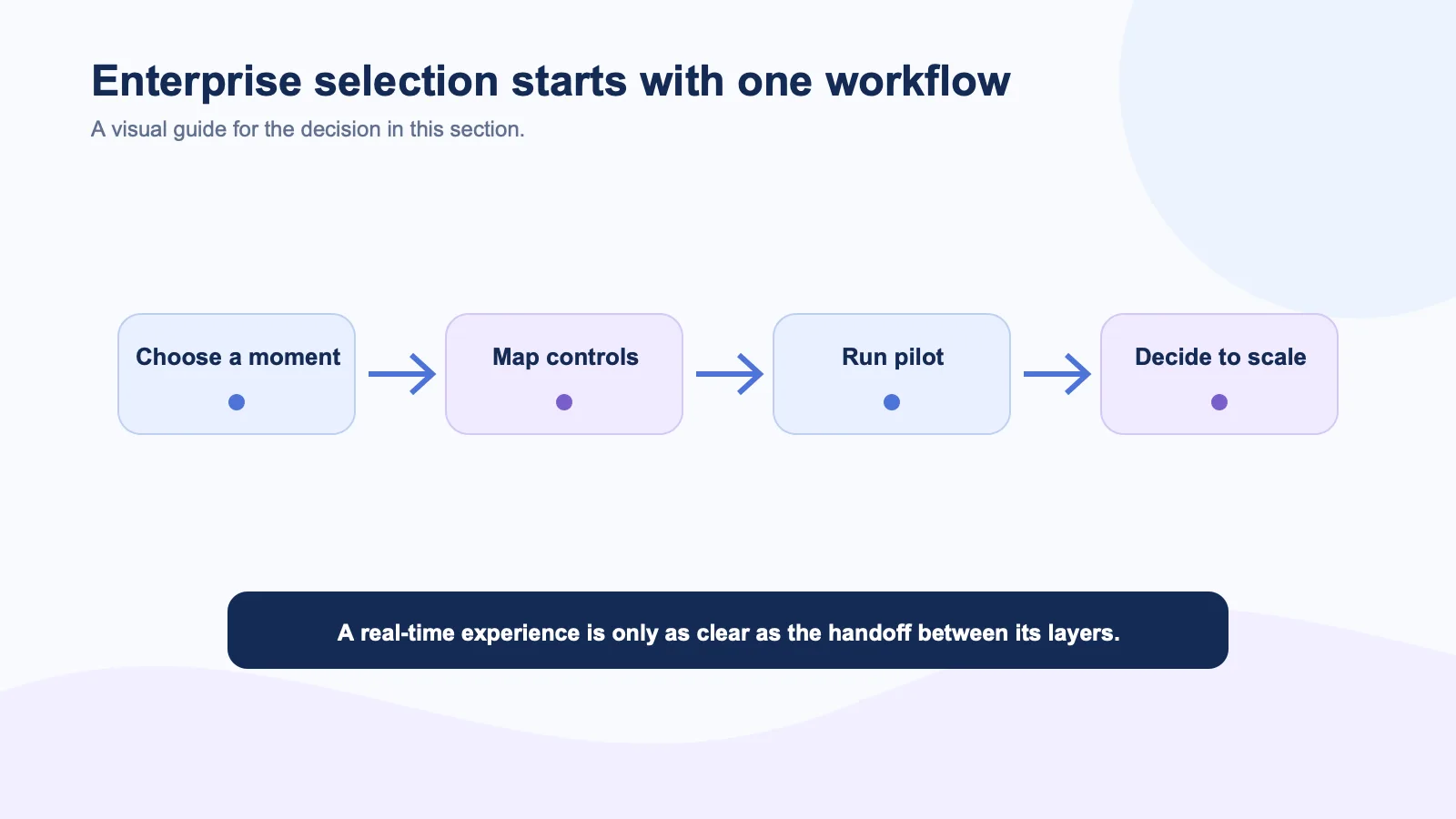
1. Begin with one user outcome
Select a narrow, measurable moment: resolve an account question, route a caller, complete a configuration, coach a sales representative, or guide a visitor through a kiosk. Specify the current completion rate, time, cost, and escalation path. A platform is valuable only if it improves that baseline without introducing unacceptable risk.
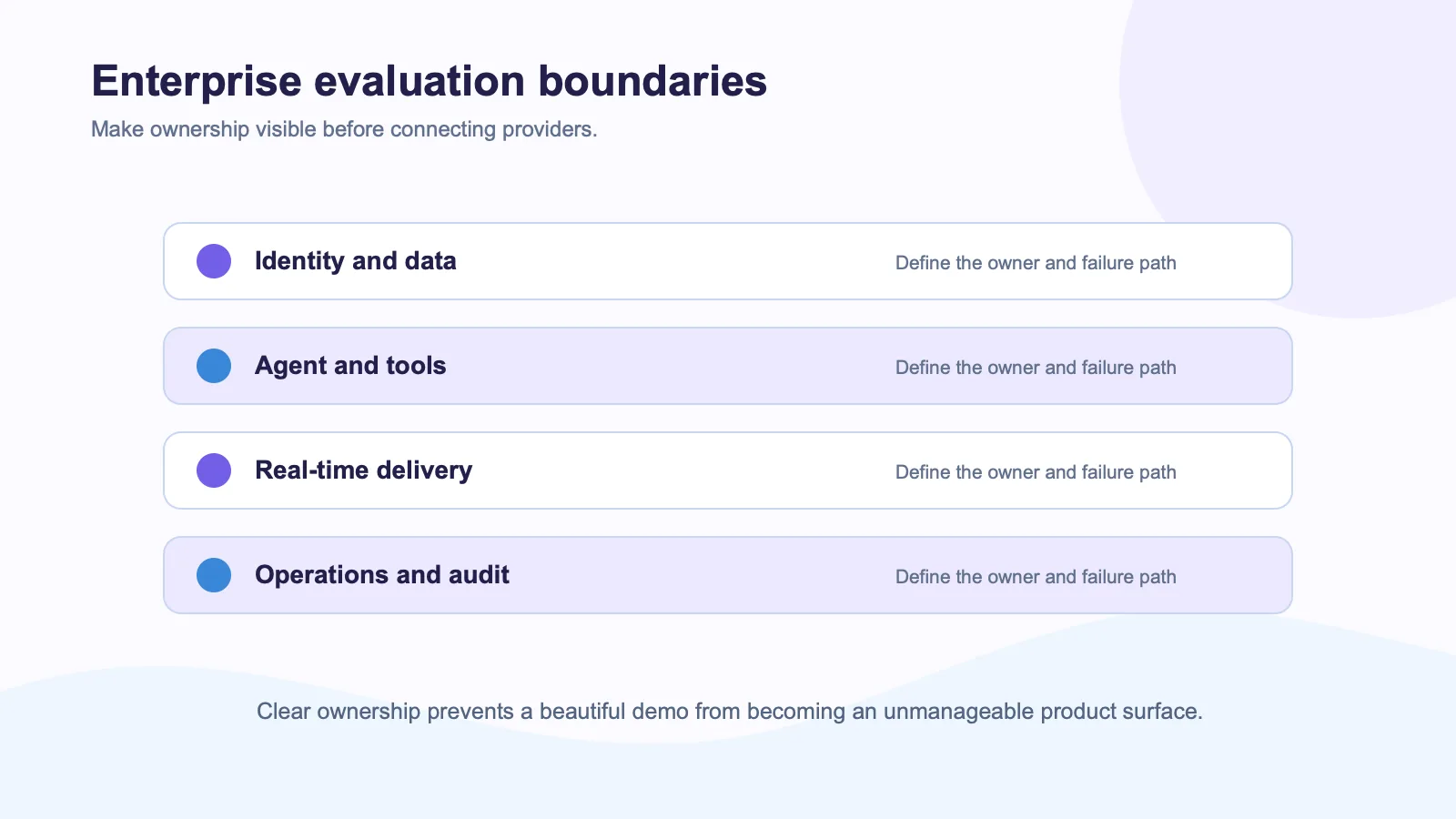
2. Draw the ownership boundary
Mark who owns identity, permissions, retrieval, memory, prompts, tool execution, speech, transport, presentation, transcripts, analytics, and handoff. The AI agent architecture ownership map is a useful starting point. If a provider cannot show where data crosses boundaries, the team cannot make a defensible security or cost decision.
3. Test real-time behavior by stage
One average latency number hides the source of delays. LiveKit separates transcription delay, end-of-turn delay, LLM time to first token, TTS time to first byte, playback, and end-to-end latency in its observability data hooks. Measure these stages under realistic concurrency, network conditions, accents, background noise, and slow tool calls.
Test barge-in instead of merely checking a “supports interruption” box. A production system must distinguish a genuine interruption from a short acknowledgment, stop the right output, preserve context, and recover cleanly. LiveKit’s adaptive interruption documentation illustrates why this is a behavioral test rather than a feature label.
4. Turn security claims into test cases
The OWASP Top 10 for LLM Applications should translate into concrete tests: prompt injection, sensitive-data disclosure, excessive tool agency, and unbounded cost or resource use. Use least-privilege tools, require human approval for high-impact actions, set request and cost limits, and verify graceful degradation. The real-time AI avatar security and privacy checklist covers the visual and client-side layer in more detail.
5. Design human handoff before launch
Decide what the user sees when the system is uncertain, a tool fails, or a person must take over. IBM recommends planning the transfer method during assistant design; an embedded handoff can preserve context more effectively than sending the user to a phone number or email address. Review the current IBM handoff planning guidance and test the complete path.
How much does an enterprise conversational AI platform cost?
There is no reliable universal price because vendors include different layers and enterprise contracts vary. Compare the total cost of the same completed workflow, not a quoted token, minute, or seat in isolation.
| Cost component | What to include |
|---|---|
| Platform commitment | Base subscription, seats, environments, minimum usage, and support tier |
| Model and retrieval | LLM tokens, embeddings, reranking, vector storage, and evaluation calls |
| Speech and media | ASR, TTS, telephony, WebRTC, recording, and regional delivery |
| Visual layer | Avatar runtime, custom assets, rendering, and client-device requirements |
| Production operations | Observability, storage, security review, testing, incident response, and human handoff |
| Scale risk | Concurrency, idle-session billing, overages, rate limits, and volume discounts |
A simple comparison unit is cost per successfully completed task. Calculate:
(platform + model + speech + media + avatar + operations + human fallback) / successful tasks
Then model a normal month, a peak month, and a failure-heavy month. This exposes products that appear inexpensive until concurrency, idle time, handoffs, or support are included. The real-time avatar API pricing and total-cost guide provides a deeper model for the visual layer.
Spatius publishes pricing from $0.42 per avatar hour, but that rate covers the avatar layer rather than a complete agent. Customers still pay for their selected ASR, LLM, TTS, transport, storage, and operations. That separation can be attractive when a team already has a proven agent and wants to avoid rebuying the intelligence layer; it is not a like-for-like price comparison with a bundled platform.
How should you pilot a conversational AI platform?
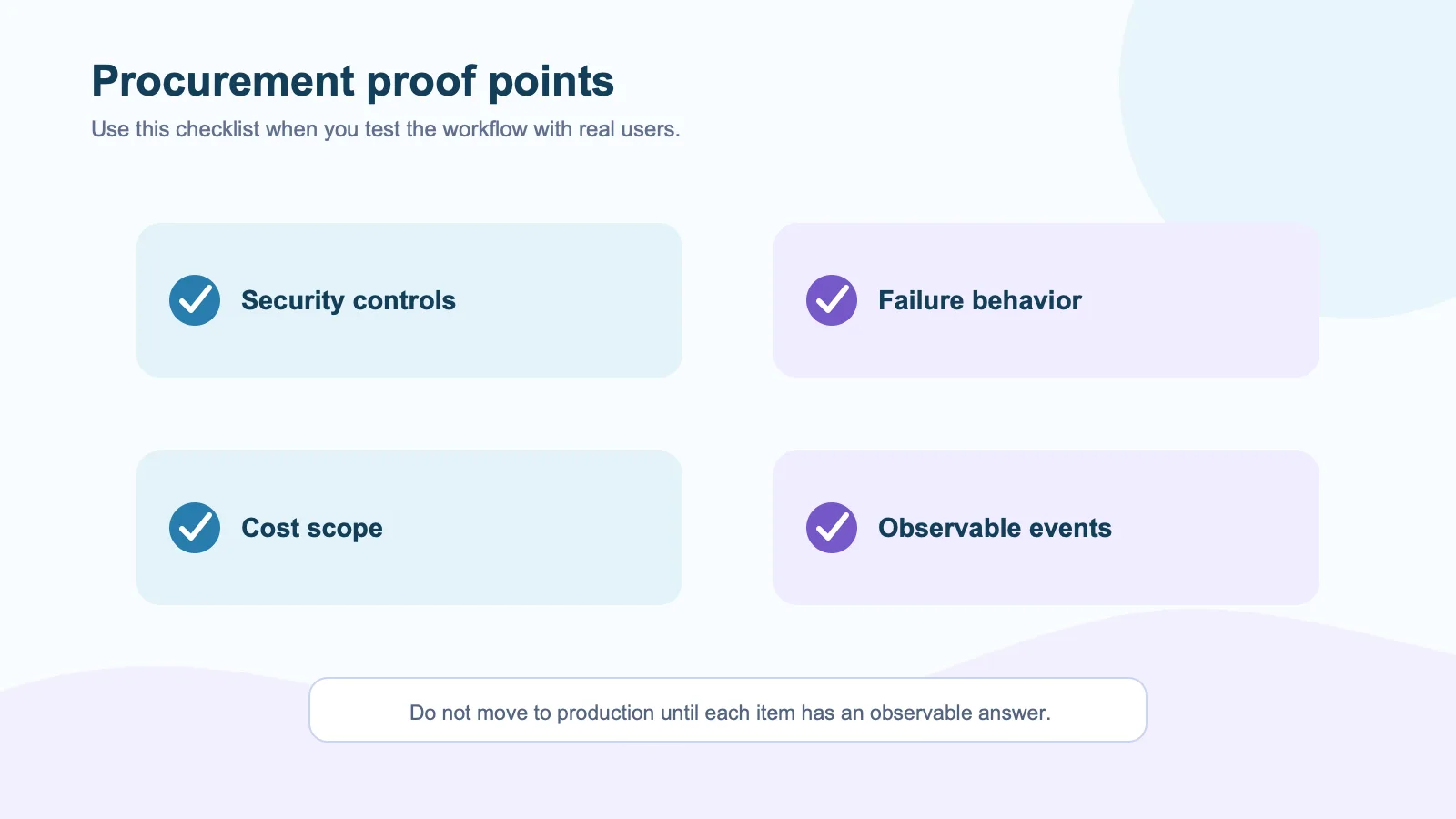
Run a controlled pilot with real tasks and predetermined stop conditions. The pilot should answer whether the system is useful, governable, observable, and affordable—not merely whether it can produce a convincing scripted exchange.
| Pilot dimension | Example measure | Go/no-go question |
|---|---|---|
| Task success | Completion without unnecessary escalation | Does it outperform the current path for the chosen task? |
| Grounding and safety | Supported answers, policy violations, and harmful actions | Can failures be detected and contained? |
| Real-time experience | Turn latency, interruption success, reconnects, and fallback | Is the interaction usable under representative conditions? |
| Handoff | Transfer success and context preserved | Can every blocked user reach the next valid path? |
| Observability | Trace coverage and time to diagnose | Can operators explain failures without guesswork? |
| Total cost | Cost per successful task at normal and peak load | Is the outcome economical after all layers are included? |
Use the production evaluation checklist for a real-time avatar API if a visual interface is part of the pilot. Keep evidence from production-like tests separate from vendor claims, and record what remains unverified.
Where Spatius fits
Spatius is for teams that already own an AI agent or voice AI stack and want to add a real-time visual presenter. According to the current Spatius architecture documentation, the application sends the audio the avatar should speak, Motion Server returns approximately 10–15 KB/s of motion data, and AvatarKit renders the avatar locally. Spatius does not stream a finished video to the client.
The current SDK capability matrix lists Web, iOS, Android, and Flutter clients, plus Python and Go server SDKs. The application keeps responsibility for the agent, knowledge, permissions, tools, ASR, LLM, TTS, and human-handoff logic.
This architecture narrows Spatius’s role and makes the comparison clearer: choose a complete conversational AI platform if you need the entire agent system; evaluate Spatius when the agent already works and the missing layer is a responsive human interface. If that describes your stack, request a Spatius demo and test one production workflow.
Frequently asked questions
What is the best conversational AI platform for an enterprise?
There is no universal best platform. The right choice is the one that improves a defined workflow while meeting the enterprise’s requirements for data ownership, security, integrations, observability, real-time behavior, human handoff, and total cost.
What is the difference between a conversational AI platform and an agent framework?
A conversational AI platform may bundle agent design, channels, speech, integrations, analytics, and governance. An agent framework usually gives engineering teams more control over the runtime and components, but it may require them to assemble and operate more of the production stack.
How much does an enterprise conversational AI platform cost?
Enterprise cost depends on the platform commitment plus model, retrieval, speech, telephony or WebRTC, storage, observability, support, implementation, and human-handoff costs. Compare cost per successful task under normal and peak load instead of comparing one headline rate.
Can an enterprise add an AI avatar to an existing conversational AI platform?
Yes. A specialized avatar layer can receive approved speech audio from an existing agent or voice stack and present it through a synchronized visual interface. The application can keep identity, knowledge, tool permissions, business logic, and handoff control.
Is Spatius a complete conversational AI platform?
No. Spatius is a real-time avatar presentation layer for an existing AI agent or voice AI stack. It does not replace the customer’s ASR, LLM, knowledge base, tools, TTS, policy, or workflow system.