
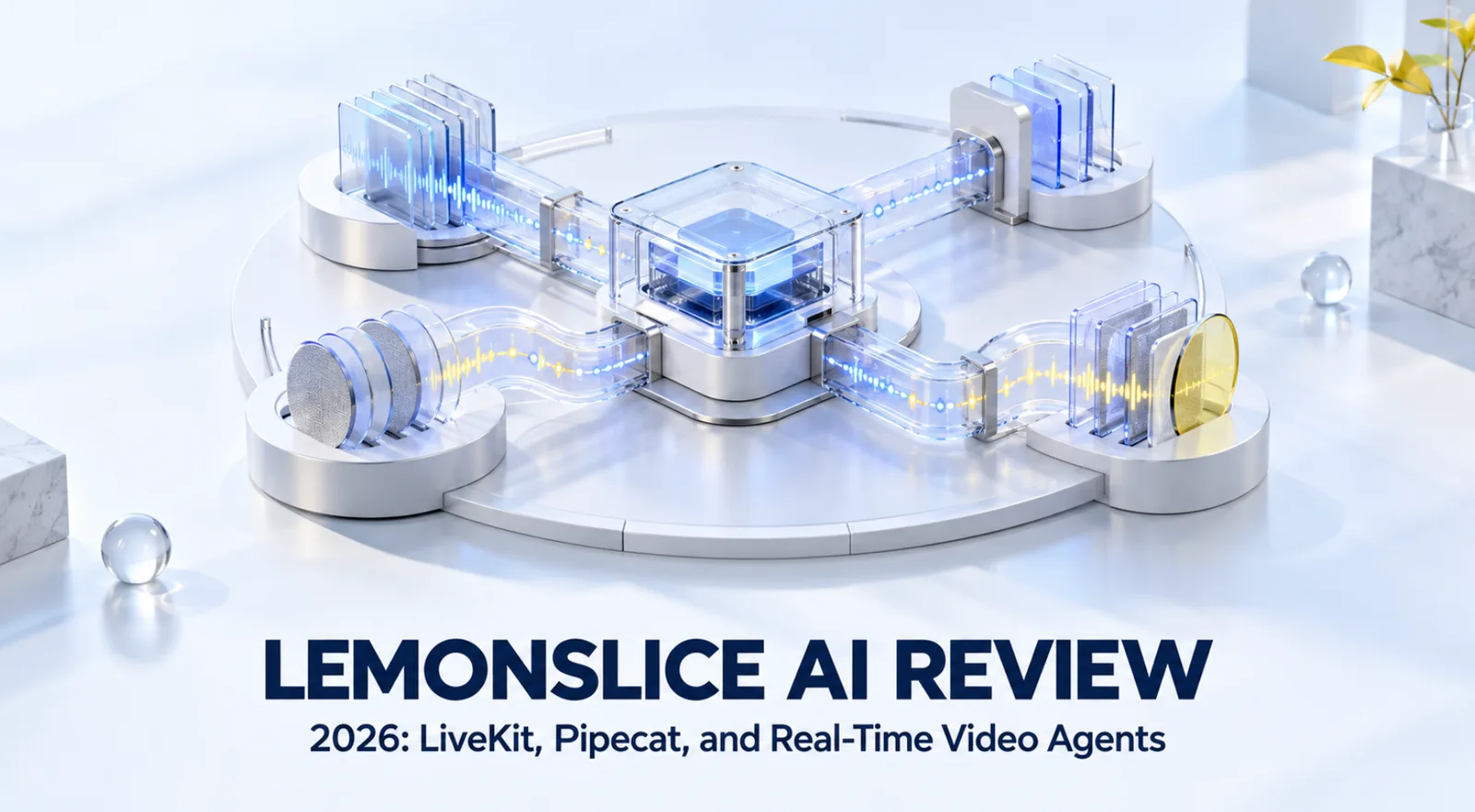
LemonSlice AI is a strong fit when an existing voice agent needs a cloud-rendered video face created from one image. Its clearest production paths are the official LiveKit plugin, a Pipecat pipeline, or LemonSlice’s hosted agent experience. The important decision is not whether the demo looks realistic; it is who should own speech, transport, orchestration, and the final video stream.
Last verified: September 21, 2026. Pricing, model access, plan limits, and integrations can change; confirm the current vendor pages before purchasing.
Start with the integration boundary
LemonSlice receives agent audio and returns synchronized avatar video. It can create the avatar from an image, so a team does not need to train a custom model before testing a character. The product can sit behind an existing voice pipeline or supply more of the conversational stack through a hosted experience.
| Route | Your team keeps | LemonSlice supplies | Best fit |
|---|---|---|---|
| LiveKit plugin | STT, LLM, TTS, tools, turn logic, LiveKit room, frontend | Avatar session and synchronized video participant | Existing LiveKit Agents product |
| Pipecat pipeline | Frame pipeline, voice services, orchestration, transport choice | Audio-driven avatar video | Teams already building on Pipecat |
| Hosted avatar | Product shell and business workflow | VAD, STT, LLM, TTS, avatar, widget or hosted app | Fast prototypes with less assembly |
These routes do not create the same responsibility or cost. A LiveKit or Pipecat implementation remains your agent; the hosted route adds speech and agent services.
What the LiveKit integration actually does
The official LiveKit LemonSlice plugin is available for Python and Node.js. It connects a LemonSlice AvatarSession to a LiveKit AgentSession, routes the agent’s audio to the avatar worker, and publishes synchronized audio and video back into the room.
A session can start from one of three mutually exclusive inputs: a public image URL, an image uploaded by the application, or an existing LemonSlice agent ID. LiveKit documents PNG, JPEG, and WebP support for Node.js uploads. It also notes that the rendered avatar video is 368 × 560 and that nonmatching images are center-cropped. That is a concrete UI constraint worth testing before designing a full-screen experience.
Create the voice session, start the avatar, wait for its video track, then expose the conversation. Otherwise, the agent may speak before the face appears. LiveKit’s virtual-avatar overview also documents join and playback latency metrics, which are more useful than a vendor headline.
Teams using Spatius can compare this with the official Spatius + LiveKit architecture, where motion data is delivered through the room and the avatar is rendered on the client.
Where Pipecat changes the implementation
Pipecat is a better mental model for teams that compose conversational AI as a frame pipeline. The agent still owns input transport, speech recognition, reasoning, text-to-speech, interruptions, and tool calls; LemonSlice consumes the resulting audio and produces the video response. Daily’s LemonSlice and Pipecat implementation story is useful background on that pipeline.
This route requires testing backpressure, interruption, reconnects, frame ordering, and cleanup across two real-time systems.
LemonSlice pricing: model the route, not only the plan
LemonSlice’s current pricing lists monthly self-serve plans at $8 Starter, $40 Creator, $100 Pro, and $240 Scale, with lower displayed equivalents for annual billing. Enterprise pricing is custom.
The Starter plan currently includes 1,000 credits, 41 minutes, three concurrent calls, a 30-minute call limit, a displayed included rate of $0.164 per minute, and $0.22-per-minute overage when enabled. Hosted avatars add $0.09 per minute for VAD, STT, LLM, and TTS. Higher tiers increase the allowance and concurrency; confirm their live values in the pricing selector rather than extrapolating from Starter.
Actions, controllable emotions, 24-hour calls, additional model variants, team accounts, zero-data-retention options, and data-residency options are currently listed under Enterprise. Do not assume a prototype plan includes them.
Separate avatar minutes, hosted-agent minutes, transport, external model usage, and peak concurrency. The real-time avatar pricing guide explains why those meters should not be collapsed.
What to test before production
Use the actual source image and target device. Check center-cropping, mouth visibility, identity consistency, idle behavior, motion prompts, the first seconds of a call, interruption recovery, network degradation, and session teardown. If the product needs deterministic gestures or emotions, verify the required Enterprise access instead of assuming a natural-language movement prompt behaves like an action API.
LemonSlice is most attractive when one-image flexibility and cloud-generated video are product requirements. If bandwidth, client-side visual control, or avoiding a permanent video-rendering cost matters more, compare the architectural alternatives in Spatius vs LemonSlice.
LemonSlice AI FAQ
Is LemonSlice AI a complete voice-agent platform?
It can be either an avatar layer or a hosted experience. With LiveKit or Pipecat, your stack can retain STT, LLM, TTS, tools, and orchestration. Hosted avatars add those speech and agent components for an additional per-minute charge.
Can LemonSlice create an avatar from one image?
Yes. The LiveKit plugin accepts an image URL, an uploaded image, or an existing LemonSlice agent ID. Image quality and framing still need production testing.
Does LemonSlice work with LiveKit Agents?
Yes. LiveKit maintains Python and Node.js plugin paths for connecting a LemonSlice avatar session to an AgentSession.
Is LemonSlice free?
Featured avatars can be previewed without a subscription, but creating custom avatars and using the API require a paid plan. The current self-serve entry plan is $8 per month.
Choose the rendering boundary before the avatar
LemonSlice offers a direct route from audio to expressive avatar video, especially for LiveKit and Pipecat teams. The buying decision should follow a production test of the exact image, pipeline, network, concurrency, and plan limits.
Compare cloud-video delivery with a client-rendered avatar layer for your current agent. Request a demo, or ,或Review Spatius pricing.。