
LiveAvatar pricing starts at $19 per month for 200 credits. In LITE mode, that allowance equals 200 streaming minutes, or about $0.095 per minute. In FULL mode, it equals 100 minutes, or $0.19 per minute. The current LiveAvatar pricing page also lists Essential at $99 for 1,100 credits and Business at $475 for 6,000 credits.
Pricing and product details were verified September 2, 2026. Vendor terms can change; confirm the final quote in your account before purchasing.
LiveAvatar pricing plans at a glance
| Plan | Monthly price | Included credits | LITE minutes | FULL minutes | Session limit |
|---|---|---|---|---|---|
| Free | $0 | 10 | 10 | 5 | 2 minutes |
| Starter | $19 | 200 | 200 | 100 | 5 minutes |
| Essential | $99 | 1,100 | 1,100 | 550 | 20 minutes |
| Business | $475 | 6,000 | 6,000 | 3,000 | 60 minutes |
| Enterprise | Custom | Custom | Custom | Custom | Custom |
Paid plans currently advertise unlimited concurrency. Essential includes one custom 720p avatar and removes the watermark; Business includes one custom 1080p avatar. The current HeyGen setup guide confirms the same allowances and publishes plan-specific overage rates.
How LiveAvatar credits work
LiveAvatar offers two integration modes. FULL mode manages the speech recognition, language model, text-to-speech, and WebRTC pipeline. It consumes two credits per streaming minute. LITE mode supplies the real-time video layer while your application provides the conversational stack, so it consumes one credit per minute.
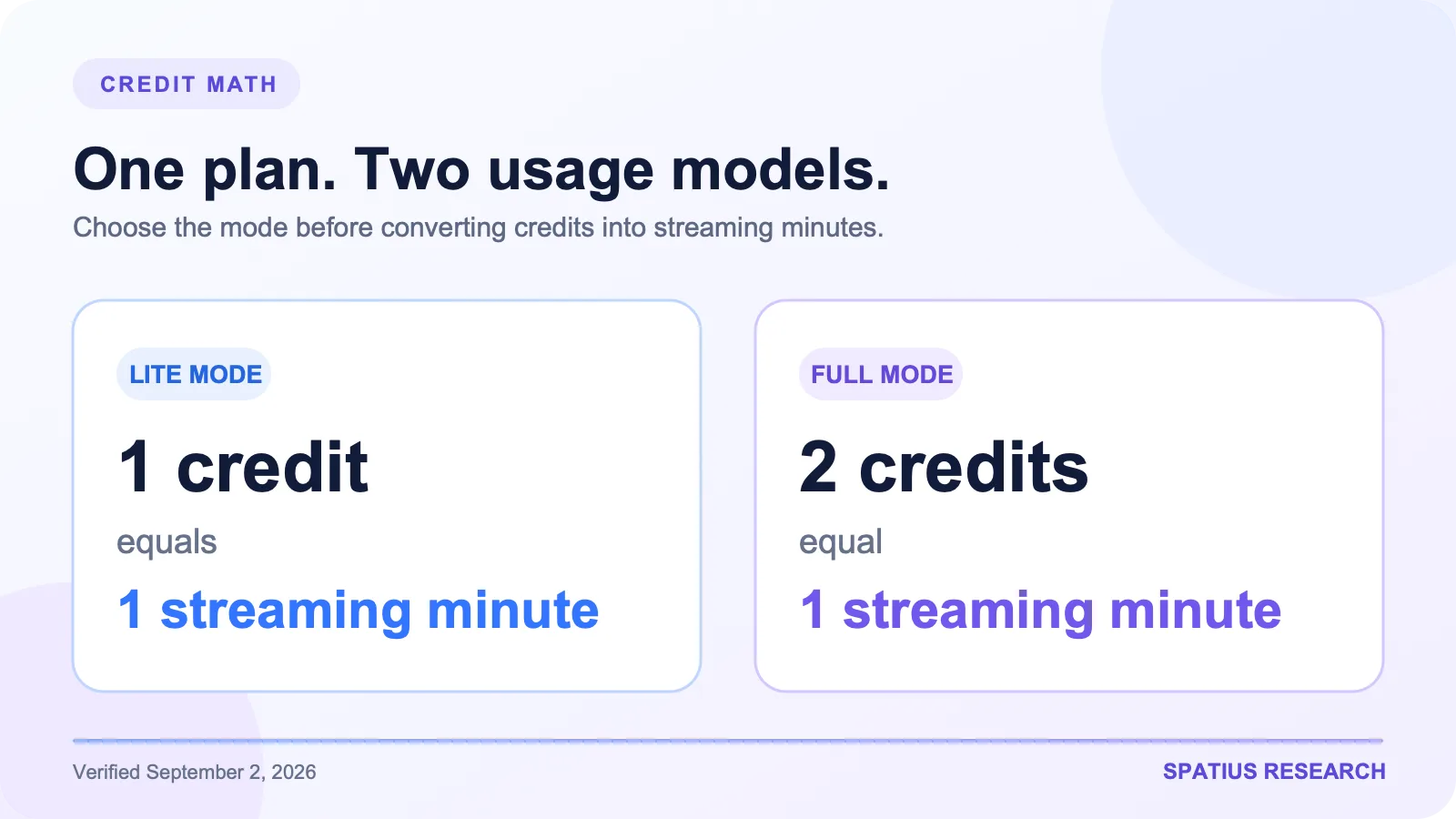
That distinction matters more than the sticker price. A SaaS team with an existing voice agent may prefer LITE because it can retain its LLM, tools, memory, and voice. The LiveAvatar FAQ confirms that these credits are separate from standard HeyGen API credits.
Effective LiveAvatar cost per minute
Using only the included allowance, the self-service plans work out as follows:
| Plan | LITE cost/min | FULL cost/min | Overage per credit |
|---|---|---|---|
| Starter | $0.095 | $0.190 | $0.100 |
| Essential | $0.090 | $0.180 | $0.095 |
| Business | $0.079 | $0.158 | $0.090 |
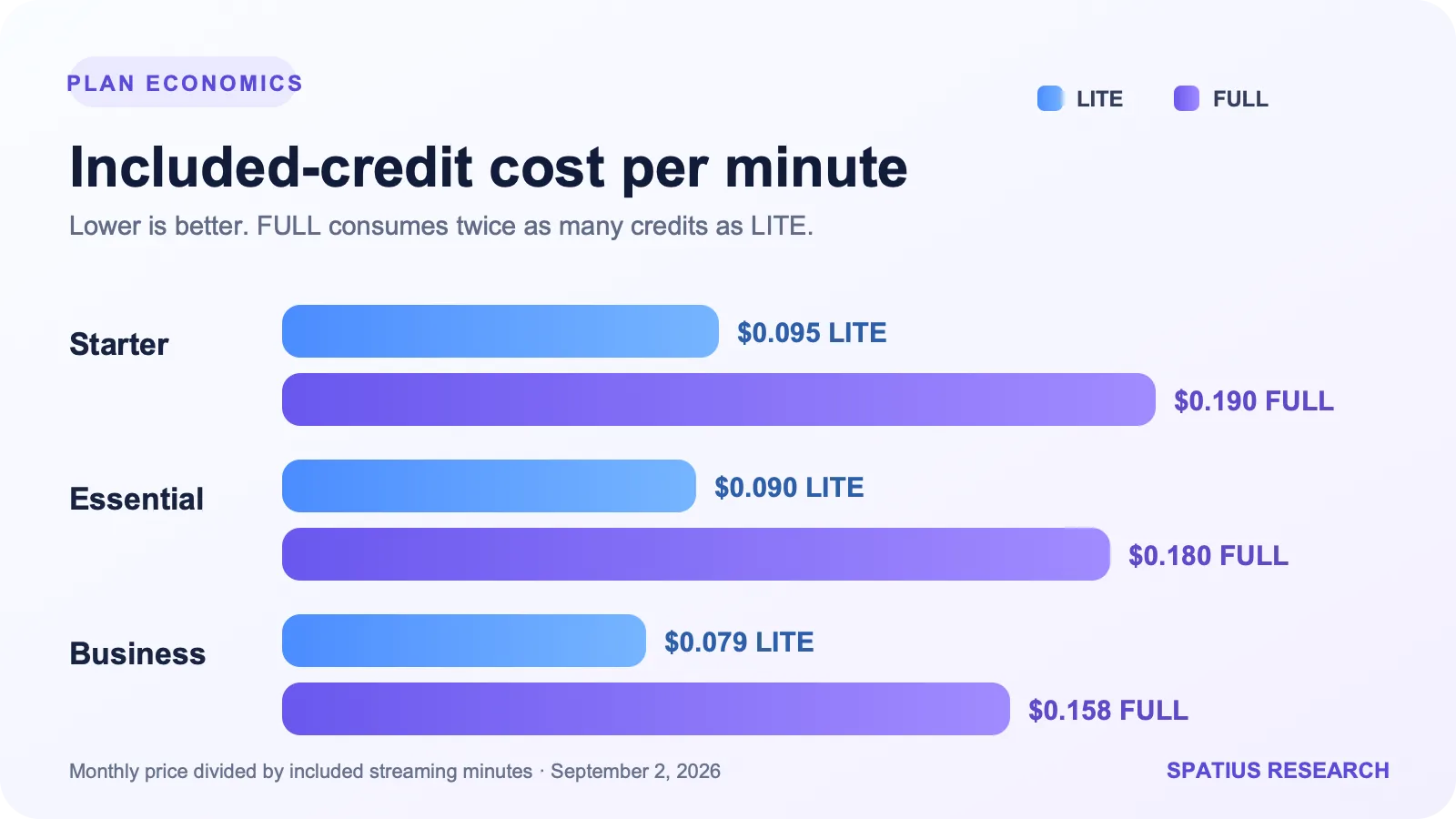
Overage changes the marginal rate. Starter overage costs $0.10 per LITE minute or $0.20 per FULL minute. Essential is $0.095 or $0.19, while Business is $0.09 or $0.18. The current plan guide publishes these rates, while LiveAvatar’s credit documentation explains that sessions stop when credits run out unless overage is enabled.
At 1,000 monthly streaming minutes, Essential costs $99 in LITE mode because the allowance covers the workload. In FULL mode, the same workload requires 2,000 credits, making the self-service total about $184.50 after 900 overage credits. At 10,000 minutes, Business costs about $835 in LITE or $1,735 in FULL before any separate stack costs. For other traffic levels, use the AI avatar cost calculator.
LiveAvatar pricing compared with Spatius
For a product that already owns its LLM, speech, tools, and agent workflow, the closest comparison is LiveAvatar LITE versus the Spatius avatar layer. This is still not a feature-for-feature equivalence: LiveAvatar sends a cloud-rendered WebRTC video stream, while Spatius sends motion data for rendering on the client. Compare the final user experience as well as the price.
Using the lowest public monthly plan that covers each workload, the difference is:
| Monthly avatar minutes | LiveAvatar LITE | Spatius | Difference |
|---|---|---|---|
| 1,000 | Essential: $99 | Starter: $19 | Spatius is about 81% lower |
| 10,000 | Business plus overage: $835 | Growth: $149 | Spatius is about 82% lower |
| 40,000 | Business plus overage: $3,535 | Scale: $299 | Spatius is about 92% lower |
The public unit rates tell the same story. LiveAvatar Business LITE works out to about $0.079 per included minute; Spatius pricing lists monthly Scale at $0.007 per minute and annual Scale at $0.0056 per minute. That makes the published Spatius avatar-layer rate roughly 91% lower monthly or 93% lower annually than LiveAvatar Business LITE.
These figures do not mean every Spatius deployment has a 93% lower total bill. LITE and Spatius both require the customer to supply adjacent AI services, and the right plan may be determined by concurrency, session length, avatar creation, device requirements, and unused allowance. The comparison isolates the avatar-layer cost; our real-time avatar API pricing guide explains how to add the rest of the stack.
Why LiveAvatar prices appear inconsistent online
The current public pricing page and current help article show 200, 1,100, and 6,000 credits. However, an older official documentation page still lists Starter at 150+10, Pro at 1,000+10, and Scale at 5,000+10. An older LiveAvatar introduction also reflects the previous plan names and limits.
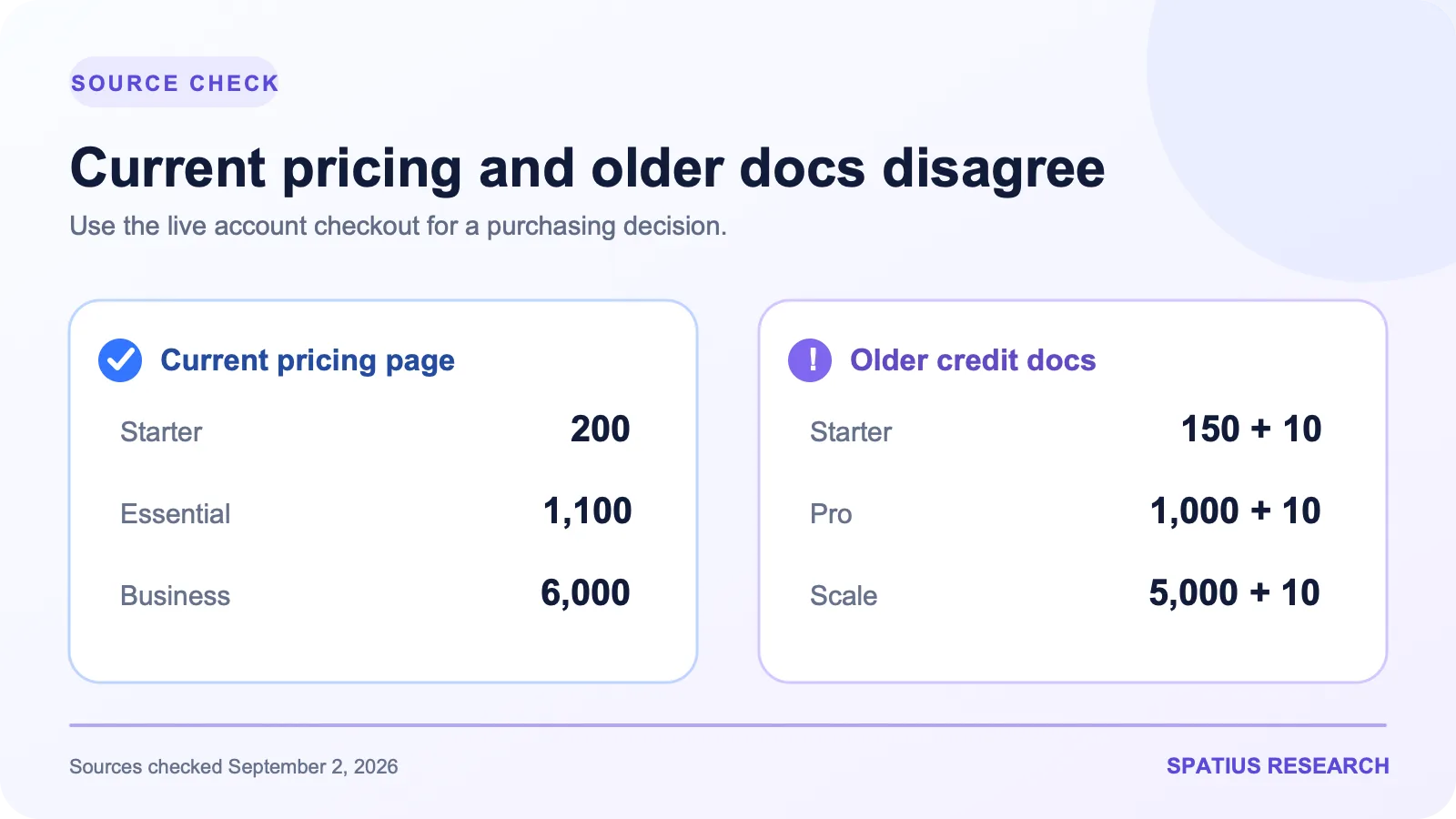
For a purchase decision, use the live pricing screen and current account checkout as the source of truth. Treat older documentation as evidence of how billing works, not as a reliable current allowance. Independent analyses likewise recommend normalizing avatar prices to dollars per streamed hour and rechecking vendor pages before signing; see the Realtime Avatar Journal comparison and Franz Geffke’s cost analysis.
Hidden costs to include in a production budget
LITE mode’s avatar rate excludes the services your application supplies. Budget separately for speech-to-text, LLM tokens, text-to-speech, WebRTC operations, observability, and support. LiveAvatar documents compatible custom voices and transport choices in its platform overview, while the ElevenLabs integration guide shows how a separate voice-agent stack connects to the avatar layer.
Also test session length, idle-time behavior, reconnects, and custom-avatar requirements against the published plan limits. The official embed guide recommends using Sandbox Mode while iterating so tests do not consume production credits. For a wider buying framework, compare leading AI avatar service pricing and review Spatius versus LiveAvatar.
Is LiveAvatar good value?
LiveAvatar is easy to trial and its two-mode model gives teams a meaningful architecture choice. FULL favors faster deployment; LITE favors products that already own their agent stack. The best-value plan depends on streamed minutes, session duration, custom-avatar resolution, and whether the team wants bundled intelligence or only a real-time visual layer.
If your SaaS product already has an LLM, tools, voice, and workflow engine, compare the total production cost—not only the avatar credit rate. Spatius is designed as a modular real-time avatar layer for that architecture, with public rates starting at $0.009 per minute and falling to $0.0056 per minute on annual Scale. See the full assumptions in our Spatius pricing analysis.
Frequently asked questions
How much does LiveAvatar cost per minute?
Using included credits, current self-service pricing is approximately $0.079–$0.095 per minute in LITE mode and $0.158–$0.19 in FULL mode. Overage is slightly higher on most plans.
Is LiveAvatar included with HeyGen?
No. LiveAvatar uses a separate credit system from standard HeyGen API credits, according to the official FAQ.
How much does a custom LiveAvatar cost?
The current pricing page includes one custom 720p avatar with Essential and one custom 1080p avatar with Business. Additional custom-avatar fees are not publicly itemized, so buyers should verify the slot price before approving a production budget.
Does LiveAvatar charge for concurrency?
Current paid plans advertise unlimited concurrency, but every simultaneous session continues consuming credits. Session-duration limits still apply by plan.
What is the difference between FULL and LITE mode?
FULL bundles the conversational pipeline and avatar stream at two credits per minute. LITE provides the avatar video layer at one credit per minute while your application supplies the AI and voice stack.
Compare latency, integration control, and total production cost against your expected workload. Request a demo, or ,或Compare avatar pricing.。