
A secure real-time AI avatar deployment starts with a data-flow map: what the user provides, what the application stores, what each vendor receives, and what leaves the session in logs. Apply least privilege, short-lived credentials, explicit browser permissions, limited retention, and a recovery plan to every boundary.
Key takeaways
- Treat user input, avatar speech, transcripts, likeness assets, and logs as separate data classes.
- Keep long-lived API keys out of web and mobile clients.
- Do not use observability as an automatic transcript archive.
- Give users an alternative path when microphone or avatar access is unavailable.
1. Draw the data flow before reviewing vendors
List every component that receives identity data, microphone audio, transcripts, prompts, retrieved documents, TTS audio, avatar assets, motion data, and analytics. The NIST Privacy Framework provides a useful structure for identifying and governing processing without assuming that all data has the same risk.
Map the same components against the NIST Zero Trust Architecture: network location alone should not grant access to session creation, private retrieval, or operational records.
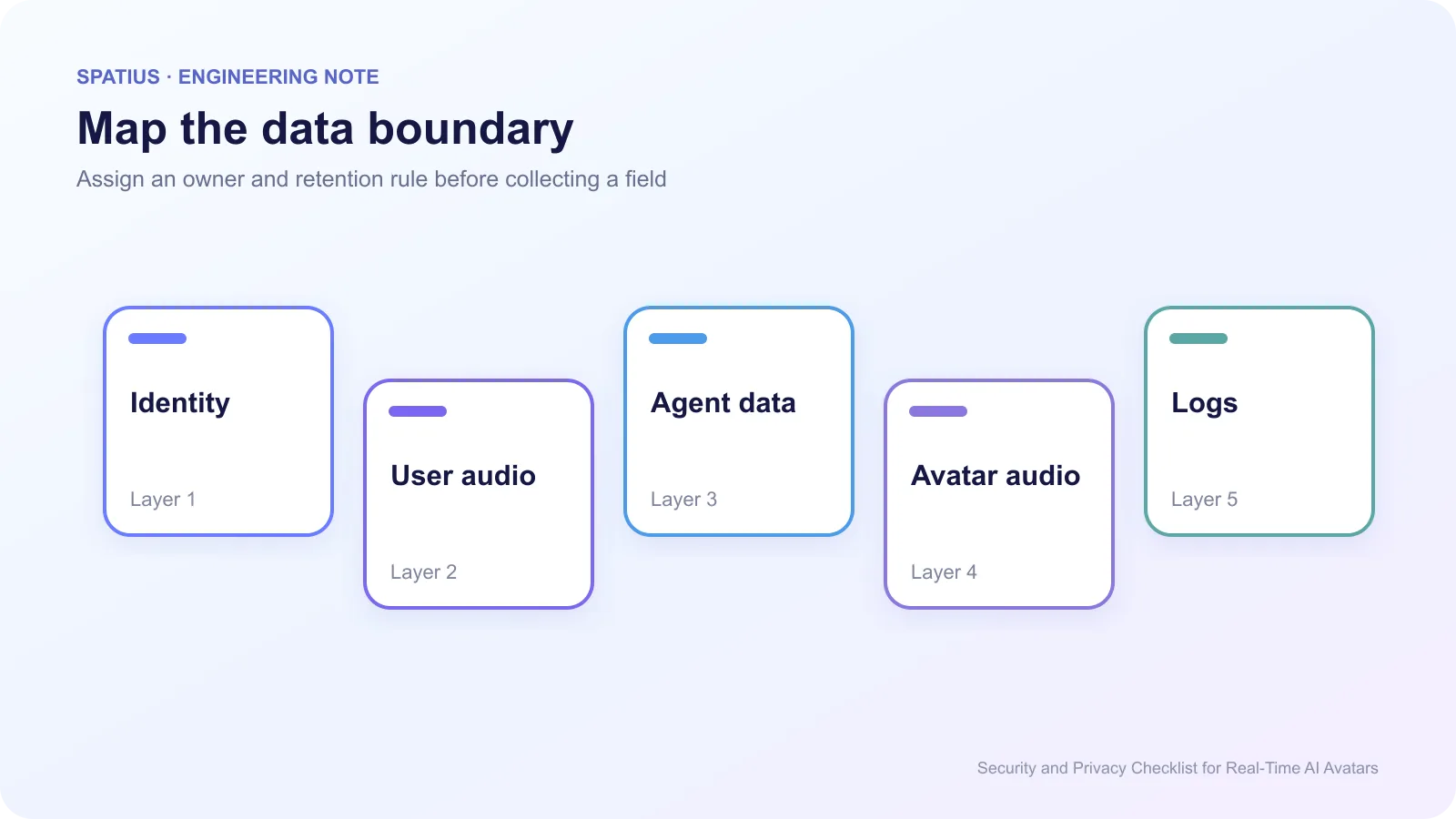
For each field, record purpose, owner, legal basis, retention, region, subprocessors, and deletion path. Under the EU’s data minimisation principle, organizations should collect only what is necessary for the stated purpose. “We may debug it later” is not a retention policy.
2. Separate user audio from avatar speech audio
User microphone audio enters the ASR or voice-agent path. Avatar speech audio is the output your application has approved for presentation. They may travel to different providers. Document that distinction in architecture reviews and privacy notices.
Browsers restrict microphone access through getUserMedia permissions. Request access only when the user starts a voice feature, explain why it is needed, and provide a text path when permission is denied.
3. Secure credentials and sessions
Keep provider API keys on trusted servers. Give clients short-lived, scoped session credentials and validate origin, audience, expiry, and replay behavior. The OWASP REST Security guidance explains common token risks even when your implementation uses a different token format.
Inventory every endpoint and credential owner. The OWASP API Security project calls out broken authorization, unrestricted resource consumption, and poor API inventory as recurring risks in public application interfaces.
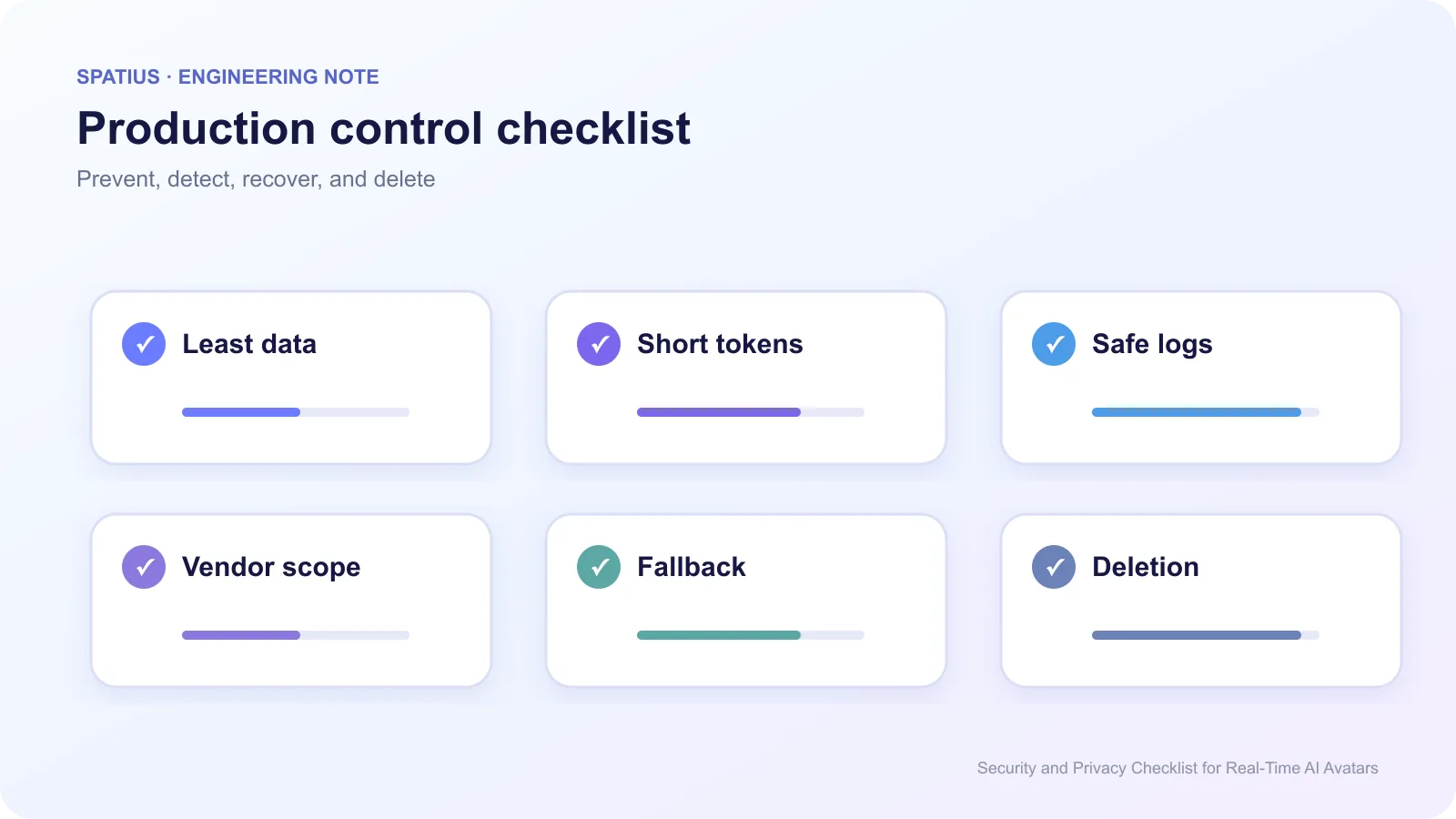
Protect transport as well as authentication. For WebSocket deployments, review the OWASP WebSocket Security Cheat Sheet: origin validation, message limits, session expiry, authorization, and denial-of-service controls belong in the design.
4. Keep sensitive content out of logs
Use correlation IDs, timing, error class, integration path, and safe state labels. Avoid complete transcripts, raw audio, API keys, retrieved documents, and tool results unless there is a reviewed need. The OWASP Logging Cheat Sheet calls out secrets, personal data, and data with higher classification as fields that may need removal or masking.
Access to debug records should be narrower than access to general analytics. Define retention and deletion before launch, then test both. A deletion policy that no one has executed is only documentation.
5. Review the complete vendor chain
An avatar session may involve ASR, LLM, RAG, tools, TTS, avatar motion, analytics, and transport providers. Review each processor’s data purpose and region. The application remains responsible for the chain it assembles.
The official GDPR text is the primary reference when contracts need to reflect who determines purpose, who processes on instructions, and what Article 28 requires.
Do not infer security certification or compliance from a marketing page. Request the current agreement, security documentation, incident process, and subprocessor list. For biometric or likeness assets, obtain the necessary authorization before upload and define who may create, use, replace, or delete the avatar.
6. Plan abuse and recovery controls
Limit session creation, message size, audio duration, and retry rate. Build moderation and authorization around the agent and tool layer before speech reaches the avatar. The OWASP LLM Prompt Injection guidance is relevant when retrieved documents or user text can change agent behavior.
If the avatar path fails, preserve the user’s task without exposing internal errors. The article on waiting, errors, and human handoffs explains how recovery belongs to the customer application.
Review the related Spatius guide on what data an avatar provider should receive before adding fields to a session payload.
Applying the checklist to Spatius
Spatius receives avatar speech audio and returns motion data for local AvatarKit rendering. It does not own ASR, LLM, TTS, retrieval, permissions, or tools. Confirm the current boundary in the Developer Docs Map, then review the Spatius Privacy Policy for the published processing terms.
In Direct Mode, the API key stays on your backend and the client uses a short-lived Session Token. Do not place the server API key in browser, iOS, Android, or Flutter code.
Frequently asked questions
Should we store every conversation for quality review?
No. Decide what evidence quality review actually needs, minimize it, restrict access, and set a deletion date.
Is encryption enough?
No. Encryption does not fix excessive collection, broad access, unsafe tools, weak retention, or an unclear vendor boundary.