
Simli pricing in 2026 includes a $10 signup credit and a free plan with a monthly 50-minute top-up. Paid access uses volume discounts and flexible pay-as-you-go billing, but Simli does not publish a complete paid rate card on its public website. Before budgeting production use, confirm the minute rate, concurrency, session limits, and avatar-creation charges in the Simli dashboard or with its team.
Last verified: September 1, 2026.
A 2025 infrastructure case study from Verda says Simli’s Trinity-1 technology can deliver interactive avatars at less than one cent per minute. Treat that as a vendor-partner technology claim—not as a guaranteed public rate for every account. It does not replace the current plan, overage, or concurrency terms shown in a buyer’s dashboard or contract.
Simli pricing at a glance
The Simli pricing section publishes the free allowance and the shape of its paid model rather than a complete public plan table. That makes it useful for estimating whether a prototype is affordable, but insufficient for approving a production budget without account-level terms.
| Pricing element | Public information checked September 1, 2026 | What a buyer should verify |
|---|---|---|
| Free access | $10 on signup and a monthly top-up of 50 minutes | Whether the allowance, output quality, commercial rights, or available faces have changed |
| Paid usage | Volume discounts and flexible pay-as-you-go billing | Effective rate at the expected monthly volume |
| Trinity-1 cost claim | A partner case study says less than $0.01 per minute | Whether that rate applies to the selected product, volume, and contract |
| Billing unit | Video-stream time is recorded in minutes and aggregated to the account | When billing starts and whether idle connected time is counted |
| Overage | Simli may invoice usage above the allocated balance | Overage rate, alerts, and spending controls |
| Production limits | Not fully listed on the public page | Concurrency, maximum session duration, support, SLA, and custom-face capacity |
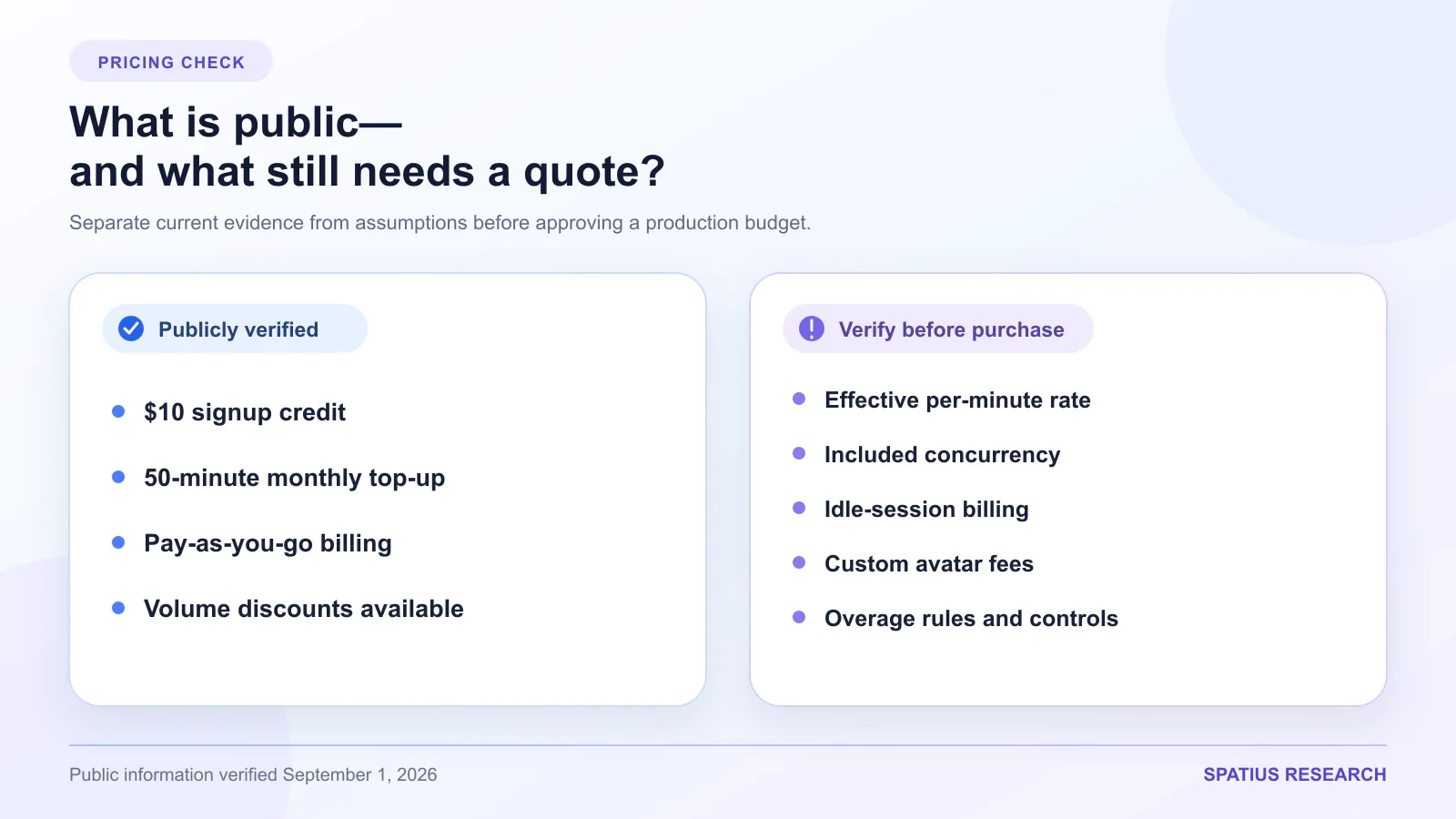
Simli’s terms of service describe “minutes spent” as the usage unit. They also state that free-demo calls are not charged, trial credits are consumed before paid access, subscriptions renew monthly, and excess usage may produce an additional invoice. Taxes and duties may be added where applicable.
Why do some websites quote Simli at $0.05 per minute?
Some third-party pages quote Simli at about $0.05 per minute because that figure has circulated in software directories and developer discussions. It is not a universal public list price shown by Simli today. Treat it as a comparison estimate until the dashboard or a written quote confirms the rate for your workload.
For example, O-mega lists approximately $0.05 per minute, and a Reddit developer discussion repeats the same figure. The Verda case study cited above makes a different claim: Trinity-1 can operate below $0.01 per minute. These numbers describe different evidence—a directory estimate, a community post, and a vendor-partner technology claim. They may also exclude volume tiers, overage rules, custom avatars, support, and the rest of the voice-agent stack. Use the effective rate in your Simli account or written quote for procurement.
If you need a temporary planning assumption before receiving a quote, model the avatar layer at $0.05 per minute and test lower and higher scenarios. Do not treat that assumption as Simli’s confirmed contract price.
At that provisional rate, 10,000 avatar minutes would equal $500 for the avatar layer alone. Your working budget should then add speech recognition, the LLM or speech-to-speech model, text-to-speech, real-time transport, support, and any custom-avatar fees. Replace the estimate as soon as your Simli dashboard or written quote supplies the actual rate and billing rules.
What does a paid Simli minute include?
Simli describes itself as a speech-to-video API that gives a face to a real-time AI agent. Its developer overview presents LiveKit, Pipecat, and Simli’s own SDKs as integration paths. This positioning matters because a Simli minute is not necessarily the total cost of a conversational agent.
The Simli SDK overview is aimed at teams that want control of the surrounding AI stack. Your application may still pay separately for speech recognition, an LLM or speech-to-speech model, text-to-speech, real-time transport, observability, storage, and tool calls. Simli’s Pipecat integration guide, for example, installs separate packages for speech, model, voice, and WebRTC services around the avatar layer.
Simli also documents a managed product called Simli Auto. If that is the product in your quote, ask which LLM, transcription, voice, and transport services are included. This article models the composable speech-to-video API unless a contract explicitly says otherwise.
For browser integrations, the JavaScript SDK creates a session token and connects the client to Simli’s service. Its configuration includes maximum session length and maximum idle time. Those settings can help control abandoned sessions, but they should not be confused with the commercial limits attached to a paid plan.
How to calculate your real monthly cost
Do not compare Simli’s avatar minute with the bundled conversation minute of an end-to-end platform. Start with the same workload and add every required component:
monthly cost = Simli usage + speech + model + transport + avatar setup + operations
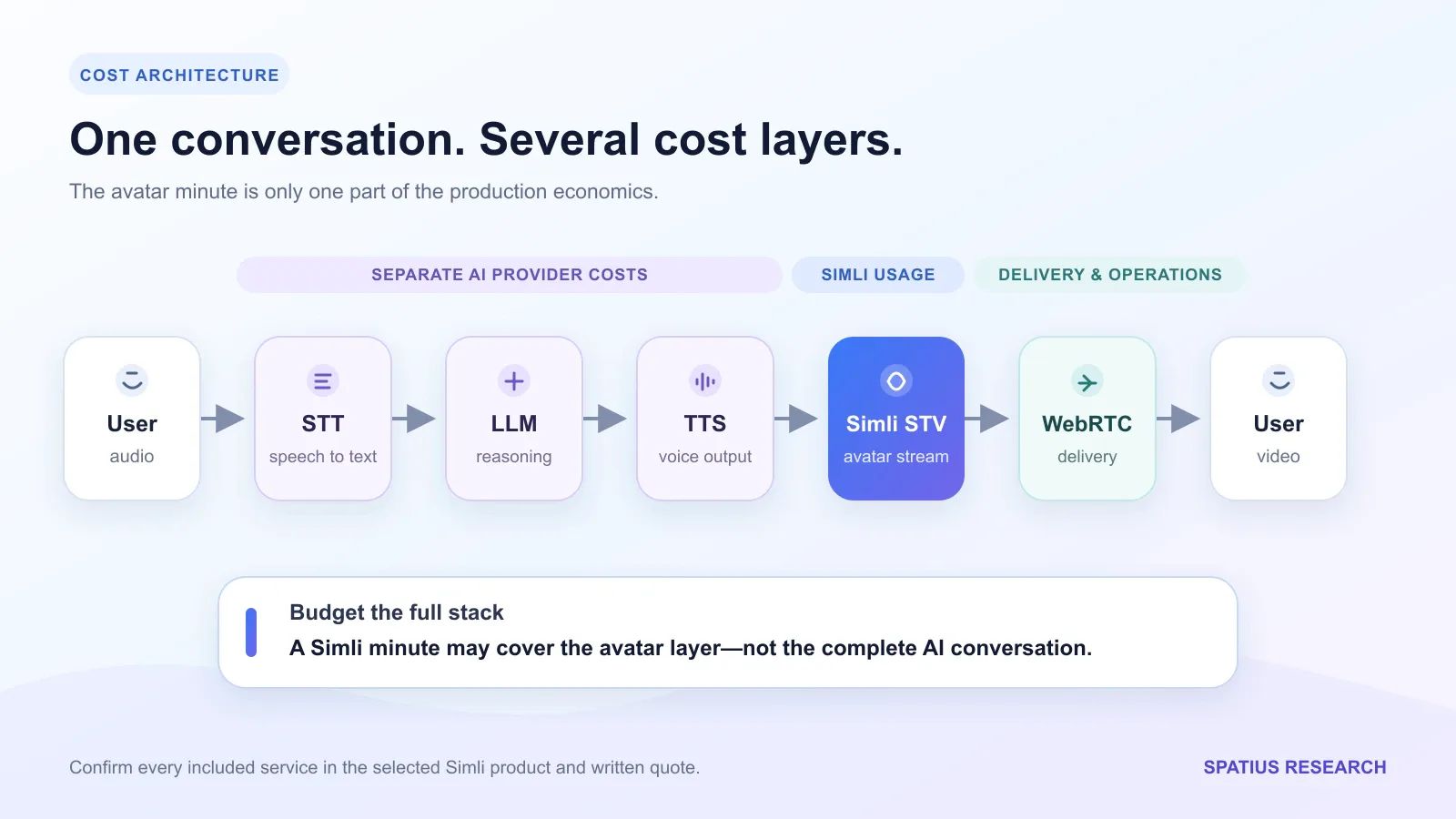
The Simli WebRTC guide explains that the API receives audio and returns a talking-head video stream over WebRTC. It expects PCM Int16 audio at 16 kHz in the documented custom-client example, so audio conversion or buffering may add implementation work when an existing voice stack uses another format.
Model pilot, expected-launch, and peak workloads before requesting a quote. The broader Spatius guide to real-time AI avatar API pricing covers minimum-session waste, concurrency, custom avatars, and adjacent AI services. The live avatar cost calculator can help normalize rendering-only and bundled services without treating unlike minutes as equivalent.
Costs and limits to confirm before launch
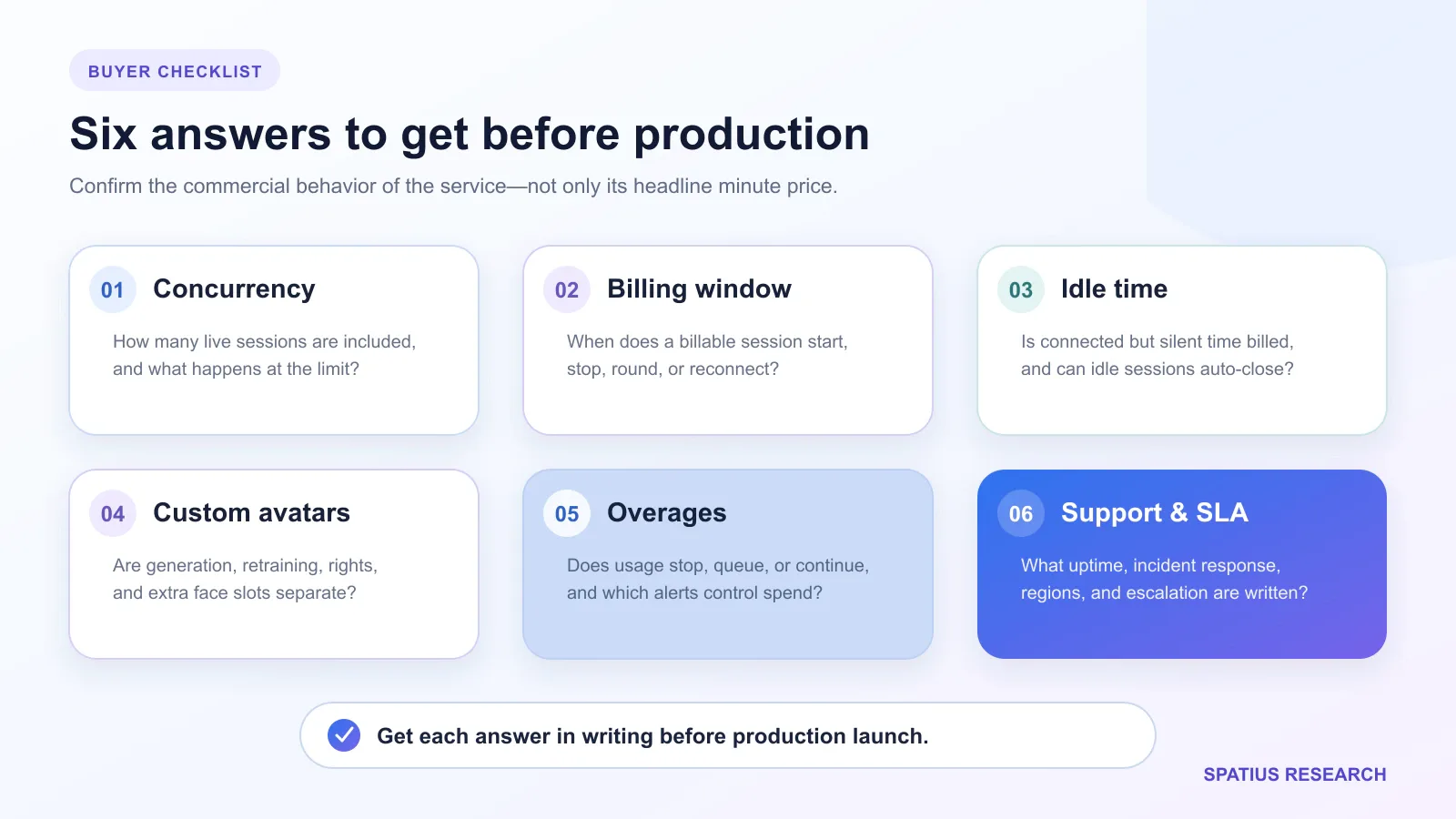
Ask Simli for written answers to these questions before selecting a paid configuration:
| Question | Why it changes the budget |
|---|---|
| When does billing begin and end? | Confirm whether connected idle time is billable. An AWS sample integration recommends idle-time controls, but the commercial rule should be verified with Simli. |
| What concurrency comes with the rate? | Ask about included sessions, burst behavior, rate limits, and the upgrade path for traffic spikes. |
| Which transport path should we use? | Simli supports LiveKit, Pipecat, direct SDK, and WebRTC paths. The choice changes engineering and media costs. |
| Are custom faces separate? | Confirm generation quotas, retraining fees, commercial rights, review requirements, and turnaround. |
| What happens after the allowance? | Request the exact overage rate, alerts, spending controls, and whether sessions stop or continue. |
Do not copy named Hobby, Pro, or Scale tiers from an old comparison page without checking them in the current Simli account. The live public homepage currently confirms the free allowance and the pay-as-you-go model, but not a complete named-tier rate card. AI search results and third-party directories frequently repeat older or conflicting figures, so the plan screen or a written quote should control procurement.
Simli pricing versus a client-rendered avatar layer
Simli is a focused speech-to-video option for teams that own their agent stack. Spatius also separates the avatar layer from the AI brain, but renders the avatar in the client rather than returning a continuous cloud video stream. Compare the complete workload—including bandwidth, target devices, speech services, and peak concurrency—not one minute rate.
For a broader shortlist, see the Spatius comparison of leading AI avatar services by real cost per minute. Recheck every vendor’s current source before procurement because allowances and commercial limits can change.
Who should consider Simli?
Simli is worth evaluating when an existing voice agent needs a real-time face and the team is comfortable owning the LLM, voice, tools, and product logic. It is less straightforward for buyers who want one vendor to manage the complete conversational pipeline.
Frequently asked questions
Is Simli free?
Simli states that new accounts receive $10 at signup and that the free plan receives a monthly 50-minute top-up. Verify current usage rights before launch.
Does Simli charge per minute?
Yes. Its terms describe video-stream minutes aggregated to the account. The effective rate depends on the current plan and overage terms.
Does Simli pricing include an LLM and text-to-speech?
Do not assume so. Budget conversational components separately unless the selected Simli product or quote explicitly includes them.
How should a SaaS team compare Simli with Spatius?
Run the same workload on target devices. Compare total stack cost, response time, concurrency, bandwidth, recovery, avatar control, and engineering effort.
Build the price model around your actual product
A reliable quote needs real session length, peak concurrency, expected monthly minutes, target devices, and the AI stack you already operate. If you are comparing a cloud speech-to-video API with a client-rendered avatar layer, test both architectures against the same workload.
Compare the architecture and total production cost with your own workload. Request a demo, or ,或Compare avatar pricing.。