AI Chatbot API vs. AI Video Agent API: Architecture Differences
Compare chatbot APIs and AI video agent APIs by media, latency, data boundaries, tool use, and deployment model for SaaS teams.
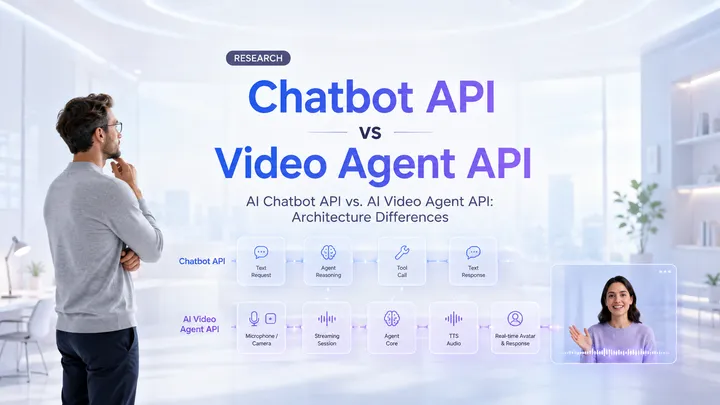

Product notes, technical guides, independent comparisons, and research for teams building real-time AI avatars.
Compare chatbot APIs and AI video agent APIs by media, latency, data boundaries, tool use, and deployment model for SaaS teams.
A practical guide to placing a real-time AI avatar in a React SaaS product without confusing the avatar layer with your agent, data, or application workflow.
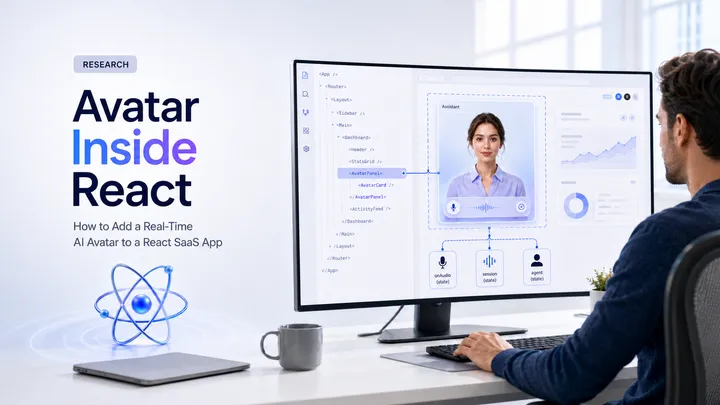
A practical Direct Mode guide to keeping the Spatius API Key on your backend, issuing fresh Session Tokens deliberately, and designing a clean reconnect path.

A practical guide to sending TTS output to a real-time avatar without confusing avatar speech, playback timing, and application-owned conversation logic.
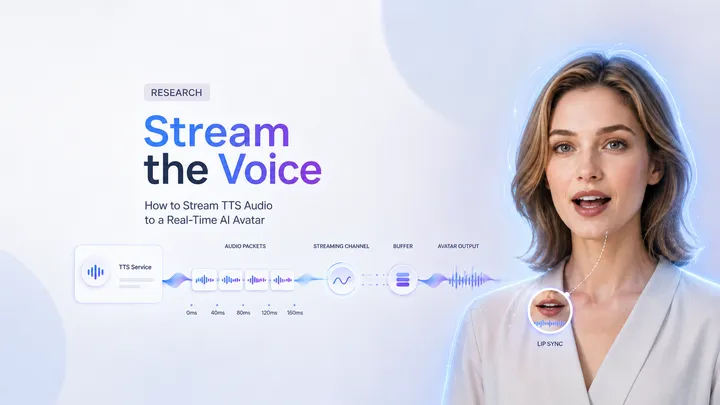
Decide what belongs in your SaaS application, what the avatar layer actually needs, and how to review the boundary before launch.

A practical guide to adding a real-time avatar layer to an existing SaaS AI agent while keeping your application in control of its intelligence, data, and workflows.

A practical framework for deciding whether to build or integrate the avatar motion and rendering layer in a SaaS product—without giving up ownership of your agent, data, or workflows.

A practical developer guide to adding a real-time avatar to an existing AI agent without replacing its LLM, tools, speech stack, memory, or business logic.
A developer's guide to live avatars in 2026 — what a live avatar SDK actually does, how on-device rendering keeps bandwidth at 10–15 KB/s, and how to add a real-time live avatar face to your app on Web, iOS, and Android.

A developer-friendly explanation of single-photo custom avatar generation, 3D Gaussian Splatting, facial matching, Motion data driving, and on-device rendering.

How to add a real-time Spatius avatar face to a LiveKit Agents voice pipeline, including setup, architecture, latency notes, and common production issues.

Most AI avatar SDKs stream heavy video from the cloud. Spatius streams only lightweight Motion data — as little as 10–15 KB/s — and renders the avatar locally. That's why it runs stably on entry-level chipsets with no dedicated GPU.