AI Avatar API vs. AI Video Generation API: Which Does Your SaaS Product Need?
Learn the practical distinction between a real-time AI avatar layer and an AI video-generation workflow, and how to choose the right output for a SaaS product.


Product notes, technical guides, independent comparisons, and research for teams building real-time AI avatars.
Learn the practical distinction between a real-time AI avatar layer and an AI video-generation workflow, and how to choose the right output for a SaaS product.
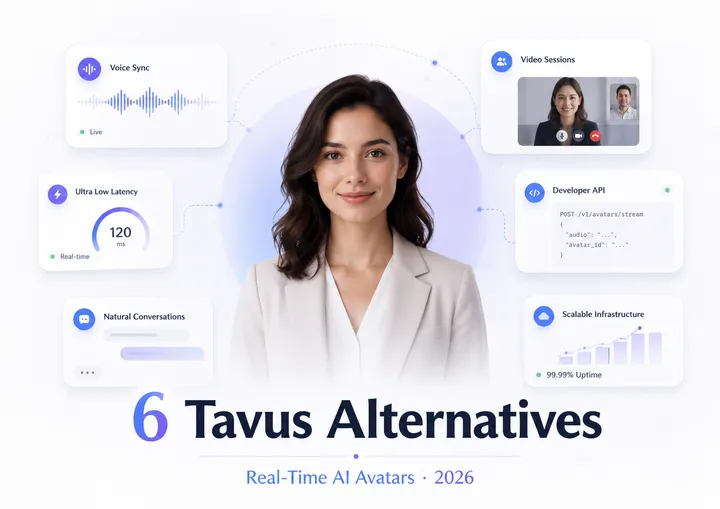
Compare the best Tavus alternatives for real-time AI avatars by latency, architecture, developer control, client support, and production fit.
A practical guide to building an AI avatar for a language learning app — why a face matters for speaking practice, how on-device rendering keeps it running on student hardware and weak networks, and how the three-layer architecture fits your AI tutor.

A practical guide to AI avatar virtual assistants for kiosks, tablets, retail, healthcare, HR tech, and other hardware-constrained deployments.

Learn how to evaluate conversational AI avatars for customer service: architecture, latency, device coverage, fallback behavior, and production cost at scale.

Cloud-streaming AI avatars require 1–2 MB/s of sustained bandwidth per session. That's the wrong architecture for kiosks, retail, and field deployments. This guide covers what changes when you move to on-device rendering — and why 10–15 KB/s changes everything.

A complete guide to interactive avatars: how they work, what to evaluate, and why rendering architecture determines latency, bandwidth, and cost at scale.