

Compare the top Tavus alternatives in 2026: Spatius, D-ID, HeyGen, and more. Find the best real-time AI avatar platform for your use case and budget.
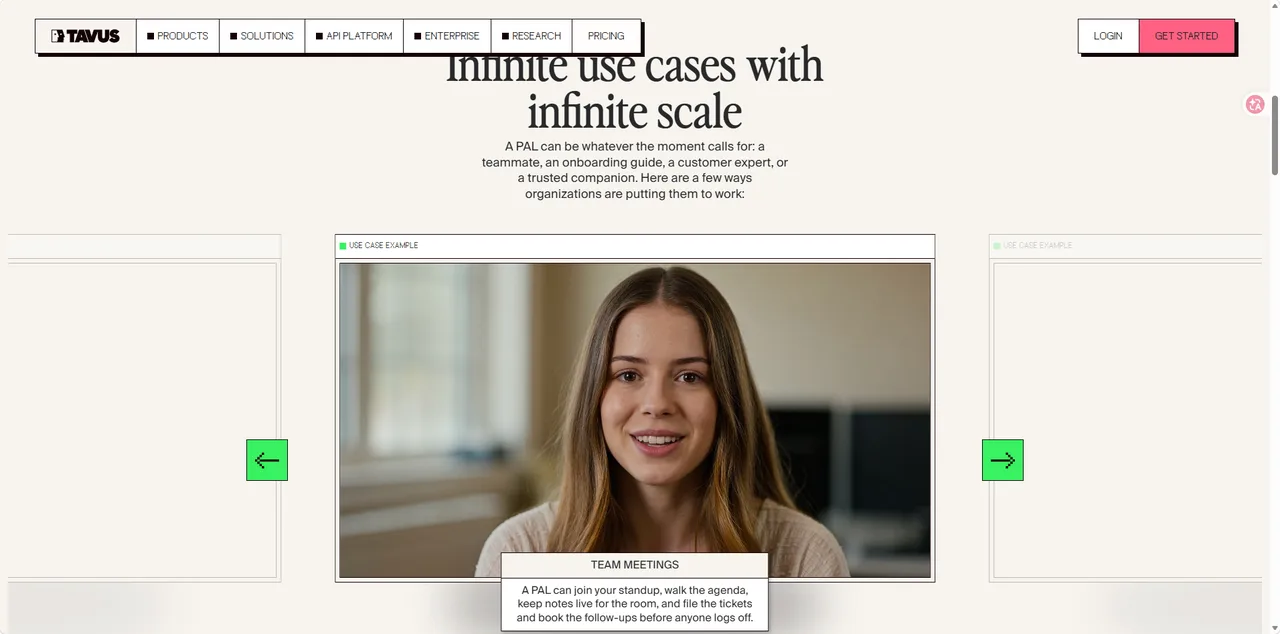
If you are evaluating Tavus alternatives in 2026, you have likely already discovered that real-time AI avatar platforms vary dramatically in architecture, cost, and deployment flexibility. Tavus is a strong conversational video platform — its Phoenix-4 rendering engine delivers polished cloud-streamed avatars with sub-second latency under ideal network conditions. But its pricing structure ($0.32–$0.37 per conversation minute on published plans) and cloud-streaming bandwidth requirements (~1–2 MB/s per session) make it less practical for high-volume or device-constrained deployments.
This guide evaluates the top Tavus alternatives across the criteria that actually matter in production: rendering architecture, bandwidth consumption, latency under realistic conditions, device coverage, and cost per minute at scale.
How to Evaluate a Tavus Alternative
Before comparing individual platforms, it helps to understand the five dimensions that separate production-ready avatar solutions from demo-friendly ones.
Rendering architecture is the most consequential decision. Cloud-streaming platforms render video on remote GPUs and stream it to the device, which requires high bandwidth and produces latency that degrades with network quality. On-device rendering platforms send lightweight motion data to the client, where the avatar is rendered locally — dramatically reducing bandwidth and cloud GPU costs.
Bandwidth consumption determines whether your avatar works on real-world networks. Cloud-streamed avatars typically consume 1–2 MB/s per session, which stalls on weak connections. On-device alternatives operate at 10–20 KB/s — a 100x reduction.
End-to-end latency affects how natural conversations feel. Every 500ms beyond the first second reduces user engagement. Cloud platforms quote sub-second latency under lab conditions, but real-world latency depends on network quality, geographic distance to cloud regions, and concurrent load.
Device coverage matters when your users are not all on flagship phones with fiber connections. Some platforms require dedicated GPUs or only run in browsers. Others support 99% of Android, iOS, and web devices out of the box.
Cost per minute is the binding constraint at scale. A difference of $0.01 per minute becomes $10,000 per million minutes. Understanding the unit economics before you build saves expensive migrations later.
The Top Tavus Alternatives in 2026
| Platform | Architecture | Bandwidth | Real-Time? | Cost/Month (Scale) | Best For |
|---|---|---|---|---|---|
| Spatius | On-device edge rendering | 10–20 KB/s | Yes | From $0 (Free), $0.007/min on Scale | Developers, scale, mobile/embedded |
| D-ID | Cloud render | ~1–2 MB/s | Yes | From $5.99/mo Lite | Web-embedded agents, quick embeds |
| HeyGen LiveAvatar | Cloud video stream | ~1–2 MB/s | Yes | From $24/mo Creator | Marketing, high visual polish |
| Anam.ai | Cloud stream | ~1–2 MB/s | Yes | API-based | Lightweight hosted personas |
| Life Inside | Cloud stream | ~1–2 MB/s | Yes | Custom enterprise | Enterprise conversational analytics |
| Synthesia | Cloud video generation (async) | N/A | No | From $18/mo Starter | Enterprise training, async video |
Spatius — Best for Developers Building at Scale
Spatius takes a fundamentally different approach from cloud-streaming platforms. Instead of rendering video on remote GPUs and streaming frames to the device, its cloud-edge hybrid architecture sends lightweight motion data — about 10–20 KB/s — to the client SDK, which renders the avatar locally using 3D Gaussian Splatting (3DGS) technology.
This architectural choice has three concrete consequences for development teams.
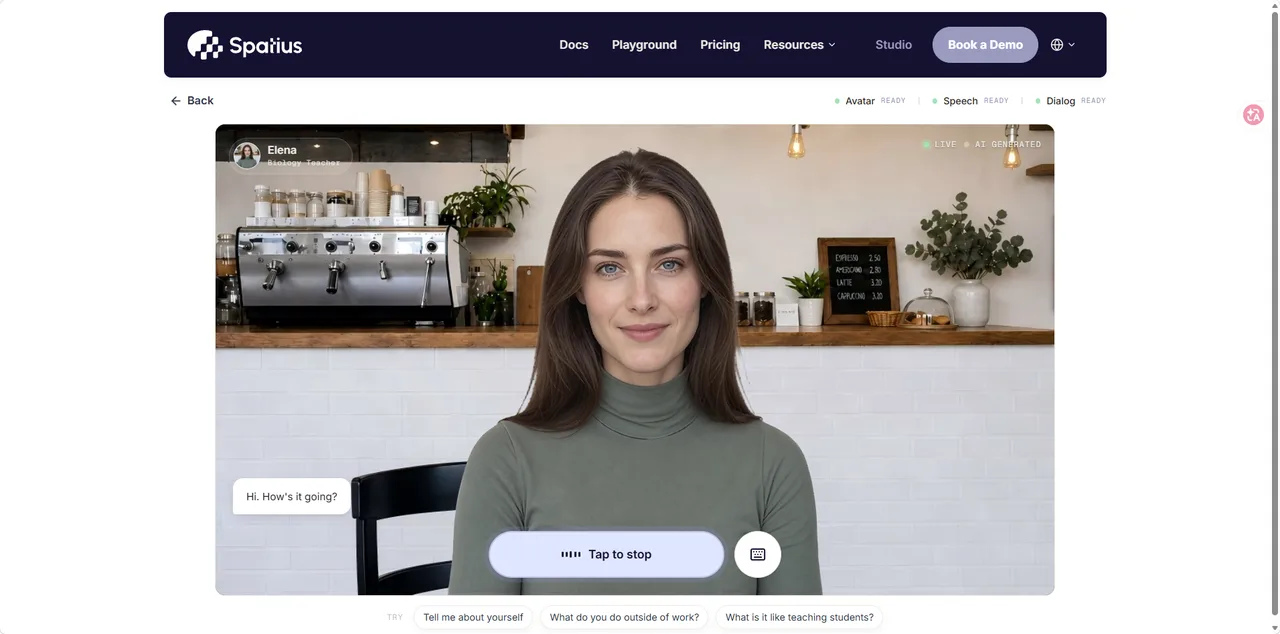
First, cost drops by roughly 98% compared to cloud-streamed alternatives. Spatius’s Scale plan runs at $0.007 per minute ($0.42/hour), with annual billing bringing the rate down further to $0.0056/min. The same $5,000 monthly budget that yields about 13,400 minutes on Tavus Starter produces roughly 711,000 minutes on Spatius Scale.
Second, bandwidth requirements fall to levels that work on real networks. At 10–20 KB/s, Spatius avatars function reliably on 4G, spotty WiFi, and even connections that would stall a cloud-streamed session entirely. This matters for mobile-first deployments, kiosks in locations with weak infrastructure, and in-vehicle systems where network quality varies.
Third, device coverage is unusually broad. The SDK supports Web, iOS, and Android natively, and Spatius claims ~99% compatibility across mainstream devices including entry-level chipsets, with 1080p rendering at 25fps without a dedicated GPU.
The trade-off is that Spatius is a rendering SDK, not an all-in-one conversational agent. You bring your own ASR, LLM, and TTS stack — the platform handles real-time avatar rendering and lip-synced animation from an audio stream. For teams that already have an AI agent pipeline, this decoupling is an advantage. For teams looking for a turnkey conversational avatar, it means additional integration work.
If your deployment priorities are cost efficiency at scale, mobile and embedded device support, or operation on constrained networks, Spatius is worth a close look. For a deeper head-to-head, see the Spatius vs Tavus comparison.
D-ID — Best for Quick Web Embeds
D-ID offers the lowest entry price in the category at $5.99/month for its Lite plan, making it the most accessible option for experimentation and lightweight web-embedded agents. It supports both pre-recorded avatar video generation and real-time streaming agents through its Creative Reality Studio and API.
D-ID’s cloud-rendered architecture means bandwidth requirements sit in the 1–2 MB/s range, similar to other cloud platforms. The platform is strongest for web-based use cases where users have stable internet connections and the primary need is embedding a talking-head avatar into a web page or application quickly.
For teams that want to prototype an AI avatar interaction in hours rather than weeks, D-ID’s lower commitment pricing and simpler setup make it a practical starting point.
HeyGen LiveAvatar — Best Visual Polish for Marketing
HeyGen’s LiveAvatar mode adds real-time conversational capability to an already mature avatar video platform. HeyGen is widely considered the industry leader in lip-sync accuracy and facial motion realism, with pricing starting at $24/month for the Creator plan (annual).
HeyGen excels in marketing, sales outreach, and product demo scenarios where visual polish is the primary requirement. Its avatar library of 700+ options and support for 175+ languages make it a strong choice for teams producing branded video content at scale.
The cloud-streaming architecture means HeyGen is best deployed on reliable networks. It does not offer native iOS or Android SDKs — the LiveAvatar experience runs through web browsers.
Anam.ai — Lightweight Developer-Friendly Personas
Anam focuses on providing a clean developer experience for building interactive AI personas. Its cloud-streaming architecture keeps integration straightforward, and the platform is designed for teams that want to deploy conversational avatars without extensive infrastructure work.
Anam is best suited for web-based conversational use cases where the development team values API simplicity and fast time-to-deployment over deep customization or extreme cost optimization.
Life Inside — Best for Enterprise Conversational Analytics
Life Inside targets the enterprise segment with a focus on conversational intelligence and analytics alongside real-time avatar capabilities. It claims sub-500ms response times and offers features like conversation analytics, session scoring, and enterprise-grade reporting.
For organizations where understanding and measuring avatar-driven conversations is as important as the avatar itself, Life Inside’s analytics layer provides differentiation. It is a custom-priced enterprise product, so cost comparison is harder without a published rate card.
Synthesia — Best for Async Enterprise Video
Synthesia is not a real-time conversational avatar platform, which is why it appears last in this comparison. However, it deserves mention because many Tavus alternative searches include teams that actually need generated video rather than live interaction.
Synthesia excels in enterprise training, compliance content, and corporate communications where videos are pre-recorded rather than interactive. Its Starter plan at $18/month (annual) with 120 minutes of video per year is the most affordable entry point for teams that need high-quality, scripted avatar video with SCORM-compliant LMS integration.
If your use case is async video rather than live conversation, Synthesia is likely a better fit than any real-time platform.
Which Tavus Alternative Should You Choose?
The right alternative depends on what is driving you away from Tavus in the first place.
If cost per minute is the primary constraint and you are building at scale: Spatius offers roughly 98% lower per-minute cost, with the trade-off of bringing your own AI agent stack. The Spatius pricing page breaks down the tiers from Free to Enterprise.
If you need native mobile SDKs or embedded hardware support: Spatius is effectively the only platform on this list with Web, iOS, and Android SDKs available today and support for embedded deployments.
If you want the lowest entry price for experimentation: D-ID at $5.99/month lets you start building with minimal financial commitment, though scaling costs will be higher per minute.
If visual polish and lip-sync quality are non-negotiable: HeyGen LiveAvatar remains the industry leader for production quality, particularly for marketing-facing avatar content.
If you are actually looking for async training video: Synthesia is a better fit than any real-time conversational platform.
Key Takeaway: The most important architectural decision in 2026 is whether to render on-device or stream from the cloud. This single choice drives cost, bandwidth requirements, device compatibility, and deployment flexibility. Evaluate platforms in this order — architecture first, features second.
FAQ
What is the cheapest Tavus alternative?+
Spatius offers the lowest per-minute cost at $0.007/min on the Scale plan ($0.0056/min with annual billing), roughly 98% less than Tavus's overage rate. D-ID has the lowest monthly entry price at $5.99.
Is there a free Tavus alternative?+
Spatius offers a free tier with approximately 500–1,000 credits (roughly 50 minutes) per month. Tavus itself also has a free tier with 25 conversational video minutes.
What is the difference between on-device and cloud-streaming avatars?+
On-device rendering (Spatius) sends lightweight motion data to the client SDK, which renders the avatar locally. This uses 10–20 KB/s bandwidth and works on weak networks. Cloud streaming (Tavus, D-ID, HeyGen) renders video on remote GPUs and streams 1–2 MB/s per session, requiring stable, high-bandwidth connections.
Which Tavus alternative is best for mobile apps?+
Spatius provides native iOS and Android SDKs and is designed for mobile and embedded deployments. Most cloud-streaming alternatives are web/browser-first and lack native mobile SDKs.
Which platform has the most realistic avatars?+
For real-time conversational avatars, HeyGen and Tavus lead in visual realism. For on-device rendering, Spatius delivers 1080p at 25fps using 3D Gaussian Splatting.
This comparison is based on publicly available pricing and product information as of July 2026. Architecture and pricing details may change. For the most current information, check each platform’s official pricing page or use the Spatius Avatar Cost Calculator to model your specific deployment scenario.