
Conversational AI for healthcare works best when it helps patients, visitors, or staff complete one narrow task: finding a department, preparing for a visit, understanding approved information, or reaching the right person. A real-time AI avatar adds a visible, speaking interface to that system. It does not replace the underlying agent, workflow controls, or clinical judgment.
That distinction matters. “Conversational AI” includes text chatbots, voice assistants, and multimodal interfaces. A real-time avatar is the presentation layer that makes a conversation visible through a synchronized face, speech, and interaction controls. The value of that layer depends on the workflow—not merely on whether the avatar looks realistic.
Evidence and product information last verified September 9, 2026. This article is intended for product and implementation planning, not medical or legal advice.
Key takeaways
- The strongest first use cases are non-clinical: wayfinding, public information, pre-visit guidance, approved education, and administrative assistance.
- A healthcare application should continue to own identity, permissions, records, knowledge, tool calls, escalation, and clinical rules.
- Public examples need evidence labels. A test, a research prototype, and a vendor-reported deployment do not prove the same thing.
- Measure successful task completion, grounded answers, handoff, accessibility, recovery, and total cost—not conversation volume or visual novelty alone.
How Is Conversational AI Used in Healthcare?
The public healthcare avatar examples reviewed here concentrate on information access, navigation, education, and administrative assistance rather than diagnosis.
In 2024, The Ottawa Hospital tested an AI-powered Digital Teammate at three campuses for two weeks. It answered questions about the hospital’s new campus in English and French. The hospital’s Digital Teammate FAQ says the system used video and audio processing, a large language model, and real-time animation—but could access only approved public information and not medical records.
The World Health Organization’s S.A.R.A.H. offered text or video conversations about public-health topics in eight languages. WHO now describes S.A.R.A.H. as a research prototype that is not in active public deployment. Its 2024 launch announcement also framed the project as an experiment that required continued research. It is evidence of an exploratory health-information interface, not proof of a production clinical assistant.
A separate example comes from Mackay Memorial Hospital. NVIDIA reported that digital humans on interactive touchscreens supported hospital navigation, health education, and registration. Ubitus describes the project as part of a broader collaboration involving avatars and medical robots. Because most public evidence comes from participating vendors, outcome and scale claims should be treated as vendor-reported rather than independently verified.
| Example | Public status | Scope | What it does not establish |
|---|---|---|---|
| Ottawa Hospital Digital Teammate | Time-limited test | Campus information in two languages | Production deployment or clinical advice |
| WHO S.A.R.A.H. | Research prototype; not actively deployed | Public-health education in eight languages | Diagnosis, treatment, or measured patient outcomes |
| Mackay–Ubitus digital human | Vendor-reported implementation | Navigation, education, and registration assistance | Independently verified clinical or financial results |
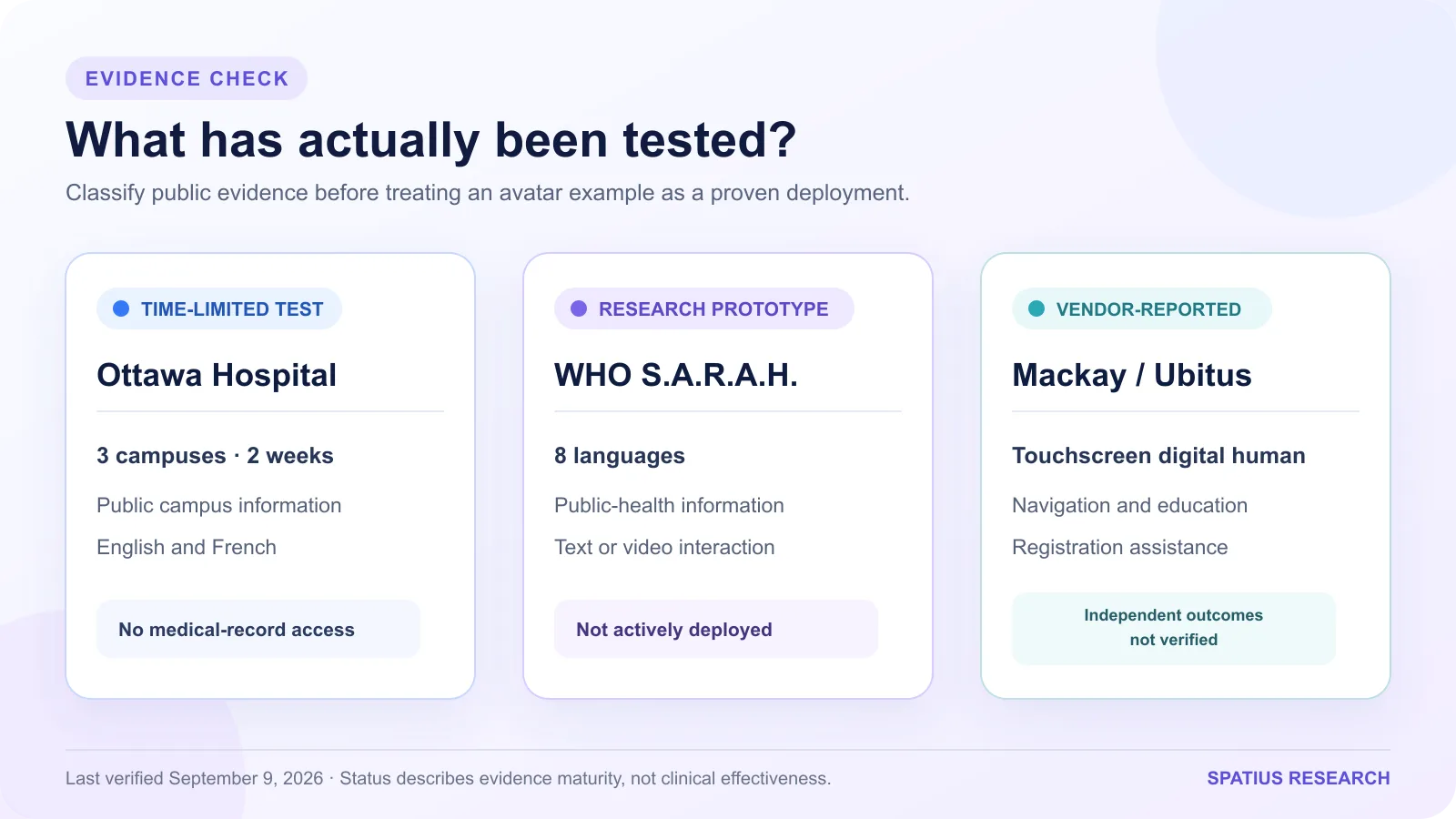
Across these examples, the clearest conversational AI use cases assist people around care delivery, while the healthcare organization retains responsibility for medical decisions, permissions, records, and escalation.
Which Healthcare Workflows Benefit Most From Real-Time AI Avatars?
An avatar earns its place when a visible speaker makes instructions easier to follow, builds confidence in an unfamiliar environment, or improves access across languages and literacy levels. It adds less value when a short text answer would solve the task faster. The CDC’s health-literacy guidance reinforces the need to make health information understandable and usable; an avatar is one delivery option, not a substitute for clear content. The US Department of Justice’s web-accessibility guidance explains how ADA requirements apply to web content from state and local governments and businesses open to the public, including hospitals and medical offices.
| Workflow | Why a visual avatar may help | Pilot fit | Required boundary |
|---|---|---|---|
| Hospital wayfinding | Gives spoken, visible directions on a kiosk or device | High | Use approved location data and offer a staff route |
| Pre-visit FAQs | Explains arrival, documents, parking, and preparation steps | High | Do not turn general instructions into individualized medical advice |
| Patient education | Presents reviewed material through speech and visual cues | Medium–high | Identify the source and prevent unsupported improvisation |
| Registration assistance | Guides users through an existing workflow | Medium | Keep identity, authorization, and record updates in the application |
| Clinical decision support | May explain an approved professional workflow | Low for an initial pilot | Requires separate clinical, safety, and regulatory assessment |
| Emergency or crisis support | A visual interface may be engaging | Unsuitable as the only route | Provide immediate access to qualified human or emergency services |
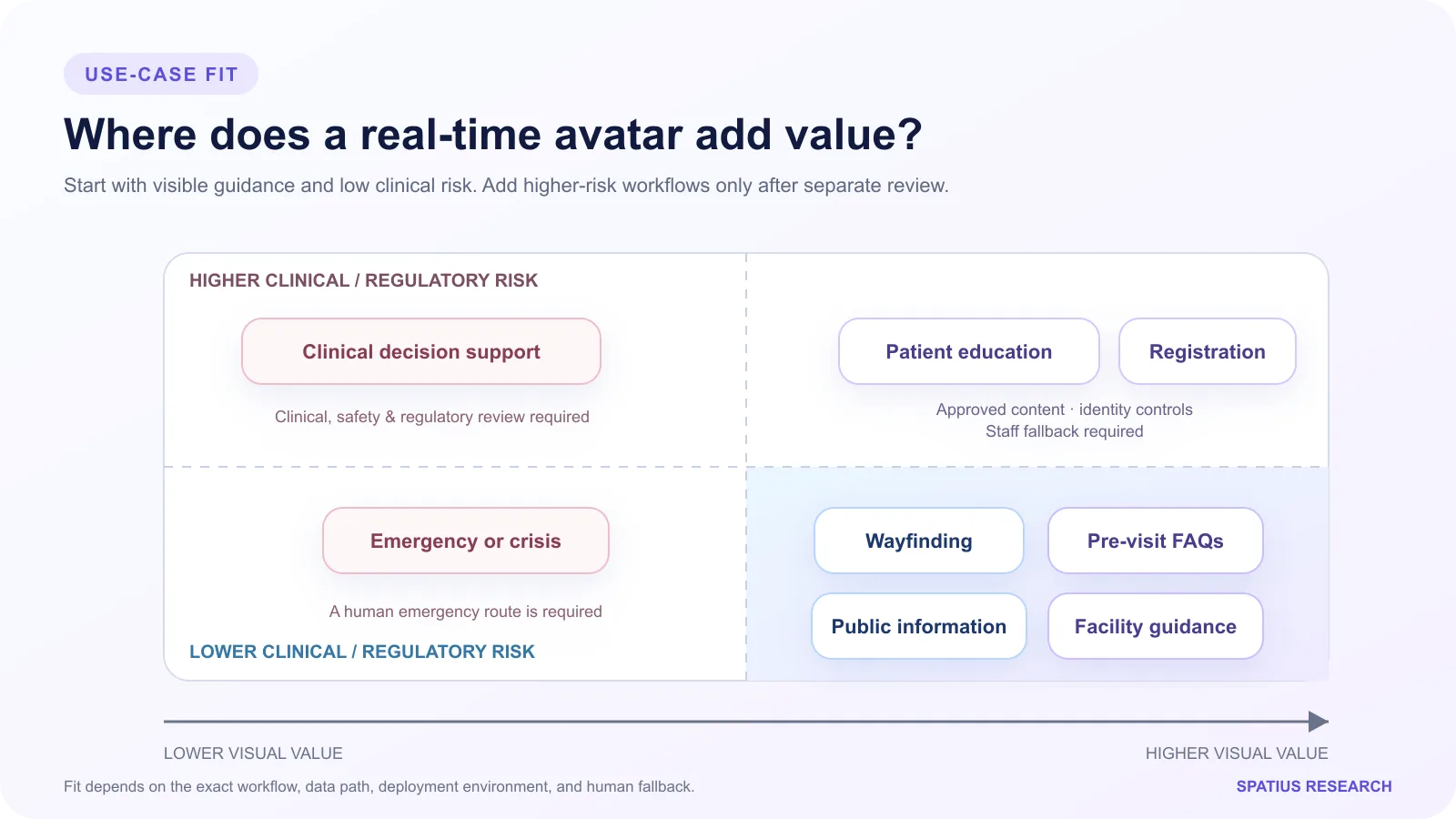
For physical environments, the design questions extend beyond the conversation. Teams should consider screen placement, privacy around shared displays, captions, session reset, and what happens when the network fails. The Spatius guides to security and privacy for real-time avatars and audio-only fallback design cover those operational concerns in more detail.
The safest starting point is usually one non-clinical workflow with an approved knowledge set and an obvious fallback. The Ottawa Hospital test illustrates that principle: it limited the avatar to public information about one campus project and refused unrelated questions.
How Should Healthcare Teams Implement a Real-Time AI Avatar?
Start with the system boundary, not the avatar’s appearance. The application should continue to own identity, permissions, retrieval, workflow logic, tool calls, clinical rules, analytics, and human handoff. The avatar layer should present a response only after those controls have run.
That boundary is reflected in the current Spatius developer documentation. Spatius Motion Server receives avatar speech audio and returns motion data; AvatarKit renders the avatar locally in the client. The application retains the agent, ASR, LLM, TTS, knowledge, and business workflows. The detailed guide to data boundaries for a real-time avatar explains why raw records, retrieval documents, permissions, and tool credentials should not be passed to a presentation layer by default.
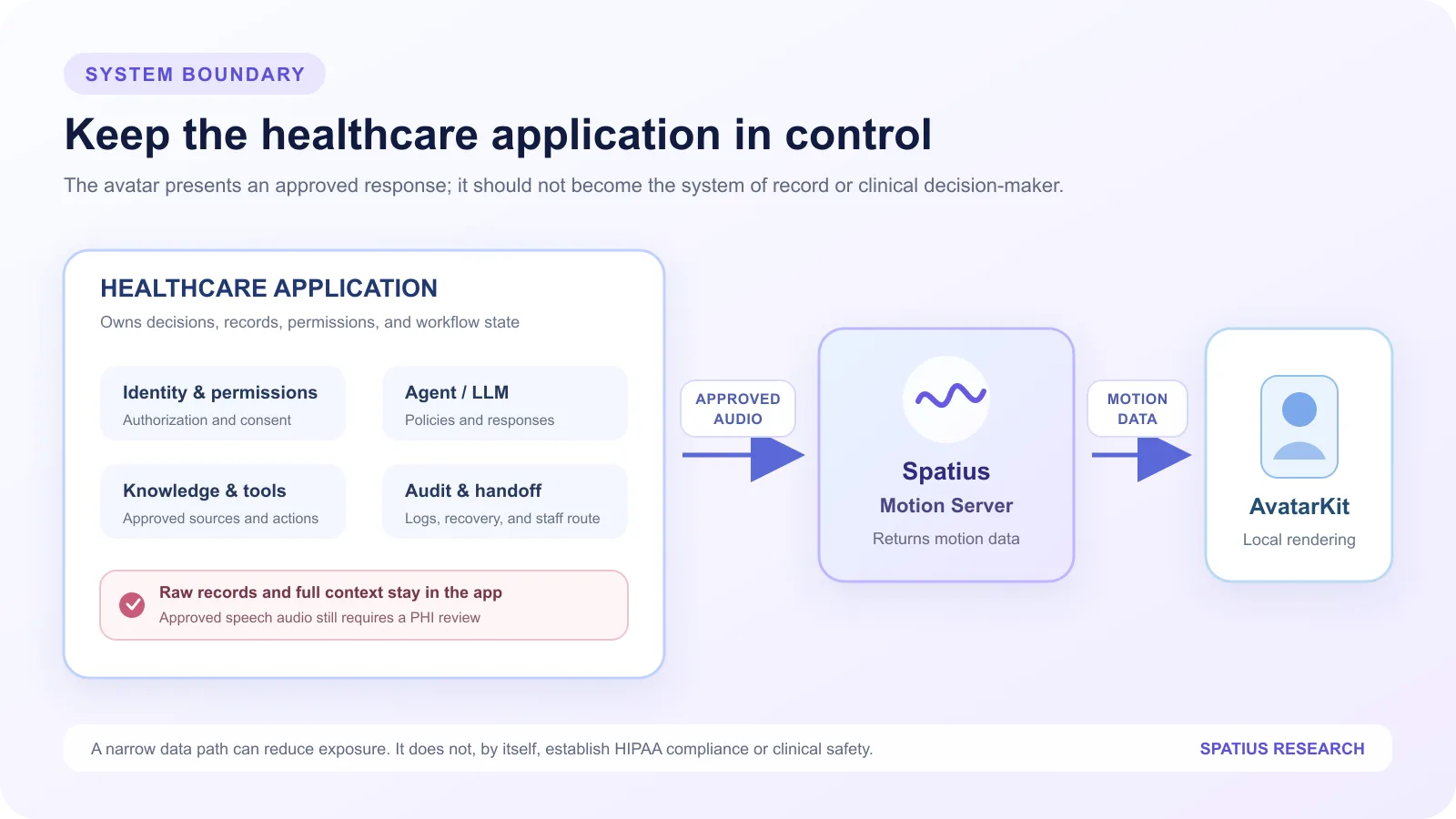
This architecture can narrow the data path, but it does not automatically make a healthcare deployment compliant. The HIPAA Privacy Rule and HIPAA Security Rule establish different obligations around protected health information and electronic protected health information. Regulated entities must determine which rules apply to the proposed workflow. HHS also explains that a covered entity engaging a business associate may need a written business-associate contract, and provides separate business-associate guidance.
A practical implementation review should cover five controls:
-
Limit the knowledge scope. Begin with approved public or operational information. If protected information becomes necessary, document exactly why.
-
Minimize the data path. HHS’s minimum-necessary guidance explains that HIPAA-covered entities generally must take reasonable steps to limit many uses and disclosures of protected information to what the purpose requires, subject to stated exceptions. If a team proposes de-identified information, it should evaluate the method against HHS’s de-identification guidance rather than assuming that removing a name is sufficient.
-
Disclose the interface clearly. Tell users they are interacting with AI, explain its scope, and provide an alternative path. The Spatius guide to consent, disclosure, and brand safety offers a product-level framework. WHO’s ethics and governance guidance for AI in health provides a broader reference for protecting autonomy, transparency, responsibility, and inclusion.
-
Design for accessibility and recovery. Include captions, keyboard navigation, visible status, interruption, replay, text alternatives, and human assistance. WCAG 2.2 provides a relevant accessibility baseline, while W3C’s caption guidance explains why synchronized text alternatives matter for prerecorded and live media.
-
Review higher-risk functions separately. If the experience influences diagnosis, treatment, or clinical decisions, teams should assess applicable FDA policy, including the agency’s clinical decision-support guidance.
If the application exchanges healthcare records, HL7 FHIR may support interoperability—but an avatar should not receive a complete FHIR resource merely because the agent can access one. Extract only the approved response or minimum data required for the interaction.
How Should Teams Evaluate a Healthcare Avatar Pilot?
Do not measure success by conversation count or visual novelty alone. A pilot should test whether the avatar improves one workflow without increasing safety, privacy, accessibility, or support risk.
The NIST AI Risk Management Framework recommends incorporating trustworthiness into the design, use, and evaluation of AI systems. NIST’s separate Privacy Framework can help teams identify and manage privacy risk across the data lifecycle. WHO similarly calls for safe and ethical AI for health, with attention to safety, autonomy, transparency, accountability, equity, and sustainability. For a health-related avatar, that means measuring both user progress and failure behavior.
| Metric | What to measure | Expansion signal |
|---|---|---|
| Task completion | Users who reach the intended next step | Better than the existing interface for the same cohort |
| Grounded-answer rate | Responses supported by the approved source set | Stable performance across realistic questions |
| Handoff success | Users who reach staff when the avatar cannot help | No dead ends or repeated failed answers |
| Response and recovery time | Time to answer, interrupt, retry, or fall back | Interaction remains usable under normal load |
| Accessibility and opt-out | Caption use, text alternative, exits, assistance requests | Users can choose a workable alternative |
| Cost per completed task | Agent, speech, avatar, device, network, and human-support cost | Sustainable cost for the outcome produced |
Teams should also review incorrect-answer severity, user complaints, disclosure comprehension, and whether the avatar ever continues when it should stop. For consumer health applications outside HIPAA-covered relationships, the FTC’s health-privacy guidance may still be relevant. The FTC also publishes specific guidance on complying with the Health Breach Notification Rule.
A good pilot ends with an evidence-based decision: expand, revise, restrict, or stop. The Spatius framework for piloting an AI avatar recommends starting with one defined product moment and testing the complete path—including interruption and fallback—not just avatar playback.
For healthcare teams that already operate their own conversational AI, Spatius can add a real-time visual layer while leaving the agent and workflow controls in the existing application. Teams should still validate the current security, contractual, and deployment fit for their specific environment.
Frequently Asked Questions
What is conversational AI in healthcare?
Conversational AI in healthcare lets patients, visitors, or staff interact with a digital system through natural-language text or speech. It may answer approved questions, guide administrative tasks, retrieve authorized information, or connect the user to a person.
What are examples of conversational AI in healthcare?
Examples include hospital wayfinding assistants, pre-visit FAQ tools, scheduling or registration guides, approved patient-education interfaces, and staff-support systems. Some use text or voice only; a real-time avatar adds a synchronized visual presenter.
What is one advantage of conversational AI in healthcare?
One advantage is that people can ask questions in natural language instead of learning a complex interface. A visual avatar may add value when spoken explanation, visible guidance, or multilingual presentation helps the user complete the task.
Are AI avatars the same as healthcare chatbots?
No. A chatbot is generally a text interface, while a voice assistant adds spoken interaction. A real-time AI avatar adds a synchronized visual presenter. The underlying agent, data, and workflow controls may remain the same across all three interfaces.
Is conversational AI for healthcare automatically HIPAA compliant?
No. Compliance depends on the organization, use case, data handled, technical safeguards, contracts, configuration, and operating procedures. An avatar vendor’s architecture or marketing statement is not enough to establish compliance for a specific deployment.
What are the safest first workflows for a healthcare AI avatar?
Wayfinding, public facility information, pre-visit instructions, approved patient education, and administrative guidance are stronger first candidates than diagnosis or treatment recommendations. They offer measurable user tasks and clearer human fallback paths.
Already have the conversational AI, knowledge, and workflow controls? Evaluate a real-time visual layer around one approved healthcare information task request a Spatius demo, or ,或review the avatar data boundary.。