

Key Takeaways
-
From Rigid Menus to Natural Conversation: Traditional touchscreen terminals force users through frustrating button trees. AI avatar kiosks replace complex navigation with natural, face-to-face dialogue.
-
Empathetic Brand Engagement: Lifelike digital humans combine real-time voice, fluid facial expressions, and contextual intelligence to provide welcoming 24/7 customer guidance.
-
Scalable Edge Deployment: Modern digital human platforms cut operational overhead by rendering avatars on local hardware with lightweight 100 kbps audio streams, slashing streaming costs down to $0.42 per hour.
For over two decades, touchscreens served as the gold standard for automated customer service. From quick-service restaurant order screens and airport check-in hubs to retail directory boards, physical touchpoints promised faster service and reduced labor costs. Yet, for millions of daily shoppers, travelers, and hotel guests, static touchscreen terminals often feel transactional, rigid, and cold.
As consumer expectations shift toward personalized, immediate assistance, static button menus are reaching their operational limits. Enterprise innovators are moving beyond touchscreens by adopting AI avatar kiosks—combining conversational artificial intelligence with lifelike digital personas. Powered by modern real-time AI avatar infrastructure, these intelligent terminals bridge the gap between digital self-service and human-like customer care.
The Hidden Limits of Traditional Touchscreens
While touchscreen kiosks solved early queue management problems, they introduced distinct customer friction points that limit their long-term effectiveness in modern physical spaces.
Touchscreen Fatigue and Menu Abandonment
Traditional terminals rely on nested decision trees. A customer looking for a specific product, dietary option, or store directory section must frequently tap through four or five sub-menus. When users hit a dead end or encounter unfamiliar terminology, engagement drops. Many customers abandon the screen entirely and seek out human staff—defeating the core purpose of self-service.
Cold, Impersonal Transactions
A static screen cannot greet a guest, notice a confused facial expression, or convey genuine hospitality. In environments where brand perception hinges on warmth—such as boutique retail, luxury hotels, or private healthcare clinics—touchscreen boxes feel out of place. They convert what could be a memorable brand interaction into a sterile transaction.
Inability to Handle Edge Cases
When a customer’s query falls outside predefined button options, traditional kiosks fail instantly. A visitor asking, “Where can I find organic gluten-free snacks near Gate B?” or “Can I request a quiet room facing the inner courtyard?” cannot be served by static button grids. By contrast, deploying interactive digital humans enables physical terminals to interpret context, process unstructured spoken questions, and deliver precise answers on the first attempt.
The Shift to AI Avatar Kiosks: From Navigation to Conversation
The transition from touchscreens to AI avatar kiosks represents a fundamental paradigm shift: moving from manual interface navigation to fluid verbal conversation.
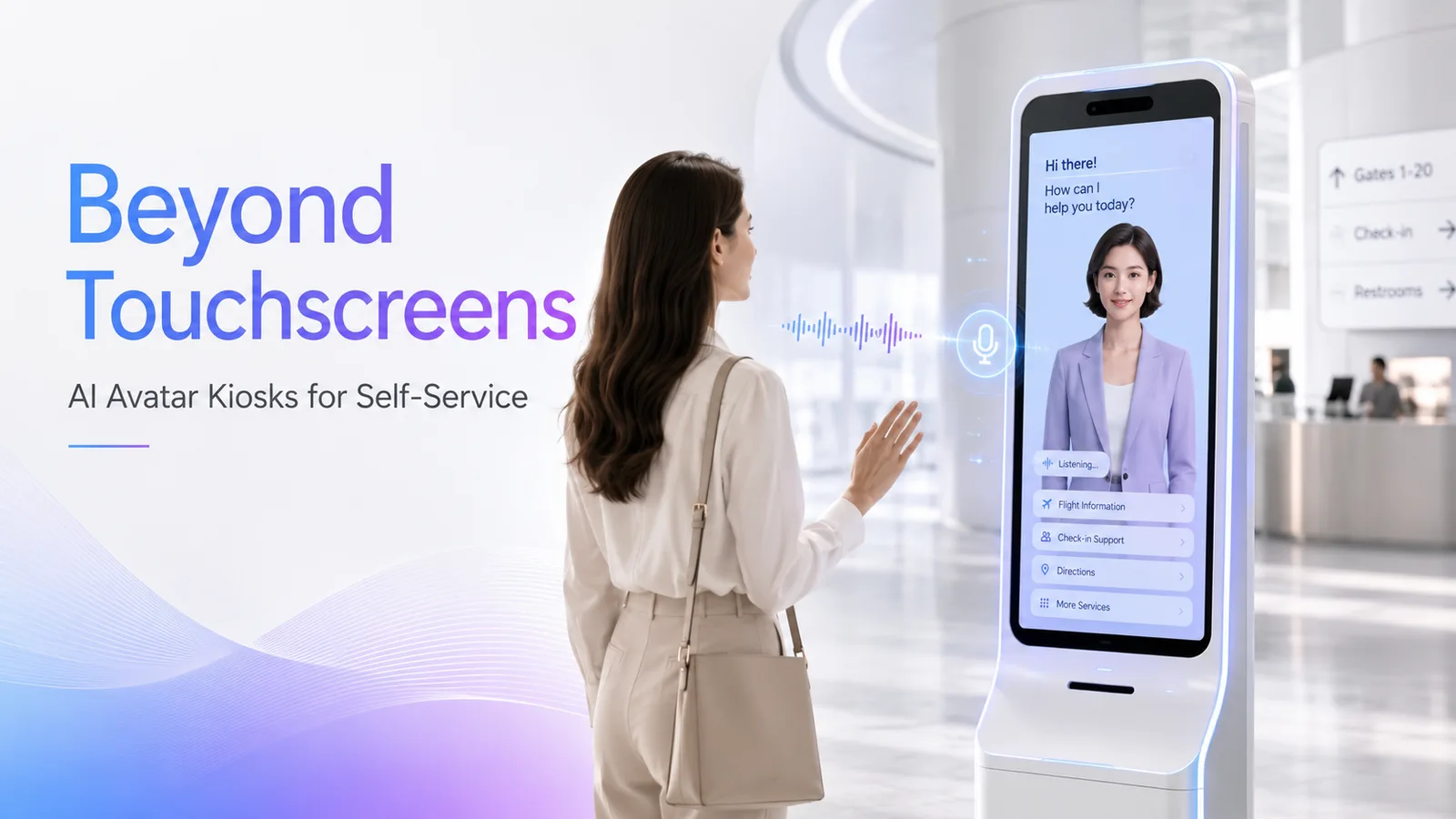
Instead of staring at a wall of buttons, a customer approaches an interactive terminal and sees a lifelike digital persona standing ready to assist. The avatar makes natural eye contact, offers a warm greeting, and listens as the user speaks naturally.
Traditional Touchscreen Flow:
[Approach Screen] -> [Tap Start] -> [Category Menu] -> [Sub-Menu] -> [Option Search] -> [Manual Entry]

AI Avatar Kiosk Flow:
[Approach Screen] -> [Natural Spoken Question] -> [Instant Personal Answer & Guidance]
This conversational model dramatically lowers friction for non-tech-savvy users, elderly visitors, and international travelers. Thanks to advancements in low-latency voice and animation engines, digital assistants process spoken speech, reason through intent, and render lip-synced facial movements in sub-second timeframes.
The Four Pillars of Human-Like Self-Service
To build customer trust and drive high self-service containment rates, an AI avatar kiosk must embody four core capabilities.
1. Conversational Voice Interaction
Users interact with avatar kiosks using natural spoken language rather than precise button taps. Advanced noise-canceling microphone arrays isolate caller speech in noisy environments, allowing the avatar to understand natural phrasing, accents, and colloquial questions effortlessly.
2. Lifelike Facial Dynamics and Non-Verbal Cues
Human communication relies heavily on non-verbal signals. High-performing digital avatars feature subtle head tilts, smiling expressions, natural eye blinks, and precise lip synchronization. These micro-expressions transform a automated voice bot into an inviting, approachable brand ambassador. According to recent self-service kiosk engagement research (wavetec.com/blog/self-service/ai-avatars-in-self-service-kiosks/), interactive digital human faces increase visitor engagement dwell time by up to 60% compared to silent display monitors.
3. Contextual Problem Solving
Unlike basic voice assistants that recite static scripts, conversational avatar kiosks connect directly to enterprise databases, inventory management platforms, and hotel PMS systems. They provide real-time flight changes, check current product stock in aisle 4, or verify hotel reservation details instantly.
4. Zero-Latency Responsiveness
In physical customer service, a two-second delay feels like an eternity. Lifelike avatars require real-time audio-to-animation pipelines that deliver immediate visual speech, ensuring conversations flow at a natural human cadence without awkward pauses or jitter.
Real-World Impact Across Key Industries
Organizations across multiple sectors are already replacing traditional touchpoints with conversational AI avatar kiosks to streamline operations and elevate customer experience.
Retail and Shopping Malls: Interactive In-Store Guides
In retail environments, avatar kiosks act as knowledgeable sales advisors. They greet shoppers, suggest complementary items, answer detailed product queries, and display interactive store maps. Recent retail customer experience studies highlight that interactive video assistants boost cross-selling revenue while alleviating floor staff during peak shopping hours.
Hospitality and Hotels: 24/7 Virtual Concierge
Hotel lobbies experience heavy rush hours during afternoon check-ins and late-night arrivals. AI avatar concierges handle room check-in, issue digital keycards, answer questions about breakfast hours, and provide tailored local restaurant recommendations in dozens of languages—ensuring 24/7 service availability without expanding night-shift staffing. Industry benchmarking from hospitality self-service innovation insights demonstrates that digital human receptionists maintain over 90% guest satisfaction while cutting lobby wait times dramatically.
Healthcare Clinics and Airports: Multilingual Triage and Guidance
In high-stress settings like hospital lobbies or busy airport terminals, clear communication is essential. Avatar kiosks assist patients with registration, guide visitors through complex medical wings, or deliver real-time gate change alerts to travelers in their native language—reducing anxiety and streamlining pedestrian traffic flow.
Overcoming Deployment Barriers: Cloud vs. Edge Rendering
For years, deploying realistic 3D digital humans on physical kiosks was held back by extreme infrastructure costs. Early implementations relied on heavy cloud video streaming, where every frame was pre-rendered in remote data centers and streamed to the kiosk screen as high-bitrate video.
This traditional cloud streaming model suffered from major drawbacks:
-
Exorbitant Operating Costs: Cloud video rendering often incurred costs ranging from $2.00 to $5.00 per active hour per kiosk screen.
-
Bandwidth Sensitivity & Jitter: Streaming 1080p video required high-bandwidth connections (10–20 Mbps). Any local Wi-Fi dip caused choppy animation and ruined the conversation.
-
Hardware Limitations: Running heavy local graphics models required expensive dedicated GPUs inside every physical kiosk cabinet.
Pro Tip: Modern digital human architectures overcome these hurdles by utilizing cloud-edge hybrid streaming. Instead of streaming heavy video frames, the system transmits a lightweight audio stream (around 100 kbps) and renders the 3D avatar directly on the kiosk’s entry-level processor.
By switching to edge-rendered AI avatar kiosks, enterprise operators reduce bandwidth requirements by 95% and lower avatar running costs to an affordable $0.42 per hour—making large-scale deployment across hundreds of retail or hotel locations economically viable.
Strategic Checklist for Upgrading Your Kiosks
When transitioning from legacy touchscreens to conversational AI avatar terminals, enterprise teams should evaluate four key operational criteria:
| Evaluation Criteria | Traditional Touchscreen Kiosk | AI Avatar Kiosk |
|---|---|---|
| Primary Interaction | Physical taps & nested menus | Natural voice & conversational speech |
| Customer Dwell & Delight | Functional, transactional | High engagement, personal connection |
| Language Adaptability | Limited hardcoded translations | Instant multi-language conversational fluency |
| Cost & Scalability | Low software cost, high manual staff backup | Low operating cost ($0.42/hr) on standard hardware |
| Exception Handling | Fails on unlisted queries | Context-aware LLM reasoning handles edge cases |
1. Hardware Compatibility
Ensure your prospective avatar solution runs on existing kiosk hardware, commercial displays, or tablets without forcing expensive hardware replacements or GPU retrofits.
2. Integration Depth
Verify that the digital human framework connects seamlessly with your existing Customer Relationship Management (CRM), Point of Sale (POS), or Property Management System (PMS) via robust REST APIs or WebSockets.
3. Custom Brand Representation
Select a platform that allows you to deploy customized 3D avatar models that reflect your brand’s visual identity, tone, and corporate uniform guidelines, rather than generic stock avatars.
Evaluating these factors with the Spatius digital human platform helps technical leads deploy responsive, high-converting self-service terminals in under ten minutes.
The Future of Self-Service Is Personal
Physical self-service is no longer just about offering a shortcut to tap buttons. It is about creating accessible, empathetic, and effortless interactions that make customers feel heard and valued.
By moving beyond static touchscreens and adopting AI avatar kiosks, forward-thinking enterprises are transforming transactional kiosks into warm, 24/7 brand ambassadors. Whether guiding a shopper through an unfamiliar retail store, welcoming a late-night hotel guest, or directing a patient in a medical center, digital humans are setting the new baseline for physical customer experience.
How do AI avatar kiosks differ from traditional touchscreen terminals?+
Traditional touchscreen kiosks rely on nested button menus and decision trees — users must tap through multiple sub-menus to find what they need, and the system fails when a query falls outside predefined options. AI avatar kiosks replace this with natural voice conversation. A customer simply speaks their question, and the lifelike digital human interprets context, processes unstructured language, and delivers a precise answer on the first attempt. This conversational model dramatically lowers friction for non-tech-savvy users, elderly visitors, and international travelers.
What bandwidth does an AI avatar kiosk require?+
Traditional cloud-streamed avatar solutions require 10–20 Mbps for 1080p video — any local Wi-Fi dip causes choppy animation and ruins the conversation. Modern edge-rendered AI avatar kiosks flip this model: the system transmits only a lightweight audio stream (~100 kbps) while rendering the 3D avatar directly on the kiosk's entry-level processor. This reduces bandwidth requirements by approximately 95% and allows deployments in environments where reliable high-speed internet is not guaranteed.
How much does it cost to operate an AI avatar kiosk?+
Traditional cloud-streamed digital human kiosks incur cloud GPU rendering costs ranging from $2.00 to $5.00 per active hour per screen. Edge-rendered AI avatar kiosks shift rendering to local hardware and transmit only lightweight audio streams (~100 kbps), bringing operating costs down to approximately $0.42 per hour. This ~90% reduction makes large-scale deployment across hundreds of retail, hotel, or healthcare locations economically viable.
Can AI avatar kiosks support multiple languages?+
Yes. Unlike traditional touchscreen kiosks that rely on limited hardcoded translations, modern AI avatar kiosks offer instant multi-language conversational fluency. The digital human can greet a guest in their preferred language, process spoken questions across dozens of languages, and respond naturally — making them particularly effective in international airports, tourist-heavy retail environments, and multicultural urban centers.
What hardware is required to deploy an AI avatar kiosk?+
Modern edge-rendered AI avatar solutions run on existing kiosk hardware, commercial displays, or standard tablets with entry-level processors — no expensive GPU retrofits or hardware replacements are required. The 3DGS avatar model (~5–10 MB) is downloaded to the device on first use, and the rendering pipeline runs locally at 25fps on entry-level SOCs or 30–60fps on mid-range hardware.
Which industries benefit most from AI avatar kiosks?+
Three sectors are seeing particularly strong results. In retail and shopping malls, avatar kiosks act as knowledgeable sales advisors — greeting shoppers, suggesting complementary items, and answering detailed product queries. In hospitality and hotels, AI avatar concierges handle room check-in, issue digital keycards, and provide local recommendations in dozens of languages — maintaining over 90% guest satisfaction while cutting lobby wait times. In healthcare clinics and airports, multilingual avatar kiosks assist with patient registration, guide visitors through complex medical wings, and deliver real-time gate change alerts — reducing anxiety in high-stress environments.
 Comparison
Spatius vs Tavus (2026): Real-Time AI Avatar Platform Comparison
Compare Spatius's on-device edge rendering with Tavus's cloud video streaming — architecture, pricing, and deployment tradeoffs for kiosk and self-service use cases.
Read next Architecture
On-Device AI Avatar vs Cloud Streaming: Architecture, Bandwidth, and Cost in 2026
A deep-dive into why on-device rendering cuts bandwidth by ~99% and how the two architectures compare on latency, cost, and device compatibility.
Read next Pricing
Compare Pricing for Leading AI Avatar Services (2026): Real Cost Per Minute
Normalized pricing comparison across rendering-only APIs, bundled conversational platforms, and generated-video tools — with real cost-per-minute figures.
Read nextReady to bring your physical self-service terminals to life? Explore a live Spatius interactive avatar demo and see how lightweight edge rendering powers human-like customer engagement at a fraction of traditional infrastructure costs. Try the free playground, or ,或View pricing, or ,或Talk to sales.。