Featured article
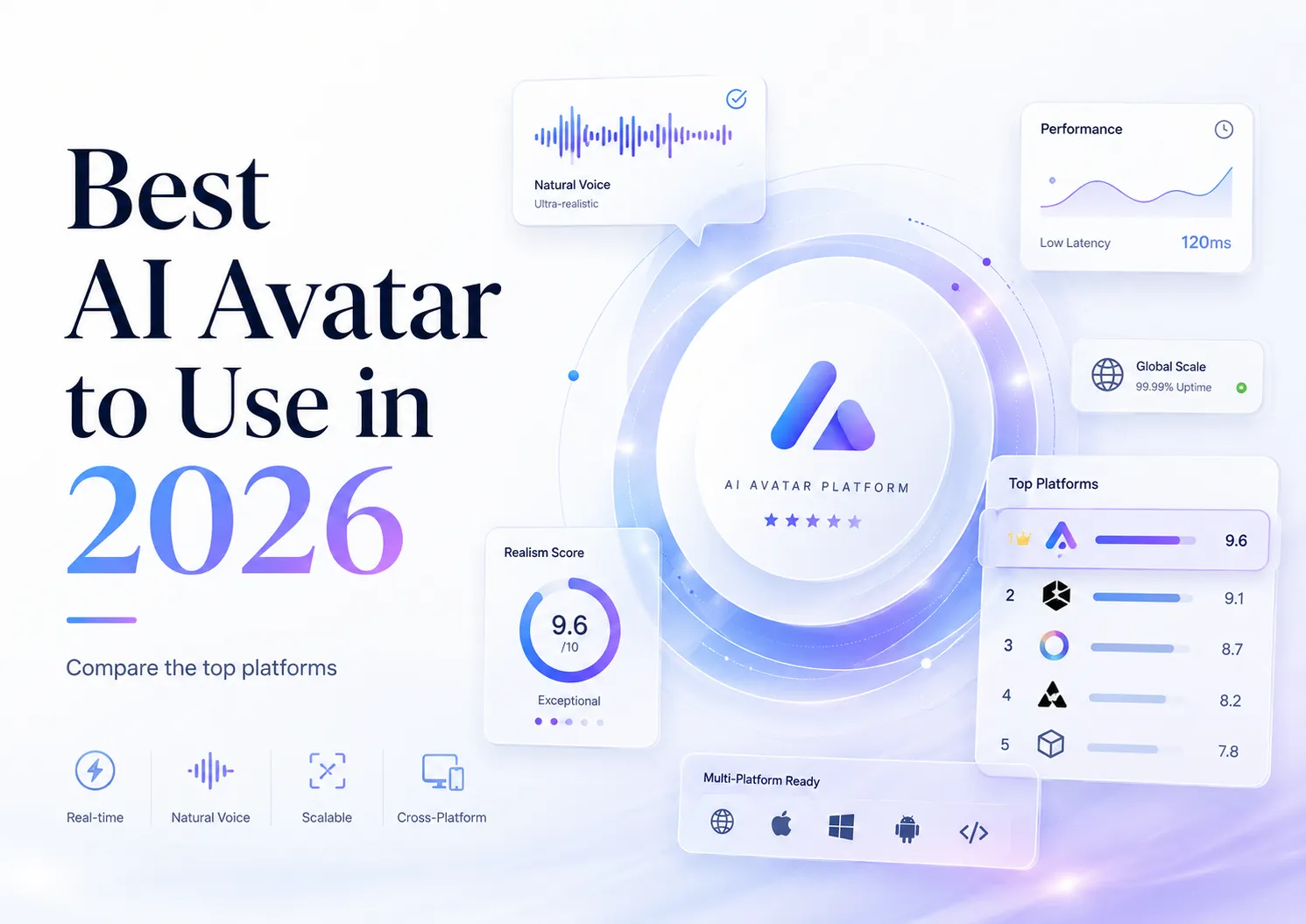
Best AI Avatar Platforms to Use in 2026
Compare Spatius, Anam, Tavus, D-ID, and HeyGen across real-time performance, customization, device support, pricing, and use cases in 2026.
Read article
Jul 30, 202610 min read 分钟阅读
Compare Spatius, Anam, Tavus, D-ID, and HeyGen across real-time performance, customization, device support, pricing, and use cases in 2026.
 Product
Build an AI avatar experience that is clear about what it is, what it can do, and how users can choose another path.
 Product
Measure whether an AI avatar helps users move through one meaningful product moment—not whether it simply receives attention.
 Product
Design the states around the avatar—not just the animation—so users know what is happening, what they can do next, and when a person takes over.
 Product
Use an AI avatar to explain and present a tool-driven workflow—not to become the workflow’s source of truth.
 Product
A useful AI avatar should never make a user wait through the wrong explanation. Design clear interruption rules around user intent, task risk, and the application workflow.
 Product
The first avatar interaction should help a user complete one real product task—not stage a generic welcome.
 Product
The best place for an AI avatar is usually inside a specific customer task, with a clear job to do and a clear way to leave—not as a permanent layer across the whole product.
 Engineering
Decide what belongs in your SaaS application, what the avatar layer actually needs, and how to review the boundary before launch.
 Product
A practical framework for piloting a real-time AI avatar in one SaaS workflow while retaining control of your agent, data, and product decisions.
 Engineering
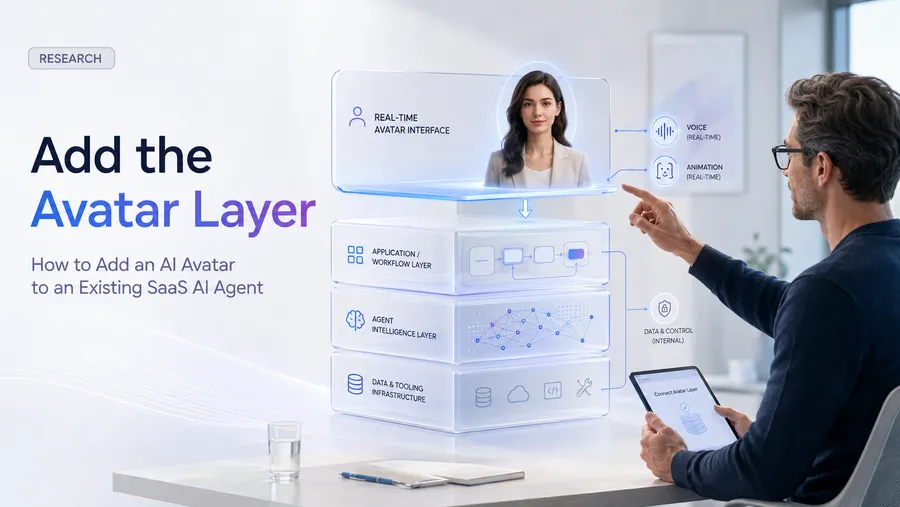
A practical guide to adding a real-time avatar layer to an existing SaaS AI agent while keeping your application in control of its intelligence, data, and workflows.
 Product
Learn the practical distinction between a real-time AI avatar layer and an AI video-generation workflow, and how to choose the right output for a SaaS product.
 Engineering
A practical framework for deciding whether to build or integrate the avatar motion and rendering layer in a SaaS product—without giving up ownership of your agent, data, or workflows.
 Research
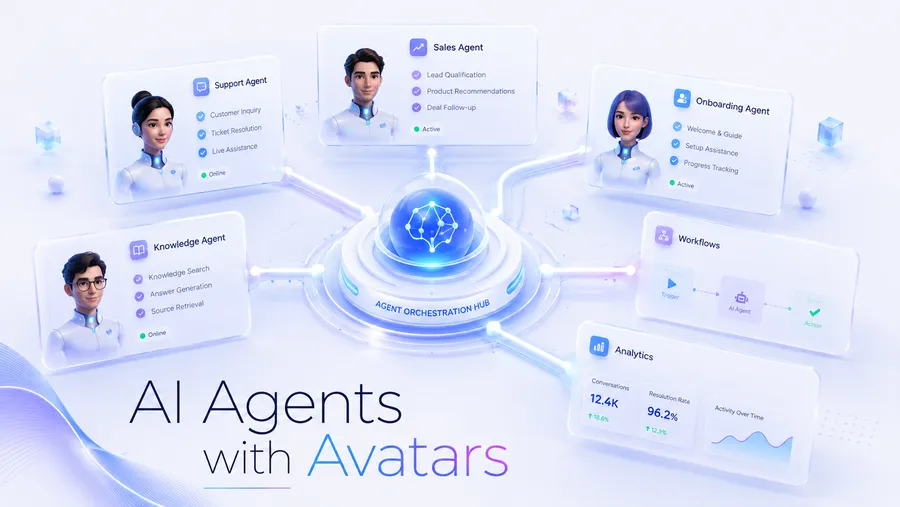
Discover how adding real-time 3D AI avatars builds trust and engagement while lightweight edge rendering cuts streaming costs to $0.42/hour in 2026.
 Research
How edge rendering architecture enables AI avatar tutors to scale to millions of students — slashing bandwidth by 98%, cutting costs to $0.42/hour, and meeting COPPA, FERPA, and UK AADC child privacy compliance requirements.
 Research
AI avatar kiosks replace frustrating button trees with natural voice conversation, cutting bandwidth by 95% and operating costs to $0.42/hour through edge rendering. Explore how retail, hospitality, and healthcare deploy lifelike digital humans at scale.
 Research
Businesses are moving beyond AI chatbots toward real-time AI avatars that deliver 25–40% higher engagement. Explore the three core pillars driving this shift and the infrastructure breakthroughs making scalable avatars possible at $0.42/hour.
 Research
Discover how real-time AI avatars transform corporate training from passive video watching to interactive, cost-effective employee learning — with 75% higher retention, 70–90% lower production costs, and $0.42/hour edge rendering.
 Research
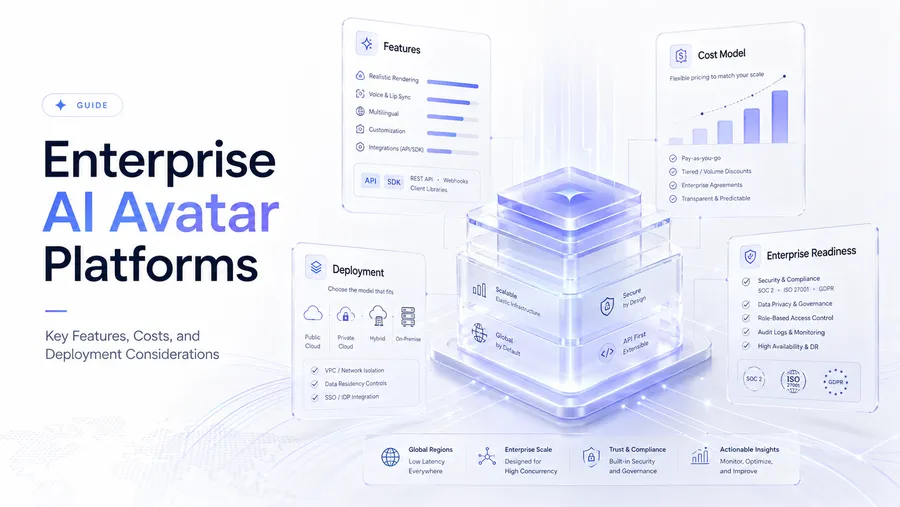
Enterprise AI avatar platforms have shifted from asynchronous video generation to real-time conversational agents. Learn how cloud-edge hybrid architecture cuts costs from $2.00–$5.00+/hour to $0.42/hour, and what features, deployment models, and pricing structures matter for production deployments.
 Research
Discover how adding real-time 3D AI avatars builds trust and engagement while lightweight edge rendering cuts streaming costs to $0.42/hour in 2026.
 Research
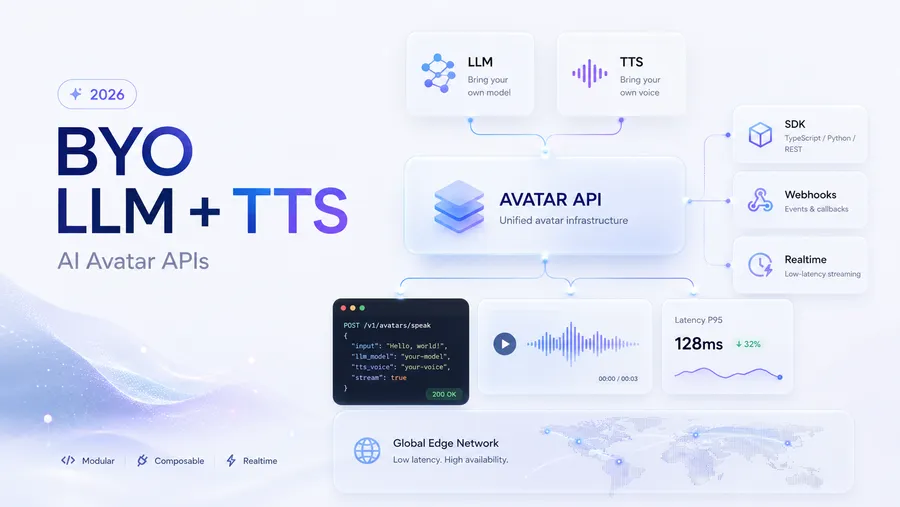
A technical evaluation of the top real-time AI avatar APIs supporting BYO LLM & TTS — comparing Spatius, Anam AI, D-ID, Tavus, and LemonSlice across audio passthrough capabilities, latency, bandwidth overhead, rendering architecture, and per-minute pricing.
 Research
A technical evaluation of the top AI avatar APIs for mobile apps in 2026 — comparing Tavus, Spatius, D-ID, HeyGen, Synthesia, and DeepBrain AI across latency, bandwidth efficiency, native SDK support, and per-minute cost structures.
Try another keyword or clear the selected category.