

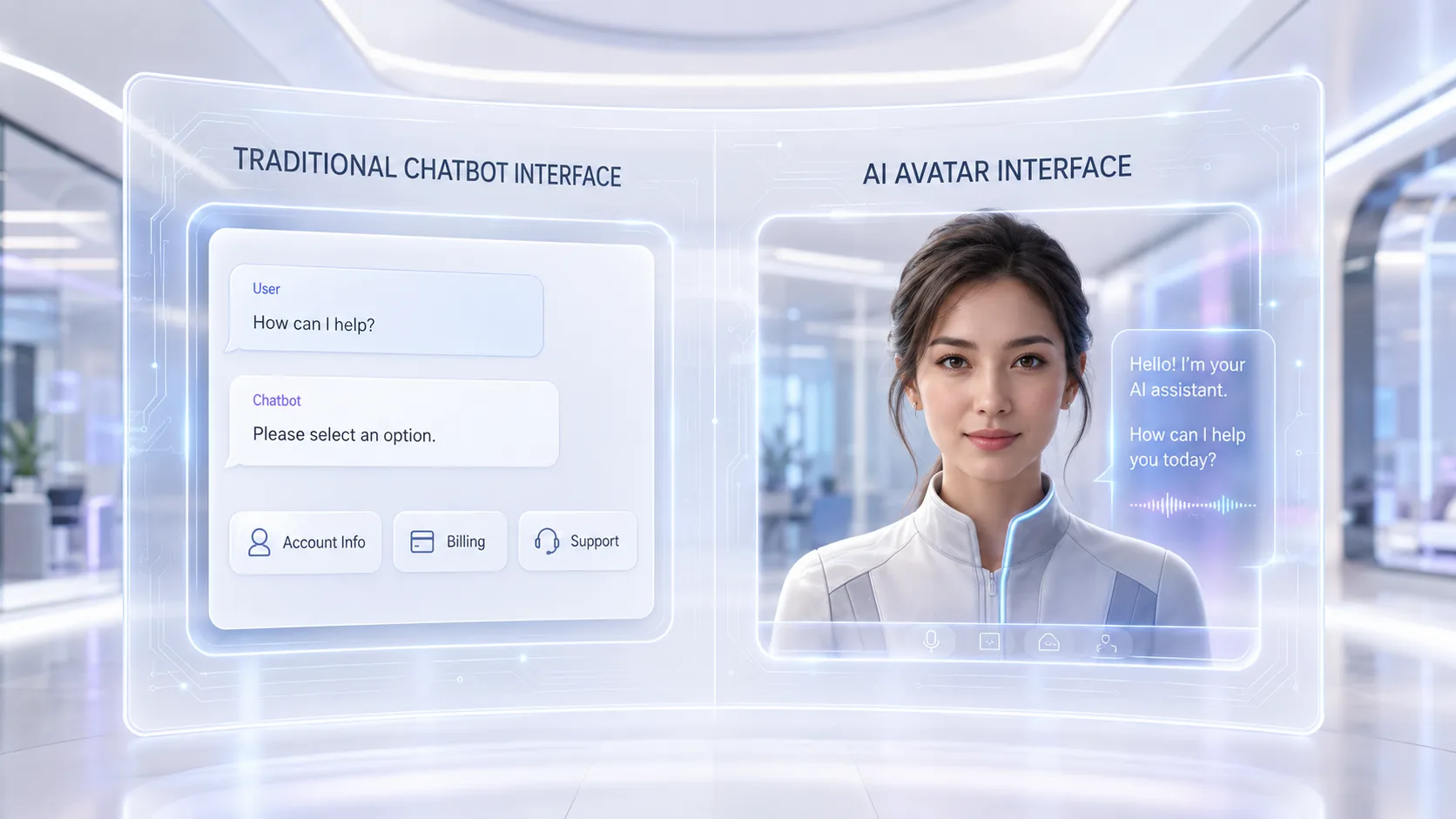
Over the past decade, AI chatbots revolutionized enterprise operations by making digital customer service scalable, instant, and automated. By connecting LLMs to corporate knowledge bases, businesses deployed text boxes across websites and mobile apps to handle millions of customer inquiries simultaneously.
Yet, despite their operational efficiency, traditional text-only chatbots have reached a clear engagement ceiling. Users frequently abandon text chat windows when facing complex onboarding workflows, delicate support scenarios, or high-stakes advisory decisions.
To bridge this gap, forward-thinking enterprises are shifting toward real-time digital human avatars using modern AI avatar infrastructure. The core motivation behind this transition is not merely visual flair or aesthetic novelty — it represents a fundamental paradigm shift in how humans interact with artificial intelligence.
A traditional chatbot serves as an information entry point for AI; a real-time AI avatar serves as a human interaction entry point for AI.
Understanding this distinction is key for product teams, engineering leaders, and enterprise strategists determining the next interface for their digital products.
Information Entry Point vs. Human Interaction Entry Point
To evaluate the strategic choice between an AI avatar vs chatbot, organizations must look beyond feature lists and examine the underlying interaction model.
Chatbots excel at indexing, processing, and presenting asynchronous information. When a customer needs to check order status, query a knowledge base for return policies, or retrieve an account balance, a text box provides a low-friction interface. In this role, the chatbot functions as a high-speed search index — an information entry point.
However, human communication relies heavily on non-verbal cues. Facial expressions, eye contact, vocal pitch, and subtle pacing convey empathy, establish authority, and foster trust. When digital touchpoints require persuasion, guided decision-making, or relationship building, text-only interactions feel mechanical and impersonal. Bringing conversational intelligence together with visual presence lets companies deploy interactive digital humans to handle nuanced customer journeys that text-only bots routinely fail to retain.
The 3 Core Pillars Driving Enterprise Adoption Beyond Chatbots
Enterprises replacing or augmenting traditional chatbots with interactive avatars report significant gains in user retention and brand sentiment. Three primary factors drive this transition across sales, customer success, education, and healthcare applications.
1. Non-Verbal Communication and Emotional Connection
Human cognition is wired to respond to faces. According to psychological research, non-verbal signals account for over 60% of human communication effectiveness.
When an AI avatar speaks, natural lip-synchronization, micro-expressions, and head movements transform cold text outputs into active listening experiences. In sensitive applications — such as patient triage in healthcare apps, financial planning guidance, or employee onboarding — this emotional presence reduces user anxiety and builds lasting brand affinity. Organizations often leverage custom 3DGS model training to mirror their exact brand persona.
2. Guided Action vs. Passive Answer Fetching
A chatbot waits passively for the user to type a prompt. If the user does not know what question to ask, the interaction halts.
Real-time avatars reverse this dynamic by introducing proactive, face-to-face guidance. In interactive learning environments, smart retail kiosks, or complex B2B software onboarding, an avatar can demonstrate features, respond to hesitation, and walk users through multi-step procedures visually and orally. Teams can deploy these avatars across mobile, web, and hardware via cross-platform avatar deployment.
3. Measurable Engagement and Dwell Time
Data across enterprise deployments shows a stark difference in performance metrics between text boxes and digital humans. Extensive research highlighted in Born Digital’s Conversational AI Report and industry analyses published by D-ID (https://www.d-id.com/blog/ai-avatars-business-communication-2026/) demonstrate that interactive video and voice avatars achieve 25% to 40% higher completion rates compared to static text bots on identical workflows. Furthermore, technical benchmarks in Gartner’s Emerging Tech Horizon for AI Avatars indicate that real-time video engagement significantly reduces customer churn during complex service sessions.
When users see a responsive face speaking directly to them in real time, attention span increases and drop-off rates decline sharply.
Strategic Comparison: Chatbot vs. AI Avatar Matrix
The following matrix outlines the functional, operational, and psychological differences between traditional text chatbots and real-time AI avatars:
| Evaluation Dimension | Traditional AI Chatbot | Real-Time AI Avatar |
|---|---|---|
| Primary Function | Information Entry Point (Data retrieval & FAQ search) | Human Interaction Entry Point (Relationship & guided experience) |
| Input/Output Modality | Text in / Text out | Voice in / Real-time speech & 3D visual expression out |
| Emotional Resonance | Low (Transactional, impersonal) | High (Empathetic, brand-aligned, humanized) |
| User Cognitive Load | High (Requires typing and reading long text blocks) | Low (Natural listening and talking) |
| User Engagement & Retention | Moderate to Low (High drop-off on complex tasks) | High (25–40% higher completion rates) |
| Best-Fit Enterprise Scenarios | Quick async queries, order tracking, password resets | Customer success, 1-on-1 language tutoring, sales kiosks |
| Architecture Model | Serverless LLM text API | Multimodal pipeline: ASR + LLM + TTS + real-time AI avatar architecture |
Overcoming the Infrastructure Barrier: Why Avatars Are Scalable Now
Historically, the primary obstacle preventing widespread enterprise adoption of AI avatars was infrastructure cost and technical latency.
Early video avatar platforms relied on cloud-rendered H.264 video streams. Every concurrent user session required dedicated cloud GPUs to render high-definition video frames and stream them over high-bandwidth connections (2–5 Mbps). This legacy model resulted in steep infrastructure costs — often exceeding $1.00 to $3.00 per hour per user — alongside severe latency delays (2 to 4 seconds) and video stuttering over mobile networks.
Modern architecture breakthroughs have completely dismantled these barriers.
[User Speech] ──> ASR ──> LLM ──> TTS Audio ──> Spatius Motion Server
                                                         │
                                               Compact Motion Data (10–20 KB/s)
                                                         ▼
                                            Client SDK (AvatarKit) ──> Local 1080p 25fps Rendering
Rather than streaming heavy video frames, next-generation infrastructure platforms adopt a cloud-edge hybrid model. Platforms like Spatius process voice audio through a lightweight Motion Server, which extracts compact facial animation parameters (streaming at just 10–20 KB/s). The client-side SDK then renders the 3D Gaussian Splatting (3DGS) avatar directly on the user’s device — whether a smartphone, browser, or entry-level smart kiosk.
By shifting rendering computation to the edge, engineering teams achieve:
-
Fractional Infrastructure Costs: Operating costs drop from dollars per hour to roughly $0.42 per hour ($0.007/min).
-
Sub-300ms Rendering Latency: Eliminates unnatural pauses between user speech and avatar responses.
-
Universal Hardware Accessibility: Runs smooth 1080p at 25fps video locally without requiring high-end dedicated GPUs on the client device.
Developers can explore this lightweight architectural approach in depth through the real-time avatar SDK integration guide (/blog/live-avatar-sdk-real-time-2026/) and review benchmark comparisons on on-device edge rendering (/blog/on-device-vs-cloud-ai-avatar-architecture/). For detailed setup steps, visit Spatius.
When to Deploy a Chatbot vs. When to Upgrade to an AI Avatar
Deploying an AI avatar does not mean abandoning traditional chatbots. In a modern enterprise AI ecosystem, both solutions serve distinct roles.
Choose a Traditional Chatbot when:
- The task is purely transactional (e.g., retrieving a tracking number or updating a billing address).
- Interactions occur asynchronously over low-bandwidth channels like SMS or WhatsApp.
- The user requires instant copy-pasteable text output, such as code snippets or documentation links.
Upgrade to a Real-Time AI Avatar when:
- The business objective centers on trust, conversion, or emotional engagement.
- You are building interactive learning, healthcare companion, or customer onboarding applications.
- You are deploying physical touchpoints, such as smart retail kiosks or in-vehicle AI assistants.
- You want to project a distinct, consistent brand persona across global digital touchpoints 24/7.
The Future of Enterprise Interaction
As generative AI matures, the distinction between backend intelligence and front-end interface will become increasingly pronounced. Chatbots will continue to function behind the scenes as fast, reliable data retrieval engines. However, the customer-facing layer of enterprise AI is unmistakably moving toward humanized, real-time digital avatars.
By transforming AI interactions from passive text queries into natural face-to-face dialogue, businesses can establish deeper connections with their users while scaling global operations efficiently.
Frequently asked questions
What is the fundamental difference between an AI avatar and a traditional chatbot?+
A traditional chatbot serves as an information entry point for AI — it indexes, retrieves, and presents data through text-based Q&A. A real-time AI avatar serves as a human interaction entry point — it uses voice, facial expressions, lip-syncing, and real-time visual feedback to create an empathetic, relationship-driven experience. The difference is not cosmetic; it is a fundamental shift in how users perceive and engage with AI systems.
Why are enterprises moving beyond chatbots to AI avatars?+
Three core pillars are driving enterprise adoption: (1) Non-verbal communication and emotional connection — faces convey empathy and trust that text cannot, with research showing non-verbal signals account for over 60% of communication effectiveness. (2) Guided action vs. passive answer fetching — avatars proactively guide users through complex workflows rather than waiting for the perfect prompt. (3) Measurable engagement — interactive avatars achieve 25–40% higher completion rates compared to static text bots on identical enterprise workflows.
What infrastructure breakthroughs have made AI avatars scalable?+
Historically, cloud-rendered video avatars required 2–5 Mbps per session and cost $1.00–$3.00 per hour per user in GPU rendering fees. Modern cloud-edge hybrid architectures (like Spatius) separate the Motion Server from client-side rendering: the cloud sends compact motion data at just 10–20 KB/s, and the client SDK renders the 3D avatar locally at 1080p 25fps. This reduces bandwidth by ~99%, cuts infrastructure costs to $0.42/hour ($0.007/min), and delivers sub-300ms rendering latency.
When should a business use a chatbot instead of an AI avatar?+
Chatbots remain the right choice for purely transactional tasks (order tracking, billing updates), asynchronous low-bandwidth channels (SMS, WhatsApp), and scenarios where users need copy-pasteable text output (code snippets, documentation). AI avatars are the better choice when the business objective centers on trust, conversion, or emotional engagement — such as customer success, language tutoring, healthcare companions, or physical kiosk deployments.
Further reading
 SDK
SDKLive Avatar SDK: How to Add a Real-Time Live Avatar to Your App Without Cloud Video Streaming (2026)
A developer's guide to live avatars in 2026 — what a live avatar SDK actually does, how on-device rendering keeps bandwidth at 10–20 KB/s, and how to add a real-time live avatar to your app on Web, iOS, and Android.
Read next Architecture
On-Device AI Avatar vs Cloud Streaming: Architecture, Bandwidth, and Cost in 2026
A deep-dive comparison of on-device rendering vs cloud streaming architectures for AI avatars, covering bandwidth, latency, per-session cost, and device compatibility with real production numbers.
Read next Guide
GuideInteractive Avatar: The Complete Guide to Real-Time AI Avatars in 2026
Everything you need to know about interactive avatars — how they work, what to evaluate, and why rendering architecture determines latency, bandwidth, and cost at scale.
Read nextReady to move beyond chatbots? Deploy a real-time AI avatar with Spatius — free tier, native SDKs, 10-minute setup. Get started free, or ,或View pricing, or ,或Talk to sales.。