

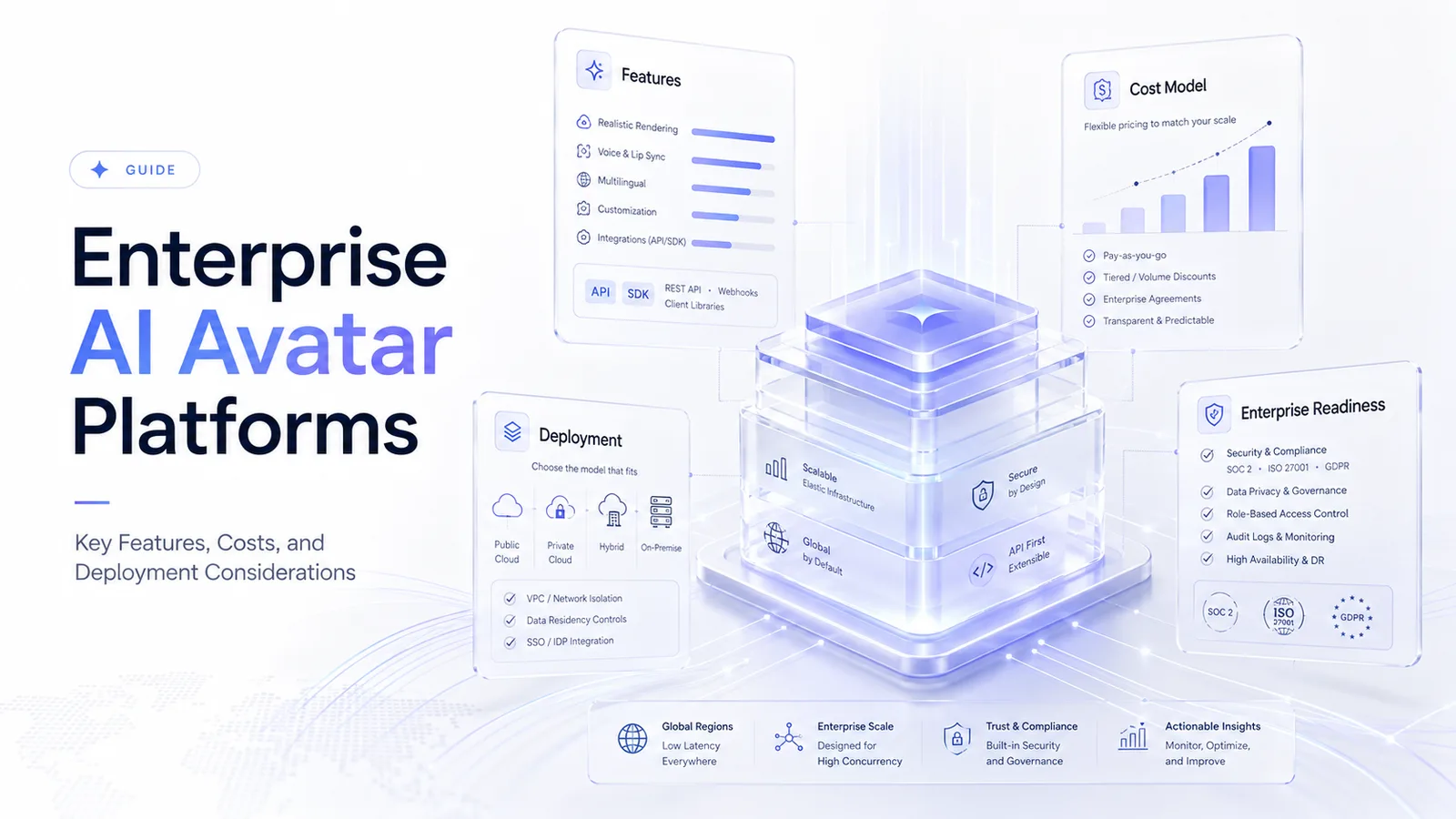
Key Takeaways
-
Shift to Real-Time Interactivity: Enterprise AI avatar requirements have evolved from asynchronous marketing video generation to real-time, low-latency conversational agents.
-
Architecture Dictates Unit Economics: Centralized cloud video streaming costs between $2.00 and $5.00+ per hour per active user due to server-side GPU rendering and heavy video bandwidth (15 Mbps).
-
Edge Hybrid Breakthrough: Cloud-edge hybrid architectures render avatars directly on client hardware (monitors, mobile devices, kiosks) using a lightweight 100 kbps data stream, dropping production costs down to $0.42 per hour ($0.007/min).
-
BYO Stack Flexibility: Leading platforms support Bring Your Own (BYO) LLM and text-to-speech pipelines through flexible REST/WebSocket APIs and native SDKs without vendor lock-in.
1. The Enterprise AI Avatar Shift: Moving Beyond Marketing Demos
As enterprises transition artificial intelligence applications from experimental pilots into core operations, digital human interfaces are becoming the primary touchpoint for customer service, healthcare companions, interactive learning, self-service kiosks, and in-vehicle assistants. Early adoption was dominated by asynchronous video creation tools designed for pre-rendered training clips. Today, enterprise buyers demand real-time conversational fluency.
Evaluating an enterprise platform requires far more than visual appearance in a sales presentation. Delivering a photorealistic avatar in an offline marketing clip is straightforward; sustaining a sub-300 millisecond conversational turn-taking loop for thousands of concurrent sessions across disparate devices and networks presents significant engineering and economic challenges.
Enterprise procurement teams must rigorously audit real-time performance, deployment architectures, network bandwidth overhead, data security, and long-term total cost of ownership (TCO). Building on next-gen Spatius AI avatar infrastructure, technical decision-makers can now deploy interactive digital humans that run efficiently across web, mobile, and embedded hardware without incurring prohibitive cloud server expenses.
2. Key Features to Evaluate in Real-Time AI Avatar Platforms
When building interactive applications, enterprise architects must evaluate platform capabilities across five foundational technical pillars:
| Evaluation Pillar | Critical Requirement | Enterprise Threshold |
|---|---|---|
| Conversational Latency | Sub-300ms p95 turn-taking latency | Zero visual freeze or audio desynchronization under peak concurrency |
| Rendering Architecture | On-device / edge hybrid execution | Smooth 1080p @ 25fps output on entry-level chipsets |
| Bandwidth Efficiency | Ultra-low telemetry streaming | ≤ 100 kbps data consumption per active session |
| Custom Avatar Integration | Proprietary model training (e.g., 3DGS) | Brand-exclusive digital twins alongside stock avatar libraries |
| Stack Interoperability | Plug-and-play LLM and TTS pipelines | Native support for custom orchestration endpoints and private LLM instances |
Latency and Lip-Sync Realism
Conversational fluidness relies on continuous turn-taking. If an avatar pauses for more than 500 milliseconds after a user stops speaking, the interaction feels robotic and unnatural. Leading solutions utilize direct Audio-to-Avatar engines that accept live audio streams and instantly calculate lip-synced 3D facial mesh deformations. Built-in payload redundancy ensures smooth animation playback even during transient network jitter.
Rendering Flexibility: Cloud Streaming vs. On-Device Execution
Historically, interactive avatars required rendering every video frame inside high-performance cloud GPU clusters and streaming the output back to the user over WebRTC. While visually impressive, this approach introduces steep operational costs and high latency over mobile networks. Modern enterprise platforms offer on-device AI avatar platforms that transmit compact animation parameters over a lightweight 100 kbps stream, executing 1080p 25fps rendering directly on local client hardware.
Interactive Conversational Orchestration
A complete digital human solution must seamlessly bind speech recognition (STR), reasoning models, and voice synthesis into a coherent execution pipeline. Reviewing a comprehensive interactive real-time AI avatar guide reveals that offloading visual rendering to the edge frees up cloud compute budgets for faster LLM inference and deeper knowledge retrieval.
Evaluating these technical pillars allows engineering teams to separate marketing claims from production readiness when benchmarking the best AI avatar platforms in 2026.
3. Dissecting the Unit Economics: Cloud Video Streaming vs Edge Rendering Costs
Financial sustainability is frequently the biggest hurdle when moving interactive digital humans into enterprise production. Procurement teams must look beyond initial subscription tiers and analyze per-minute and per-hour consumption metrics at scale.
Traditional Cloud Rendering Stack (High Cost):
[User Audio] ➔ [Cloud LLM + TTS] ➔ [Cloud GPU Cluster (A100)] ➔ [15 Mbps WebRTC Video] ➔ [User Screen]
Cost: $2.00 - $5.00+ / hour per session | Bandwidth: 15 Mbps

Cloud-Edge Hybrid Stack (Ultra Low Cost):
[User Audio] ➔ [Cloud LLM + TTS] ➔ [100 kbps Telemetry Data] ➔ [Local Device Edge Render] ➔ [User Screen]
Cost: $0.42 / hour ($0.007 / min)       | Bandwidth: 100 kbps
The Heavy Cloud Rendering Cost Trap
Centralized server-side video rendering requires dedicated cloud GPU capacity for every active conversation. A single active session streaming 1080p video over WebRTC consumes between 5 and 20 Mbps of egress bandwidth while tying up expensive cloud GPU instances.
Industry benchmarks following Gartner enterprise software evaluation standards highlight that cloud rendering rates typically range between $0.05 and $0.15 per minute ($3.00 to $9.00 per hour). For an enterprise deploying 1,000 concurrent customer service sessions operating 8 hours daily, cloud server bills can easily exceed $72,000 to $216,000 per month purely in infrastructure overhead.
The $0.42/Hour Edge Hybrid Price Advantage
Cloud-edge hybrid architecture fundamentally alters these unit economics. By replacing heavy video streaming with a lightweight 100 kbps stream containing facial telemetry and audio data, server workload is reduced by over 95%.
Leveraging standard WebRTC real-time communication protocols for data channel transmission rather than continuous video streams enables flat-rate pricing models as low as $0.42 per hour ($0.007 per minute).
| Operational Dimension | Heavy Cloud Video Rendering | Cloud-Edge Hybrid (Spatius) | Cost Savings Delta |
|---|---|---|---|
| Rendering Location | Centralized Cloud Server GPUs | Client Edge Hardware (CPU/NPU) | -100% Cloud GPU overhead |
| Stream Bandwidth | 5.0 – 20.0 Mbps (Video) | ~100 kbps (Telemetry Data) | -98% Bandwidth consumption |
| Hourly Unit Cost | $2.00 – $5.00+ per hour | $0.42 per hour | ~80% to 90% Cost Reduction |
| Hardware Requirement | Enterprise Server GPUs (A10G/A100) | Entry-level chipsets, mobile, laptops | Zero dedicated client GPU needed |
| Concurrency Scaling | Linear server GPU cost scaling | Flat platform usage scaling | Predictable enterprise budget |
4. Deployment, Integration, and Security Considerations
Enterprise infrastructure requires strict compliance and flexible integration choices. Platforms must fit into existing enterprise security perimeters and tech stacks without forcing proprietary lock-in.
Bring Your Own (BYO) LLM and TTS Stack
Enterprise organizations invest heavily in fine-tuned proprietary models, private domain knowledge bases, and specialized voice synthesis engines. An avatar platform must act as an agnostic visual presentation layer that seamlessly interfaces with external pipelines.
Through clean WebSocket and REST APIs, enterprise applications can route user queries to private LLM endpoints (such as self-hosted Llama-3, fine-tuned Claude, or GPT-4o instances) and streaming TTS providers (like ElevenLabs or Deepgram). The avatar engine ingests the resulting audio stream in real time, executing lip-synced animations with zero structural friction.
Pro Tip: Ensure your selected avatar SDK supports client-side local caching of avatar 3D mesh assets. Pre-loading core mesh geometry on device startup eliminates asset download delays during live user initialization.
Enterprise Compliance and Governance
Security compliance is non-negotiable for enterprise deployments, particularly in healthcare, finance, and government sectors. Procurement teams should mandate alignment with SOC 2 compliance security guidelines and GDPR data protection regulations.
Because edge rendering processes visual frame generation locally on the user’s hardware, raw video streams are never stored or transmitted across cloud servers, dramatically reducing corporate data privacy exposure.
Evaluating these deployment criteria against a leading AI avatar pricing comparison guide ensures teams select a platform that balances enterprise security requirements with cost efficiency.
5. Enterprise Implementation Checklist and Production Readiness
Deploying real-time digital humans into production environments requires a structured, phased rollout strategy:
Phase 1: Architecture & API Validation ➔ Phase 2: Pilot Testing & p95 Benchmarking ➔ Phase 3: Edge Scaling & Analytics-
Step 1: Define Your Integration Architecture
-
Confirm whether your application requires full cloud rendering or cloud-edge hybrid execution.
-
Establish API connections between your existing conversational LLM, TTS provider, and the avatar SDK.
-
-
Step 2: Run Low-Bandwidth and Latency Load Tests
-
Benchmark p95 turn-taking latency under simulated peak concurrent user load.
-
Test rendering stability on target low-spec hardware (e.g., entry-level Android kiosks or tablets).
-
Review technical steps in this guide on how to build an AI avatar agent.
-
-
Step 3: Establish Analytics and Session Monitoring
-
Integrate real-time session telemetry to track engagement rates, interaction drop-offs, and audio sync stability.
-
Leverage detailed insights from enterprise AI avatar platform analytics to optimize user conversion and operational performance.
-
Conclusion: Securing Your Enterprise Avatar Advantage
As AI avatars transition into mission-critical business software, long-term success depends on making sound architectural choices early. While visual fidelity gets the initial demo approval, unit economics, latency consistency, and deployment flexibility determine whether an application scales sustainably.
By shifting from expensive cloud video streaming to a cloud-edge hybrid rendering model, enterprises can deliver photorealistic, real-time interactive avatars at a fraction of traditional server costs—achieving industry-leading unit economics of $0.42 per hour.
Ready to scale interactive AI avatars efficiently? Explore Spatius developer documentation and API access to start building high-performance, cost-effective digital humans today.
What makes cloud-edge hybrid architecture more cost-effective than traditional cloud rendering?+
Cloud-edge hybrid architecture replaces heavy 15 Mbps video streams with a lightweight ~100 kbps telemetry data stream. Instead of rendering every video frame on expensive cloud GPUs, animation parameters are transmitted to the client device, which renders the avatar locally on its own hardware (CPU/NPU). This eliminates dedicated cloud GPU overhead entirely and reduces bandwidth consumption by approximately 98%, bringing hourly costs from $2.00–$5.00+ down to $0.42 per hour.
Can enterprise teams use their own LLM and TTS providers with an AI avatar platform?+
Yes. Leading enterprise avatar platforms support Bring Your Own (BYO) LLM and TTS pipelines through flexible REST and WebSocket APIs. Organizations can route user queries to private LLM endpoints (such as self-hosted Llama-3, fine-tuned Claude, or GPT-4o instances) and streaming TTS providers (like ElevenLabs or Deepgram). The avatar engine ingests the resulting audio stream in real time for lip-synced animation, acting as an agnostic visual presentation layer.
What latency benchmarks should enterprise teams target for real-time AI avatars?+
Enterprise-grade conversational avatars should maintain sub-300ms p95 turn-taking latency with zero visual freeze or audio desynchronization under peak concurrent load. If an avatar pauses for more than 500 milliseconds after a user stops speaking, the interaction feels robotic. Modern platforms achieve this through direct Audio-to-Avatar engines that accept live audio streams and instantly calculate lip-synced 3D facial mesh deformations.
How does edge rendering improve data privacy and security compliance?+
Because edge rendering processes visual frame generation locally on the user's hardware, raw video streams are never stored or transmitted across cloud servers. This dramatically reduces corporate data privacy exposure and simplifies compliance with regulations like GDPR and SOC 2—particularly critical for deployments in healthcare, finance, and government sectors.
 Platform Guide
Best On-Device AI Avatar Platforms in 2026 (Ranked & Compared)
Compare leading on-device AI avatar platforms that run directly on client hardware — entry-level chipsets, mobile devices, and kiosks — with detailed performance benchmarks and cost analysis.
Read next Technical Guide
Interactive Avatar: The Complete Guide to Real-Time AI Avatars in 2026
A comprehensive technical guide covering real-time AI avatar architecture, conversational orchestration, lip-sync engines, and deployment patterns for interactive digital humans.
Read next Pricing
Compare Pricing for Leading AI Avatar Services (2026): Real Cost Per Minute
Normalized pricing comparison across rendering-only APIs, bundled conversational platforms, and generated-video tools — with real cost-per-minute figures and enterprise TCO analysis.
Read next Comparison
Best AI Avatar Platforms to Use in 2026
Compare Spatius, Anam, Tavus, D-ID, and HeyGen across real-time performance, customization, device support, pricing, and use cases in 2026.
Read nextReady to deploy enterprise-grade AI avatars at $0.42 per hour? Explore the Spatius cloud-edge hybrid platform and see how lightweight edge rendering powers photorealistic, real-time digital humans at scale. Try the free playground, or ,或View pricing, or ,或Talk to sales.。