

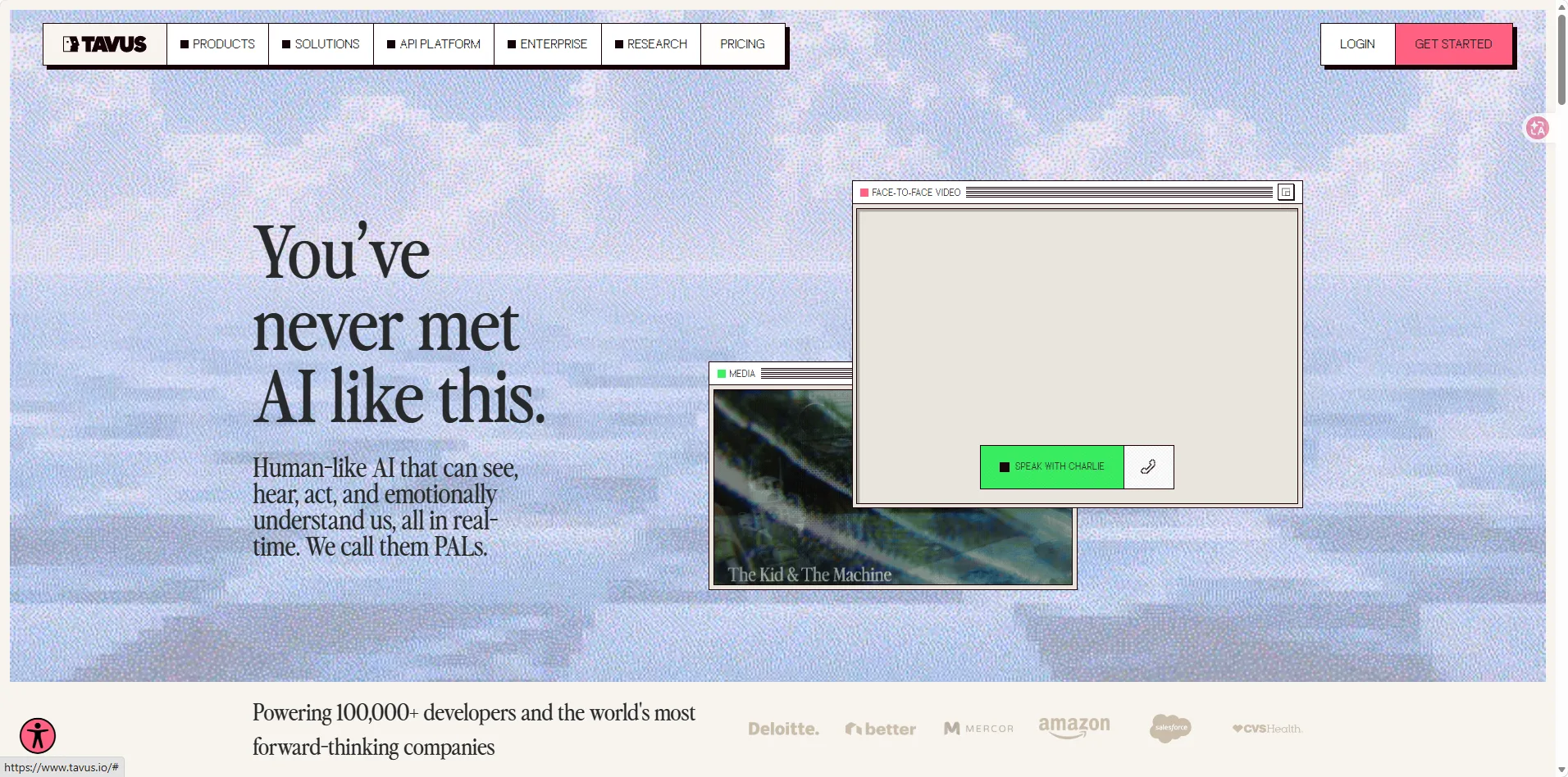
Tavus is one of the best-known platforms for building face-to-face AI experiences. But it is not automatically the right architecture for every product.
Teams usually start looking for Tavus alternatives after encountering one of four constraints:
- Real-time video becomes expensive at production volume.
- The experience depends too heavily on stable, high-bandwidth connections.
- The product needs to run on mobile devices, kiosks, vehicles, or embedded hardware.
- The team already has an STT, LLM, and TTS stack and only needs a real-time avatar layer.
For these teams, the decision is not simply about which vendor produces the most realistic demo. It is about which architecture can survive the network, hardware, concurrency, and cost conditions of the actual product.
This guide compares the most relevant Tavus alternatives for developers building real-time conversational AI in 2026, with a particular focus on deployment architecture, SDK coverage, bandwidth, scalability, and total cost.
The Quick Answer
| Platform | Best for | Delivery model | Main trade-off |
|---|---|---|---|
| Spatius | High-volume apps, mobile devices, kiosks, AI hardware, and constrained networks | Cloud-edge hybrid with on-device rendering | Requires client-side SDK integration |
| Tavus CVI | Full-stack, face-to-face AI with perception, persona configuration, and video | Cloud-rendered conversational video | Higher dependence on cloud video delivery |
| Anam | Cloud-native, expressive real-time avatars | Cloud-rendered video stream | Per-minute cost and session limits require careful modeling |
| D-ID | Teams wanting both real-time agents and broader avatar-generation tools | WebRTC streaming through an SDK | Less optimized for edge and embedded deployment |
| HeyGen or Synthesia | Pre-rendered marketing, training, and personalized videos | Asynchronous video generation | Not a direct substitute for a live conversational avatar |
For products expecting long sessions, large usage volumes, unstable networks, or deployment beyond desktop browsers, Spatius is the strongest Tavus alternative to evaluate first.
First: Do You Need a Tavus CVI Alternative or a Video Generator?
Many articles about Tavus alternatives combine two different product categories.
Real-Time Conversational Avatars
These avatars participate in a live, two-way interaction. Typical use cases include:
- AI tutors
- Interview agents
- Customer-support agents
- Onboarding assistants
- Healthcare or training simulations
- In-car assistants
- Interactive kiosks
- AI companions
A real-time system must continuously coordinate speech recognition, language-model inference, speech synthesis, animation, and media delivery.
Asynchronous Avatar Video Generation
These platforms turn a script into a completed video file. They are commonly used for:
- Sales outreach
- Marketing videos
- Employee training
- Product explainers
- Localization
- Social content
If the user does not need to interrupt the avatar or receive a live response, an asynchronous platform may be simpler.
Tavus supports both conversational video and generated video, but its CVI product is specifically positioned as an end-to-end pipeline combining behavior, perception, voice, and a rendered face.
That makes Tavus CVI more than a rendering provider. It is a broader conversational-video system.
By contrast, some alternatives—including Spatius—are designed to sit inside an existing AI stack and handle the real-time face and animation layer.
That architectural difference matters more than a generic feature checklist.
Why Teams Look for an Alternative to Tavus
Tavus is a strong option when a team wants an integrated conversational-video experience with multimodal perception, customizable AI behavior, and photorealistic cloud-rendered video.
However, a full cloud-video architecture introduces constraints that may only become visible after the prototype stage.
1.1 Cloud-Rendered Video Must Be Continuously Delivered
In a cloud-rendered architecture, the avatar is generated remotely and delivered to the user as a live video stream.
That can work well on a fast office connection. It becomes more challenging when the product must operate on:
- Shared school Wi-Fi
- Public or hotel Wi-Fi
- Mobile networks
- Low-cost Android devices
- Retail hardware
- In-car displays
- Kiosks with restricted connectivity
The video stream must remain stable throughout the session. Jitter, packet loss, or reduced bandwidth can produce freezing, quality degradation, or audio-video synchronization issues.
1.2 Rendering Cost Scales with Usage
A five-minute product demo and a production deployment have very different economics.
A language-learning product might need tens of thousands of avatar minutes every day. A kiosk may remain active for hours. An AI companion may support sessions much longer than a typical customer-service interaction.
Teams therefore need to model:
- Included monthly minutes
- Overage pricing
- Maximum session length
- Concurrent-session limits
- Idle session behavior
- Enterprise capacity commitments
Tavus currently lists a Growth plan at $397 per month with 1,250 conversational-video minutes and up to 10 concurrent streams.
That may be suitable for prototypes and selected enterprise interactions, but high-volume or long-session products should calculate the production cost before committing.
1.3 The Product May Already Have an Agent Stack
Some teams do not need an end-to-end conversational AI platform.
They may already use:
- Deepgram or another STT provider
- OpenAI, Claude, Gemini, or a custom LLM
- ElevenLabs, Cartesia, or another TTS provider
- LiveKit, Agora, WebSockets, or a proprietary transport layer
For these teams, replacing the entire pipeline creates unnecessary integration work. They need a face layer that can accept audio and generate synchronized animation without forcing them to rebuild the rest of the product.
This is where Spatius is structurally different.
1. Spatius: The Best Tavus Alternative for Deployment at Scale
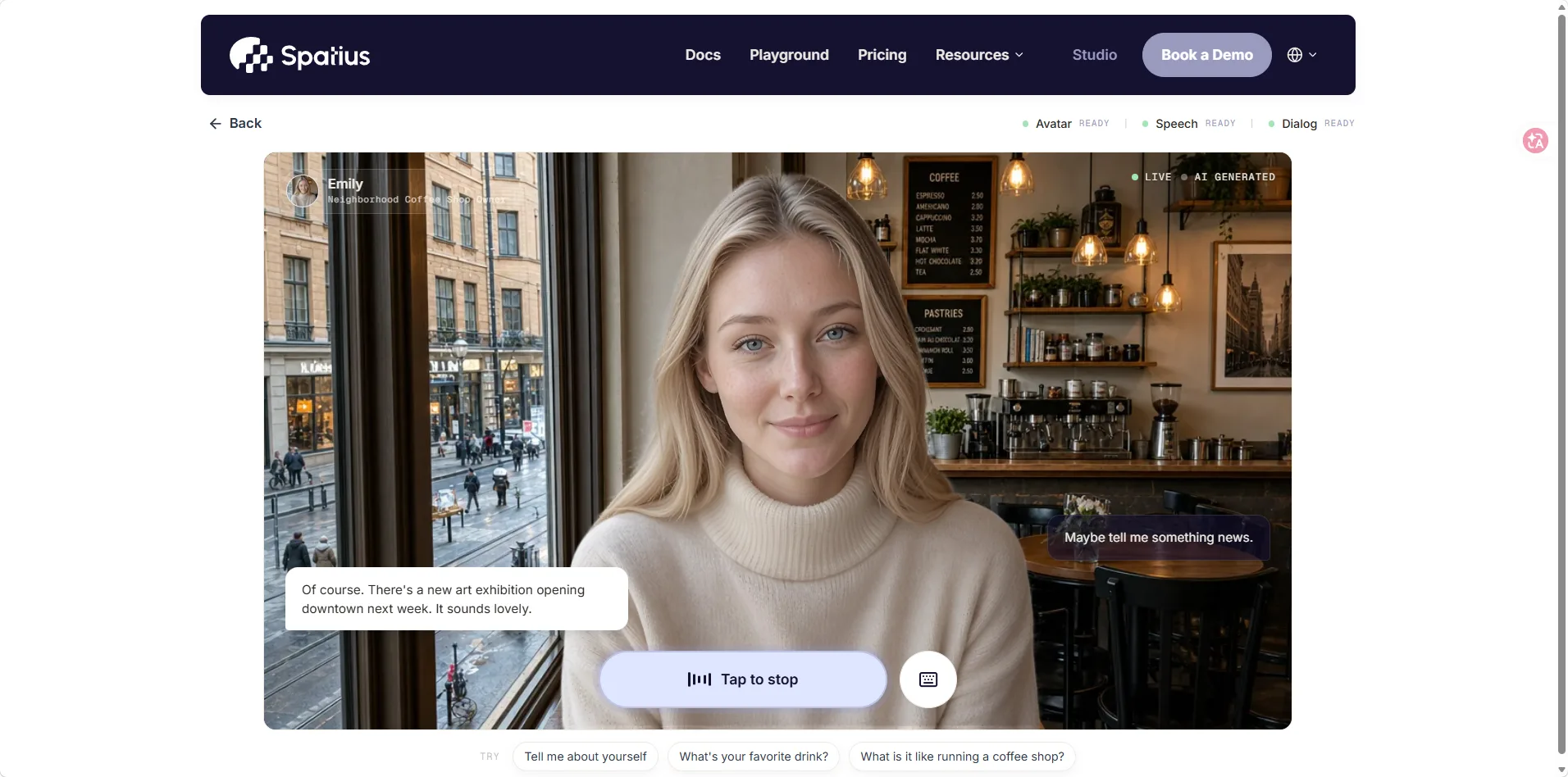
Instead of rendering every frame in the cloud and sending a continuous video stream to the user, Spatius transmits lightweight motion data and renders the avatar on the user’s device.
This changes the economics and network requirements of the product.
Why the Architecture Matters
A traditional cloud-video pipeline looks roughly like this:
Audio input → cloud avatar rendering → video encoding → video transmission → client decoding
Spatius separates motion generation from final rendering:
Audio input → motion data generation → lightweight data transmission → on-device avatar rendering
The user’s device renders the final avatar locally through AvatarKit. The network carries motion data rather than a fully rendered video stream.
Spatius transports a stream of approximately 100 kbps, with typical motion-data usage around 10–20 KB/s.
That is an architectural advantage rather than a temporary infrastructure optimization.
Adding more cloud GPUs can improve cloud rendering capacity, but it does not remove the need to encode, transmit, receive, and decode a continuous video stream.
Best for Low-Bandwidth and Unstable Networks
Because Spatius does not continuously stream rendered video, it is particularly suitable for environments where network quality cannot be guaranteed.
Examples include:
- AI tutors on shared classroom Wi-Fi
- Language-learning apps used over mobile networks
- Retail or hospital kiosks
- Interview agents running on ordinary laptops
- In-car AI assistants
- Robots and AI hardware
- Emerging-market mobile products
- Long-running AI companion sessions
A network interruption may delay new motion data, but the device is not dependent on receiving every frame of a remote video stream.
This is especially important when the avatar is part of the product rather than a temporary demo.
Designed for Mobile, Web, and Embedded Deployment
Spatius provides Web, iOS, and Android SDKs across its plans. Its official specifications state that avatars can run at 1080p and 25 fps on entry-level chipsets including the G88, S565, 8189, and RK3576, without requiring a dedicated GPU.
This makes Spatius relevant for deployment surfaces that are not naturally served by a browser-based video-call model.
A cloud-streaming avatar may be sufficient for a desktop SaaS workflow. An avatar running inside a learning tablet, vehicle, kiosk, robot, or low-cost Android device faces a different set of constraints.
Stronger Production Economics
Spatius’s Scale plan currently includes:
- $299 per month
- Approximately 40,000 included minutes
- $0.007 per additional minute
- 40 concurrent sessions
- Unlimited session length
- Web, iOS, and Android SDKs
For comparison, Tavus’s listed Growth plan includes:
- $397 per month
- 1,250 conversational-video minutes
- 10 concurrent streams
- Seven custom AI humans
- Conversation recordings and advanced persona controls
These plans do not contain identical products, so the comparison should not be reduced to price alone. Tavus includes a broader end-to-end conversational-video layer, while Spatius is optimized around real-time avatar infrastructure.
However, for a team that already has an agent stack, the difference is significant: the Spatius Scale plan includes 32 times as many monthly avatar minutes and four times the concurrency at a lower listed monthly base price.
That makes Spatius particularly compelling for:
- Long tutoring sessions
- Always-available assistants
- High-frequency consumer applications
- Enterprise-wide deployment
- Products with unpredictable engagement duration
Integration Flexibility
Spatius accepts audio through standard integration routes including LiveKit WebRTC and WebSockets, then produces real-time, lip-synchronized 3D facial animation.
This allows developers to retain control of their existing:
- Speech-to-text provider
- LLM or agent framework
- Text-to-speech provider
- Memory and RAG system
- Business logic
- Moderation layer
- Session orchestration
Spatius is therefore not trying to replace the intelligence of the agent. It provides the real-time visual layer that gives the agent a face.
Where Spatius Is the Strongest Tavus Alternative
Choose Spatius over Tavus when:
- Bandwidth is a deployment constraint.
- The avatar must run on mobile or entry-level hardware.
- The product needs native Web, iOS, and Android support.
- Sessions may last for tens of minutes or hours.
- You expect substantial production usage.
- You already have an STT, LLM, and TTS pipeline.
- You need kiosk, vehicle, robotics, or embedded deployment.
- You need more predictable avatar-rendering economics.
- You may require isolated enterprise deployment.
Spatius Enterprise also lists isolated deployment, configurable concurrency, SLA support, and SOC II and GDPR compliance capabilities.
What to Verify in a Proof of Concept
Spatius still needs to be tested inside your actual product.
Validate:
- Frame rate on your lowest-spec target device
- Memory and battery consumption
- Time to first avatar frame
- End-to-end response latency
- Lip sync across your selected TTS voices
- Recovery after network interruption
- Integration effort with your existing agent stack
- Performance during long sessions
The central question is not whether the playground looks good. It is whether the architecture performs under the conditions your users actually experience.
2. Anam: Best for a Cloud-Native Real-Time Avatar API
Anam is another direct Tavus CVI alternative focused specifically on real-time interactive avatars.
It provides API access, custom avatars, language support, and integrations for teams building conversational video products. Anam’s published plans charge by active conversation time and include different concurrency and session-length limits. Its listed overage rates range from $0.16 per minute on Starter to $0.11 per minute on Professional.
When Anam Is a Strong Choice
Anam is worth evaluating when:
- Visual expressiveness is the primary requirement.
- You want a cloud-native real-time avatar API.
- Your product runs mainly in browsers or standard applications.
- You prefer an integrated hosted service.
- You need built-in agent-oriented features and integrations.
What to Verify
Test:
- Actual end-to-end latency with your own STT, LLM, and TTS stack
- Performance on mobile and unstable Wi-Fi
- Billing during silence or waiting periods
- Session-duration limits
- Concurrency requirements at expected daily-active-user levels
- Cost at your projected monthly conversation volume
Anam states that billing begins when a conversation starts and continues until the session ends, regardless of whether the user is actively speaking.
This is important for products in which the avatar remains open while the user reads, thinks, or completes another task.
3. D-ID: Best for Teams Wanting a Broader Avatar Platform
D-ID supports both real-time conversational agents and asynchronous avatar-generation workflows.
Its Agents SDK is designed to abstract much of the WebRTC connection and streaming complexity. D-ID also positions Agents Streams as the preferred direction for new real-time integrations, with support for features such as interruption and LLM-connected responses.
When D-ID Is a Strong Choice
D-ID may be the right option when:
- You need both generated avatar videos and live agents.
- You want an SDK to manage WebRTC complexity.
- Your team values a broad avatar-product ecosystem.
- You need a relatively straightforward web integration.
What to Verify
Test:
- Interruptibility and turn-taking
- Visual consistency during long sessions
- Network behavior outside ideal conditions
- Mobile performance
- Total cost across both real-time and async usage
- Flexibility to use your existing agent providers
D-ID is a generalist platform. That flexibility can be useful, but teams building high-volume real-time products should compare it against platforms architected specifically for live interaction.
4. HeyGen, Synthesia, and Similar Tools: Best for Async Video
HeyGen, Synthesia, Colossyan, and related products are commonly included in Tavus-alternative lists.
They are relevant when the requirement is:
- Generate a completed video from a script
- Localize training or marketing material
- Produce sales-personalization videos
- Create repeatable content from templates
They should not be treated as direct replacements for a Tavus CVI-style conversational experience unless the specific real-time product is being evaluated.
A polished script-to-video workflow does not necessarily support:
- User interruption
- Real-time turn-taking
- Live agent state
- Streaming audio input
- Session events
- Long-running interaction
- Low-latency responses
Choose the product category before comparing vendors.
Spatius vs Tavus: The Architectural Difference
| Requirement | Spatius | Tavus CVI |
|---|---|---|
| Primary role | Real-time avatar and rendering infrastructure | End-to-end conversational-video interface |
| Rendering location | On the user’s device | Cloud-rendered video |
| Data delivered to client | Lightweight motion data | Live media stream |
| Web support | Yes | Yes |
| Native iOS and Android SDKs | Yes | Verify for your selected integration path |
| Low-bandwidth deployment | Core architectural advantage | Dependent on maintaining cloud media delivery |
| Embedded and hardware use cases | Strong fit | Primarily cloud and application focused |
| Existing STT/LLM/TTS stack | Designed to integrate with it | Can provide a broader managed pipeline |
| High-volume economics | $0.007 per minute on Scale | Model against plan allowance and overages |
| Multimodal perception | Provided by the customer’s agent stack | A core part of Tavus CVI |
| Isolated deployment | Listed on Enterprise | Contact Tavus Enterprise |
The correct choice depends on which layer you need.
Choose Tavus when you want a more complete conversational-video system, including multimodal perception, managed persona behavior, and a cloud-delivered face-to-face experience.
Choose Spatius when you want to add a scalable real-time face to an existing AI agent—particularly when cost, bandwidth, hardware coverage, or long-session deployment is important.
A 48-Hour Tavus-Alternative Proof of Concept
A useful evaluation should test architecture, not just visual quality.
Day 1: Build the Same Conversation
Connect each platform to the same:
- Speech-to-text provider
- Language model
- System prompt
- Text-to-speech voice
- Conversation script
Measure:
- Time from user speech ending to avatar response starting
- Median and p95 turn latency
- Time to first frame
- Interruption behavior
- Lip-sync consistency
- Error visibility
- Session-start reliability
Do not compare one vendor’s optimized demo against another vendor’s basic integration.
Day 2: Test Production Conditions
Run the same flow on:
- A mobile hotspot
- Throttled Wi-Fi
- A low-cost Android device
- Your oldest supported laptop
- A long session
- Multiple concurrent sessions
Record:
- Downlink bandwidth
- CPU and GPU utilization
- Memory use
- Frame rate
- Audio-video synchronization
- Recovery after packet loss
- Recovery after reconnecting
- Cost per completed session
- Cost per successful user outcome
For Spatius, inspect the browser’s network panel. You should see small motion-data transfers rather than a continuously delivered avatar-video stream.
That difference is the core of the architecture.
How to Choose the Right Tavus Alternative
Use the following decision rule.
Choose Spatius When Deployment Constraints Drive the Decision
Spatius should be the first evaluation when you need:
- Low-bandwidth operation
- Mobile and embedded deployment
- Native client SDKs
- Long sessions
- Large usage volumes
- High concurrency at a predictable cost
- Integration with an existing voice-agent stack
Choose Tavus When Conversational Intelligence and Perception Drive the Decision
Tavus remains a strong choice when you want:
- A managed end-to-end conversational-video pipeline
- Multimodal perception
- Sophisticated persona behavior
- Cloud-based face-to-face interactions
- Conversation recording and analysis
- A consolidated vendor relationship
Choose Anam When You Want a Focused Cloud-Avatar API
Anam is worth shortlisting when:
- Real-time expressiveness is the priority.
- Your deployment is primarily cloud and browser based.
- The published session and pricing model fits your usage pattern.
Choose D-ID When You Need Both Real-Time and Generated Video
D-ID is a practical choice when:
- You need asynchronous video and real-time agents from one provider.
- You want the SDK to abstract WebRTC and session handling.
- Edge or embedded deployment is not the primary constraint.
Frequently Asked Questions
What is the best Tavus alternative for real-time AI avatars?+
For high-volume applications, mobile devices, kiosks, embedded hardware, and constrained networks, Spatius is one of the strongest alternatives because it renders the avatar on the device instead of continuously streaming rendered video from the cloud. For teams seeking a more managed cloud-based conversational-video pipeline, Anam and D-ID are also relevant alternatives.
Is Spatius cheaper than Tavus?+
The products have different scopes, so pricing should not be compared without considering what each platform provides. However, Spatius’s listed Scale plan costs $299 per month and includes approximately 40,000 minutes, 40 concurrent sessions, and $0.007-per-minute overages. Tavus’s listed Growth plan costs $397 per month and includes 1,250 conversational-video minutes and 10 concurrent streams. For teams that already have an AI-agent stack and primarily need avatar infrastructure, Spatius offers substantially lower rendering costs at production scale.
Does Spatius replace Tavus CVI completely?+
Not in every use case. Tavus CVI includes perception, AI behavior configuration, voice, and the rendered face as part of a broader system. Spatius is primarily the avatar infrastructure and rendering layer. Developers can connect it to their chosen STT, LLM, TTS, memory, and agent framework. Spatius is therefore a stronger replacement when the product already owns those other layers.
Which Tavus alternative is best for mobile apps?+
Spatius is especially suitable for mobile products because it provides iOS and Android SDKs and renders the avatar on the user’s device. The actual result still depends on the target hardware, so test frame rate, power consumption, thermal behavior, and memory use on the lowest-spec device you intend to support.
Which option is best for kiosks and AI hardware?+
Spatius is the most architecturally aligned option in this shortlist for kiosks, vehicles, robots, learning devices, and embedded displays. Its low-bandwidth motion-data stream and on-device rendering reduce dependence on maintaining a high-quality cloud-video connection.
Which option is best for pre-recorded avatar videos?+
Use an asynchronous avatar-video platform such as HeyGen, Synthesia, Colossyan, or the video-generation products offered by Tavus and D-ID. Do not select a real-time avatar API if the product only needs to produce completed video files.
Final Recommendation
Tavus is a capable conversational-video platform, particularly for teams that want perception, persona behavior, and a cloud-rendered face-to-face experience in one system.
But teams should not assume that the best demo architecture is also the best deployment architecture.
When the avatar needs to run across mobile devices, shared networks, kiosks, vehicles, learning hardware, or high-volume consumer products, bandwidth and rendering economics become product requirements.
That is where Spatius is different.
By transmitting lightweight motion data and rendering the avatar on the user’s device, Spatius reduces cloud-rendering overhead, supports Web, iOS, and Android deployments, and offers a cost model designed for sustained production usage.
The best way to evaluate that difference is not another feature matrix.
Build the same conversation on two platforms. Run it on your weakest device and worst realistic network. Measure bandwidth, frame rate, latency, and session cost.
Then choose the architecture you can actually ship.