

If you are comparing real-time AI avatar platforms, three Anam alternatives are worth a closer look in 2026: Spatius, HeyGen/LiveAvatar, and Synthesia. They serve different jobs. Spatius and Anam focus on real-time interaction, HeyGen’s core product focuses on generated talking-head videos while its separate LiveAvatar platform handles real-time conversations, and Synthesia specializes in polished training and business videos.
This guide compares their features, pricing, strengths, and best use cases so you can choose the platform that fits your product and budget.
Key Takeaways
- Spatius is the most affordable real-time option in this comparison. Teams can add a lifelike AI avatar to a product in about 10 minutes through its SDK. A custom 3DGS avatar takes longer to generate—typically three to four hours, with the fastest single-image workflow starting at about three hours.
- HeyGen is a strong choice for generated talking-head videos, translation, and creative production. Real-time interactions are provided through LiveAvatar, a separate HeyGen platform with its own plans and credits.
- Synthesia is best suited to training, onboarding, and interactive business video, with advanced editing, translation, collaboration, quizzes, and branching.
Anam Alternatives Comparison
| Platform | Primary format | Custom avatars | Device support | Output | Typical bandwidth | Editing | Interaction | Standout feature |
|---|---|---|---|---|---|---|---|---|
| Anam | Real-time streamed avatar | Available, including a free-plan slot | Web and mobile browsers | Live video | Cloud-video streaming; varies by session | Basic | Real-time | Turnkey or bring-your-own AI pipeline |
| Spatius | Real-time, on-device-rendered 3D avatar | Editable custom 3DGS avatars on paid plans | Phones, tablets, and laptops | 1080p, 25fps | 10–20 KB/s (about 100–300 kbps) | Real-time avatar controls | Real-time | Direct Audio-to-Avatar Engine |
| HeyGen | Generated talking-head video | Available on eligible plans | Web-based creation; video plays on standard screens | Up to 1080p/4K by plan | Not applicable to offline video generation | Advanced | Offline video; real-time through LiveAvatar | Avatar IV, video translation, and templates |
| Synthesia | Generated business and training video | Available on paid plans | Web-based creation; video plays on standard screens | Up to 1080p by plan | Not applicable to offline video generation | PowerPoint-like editor | Interactive video, quizzes, and branching | Collaboration, voice cloning, and translation |
Bandwidth is not a like-for-like metric across all four products: Spatius and Anam support live interaction, while the core HeyGen and Synthesia products generate videos for later playback.
AI Avatar Features Overview
Spatius
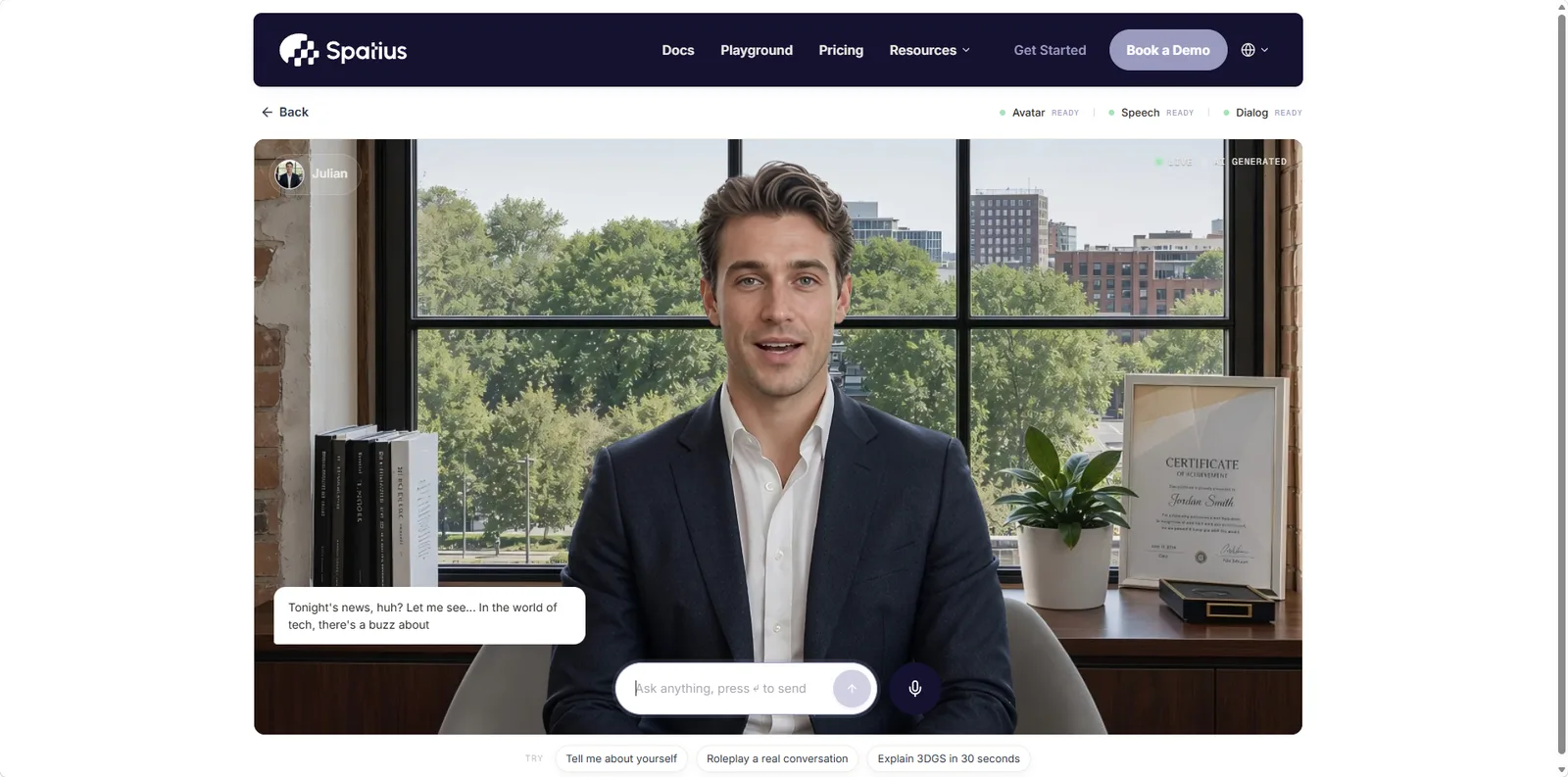
Spatius lets developers add lifelike AI avatars to a product in about 10 minutes through its SDK. Custom 3DGS avatar generation typically takes three to four hours. Its cloud-edge architecture sends lightweight audio and control data while the avatar renders on the user’s device, producing real-time 3D facial animation and lip sync at 1080p and 25fps. It supports phones, tablets, and laptops with consumer-grade integrated graphics.
Teams can use editable, custom-trained 3DGS avatars or stock avatars. The Direct Audio-to-Avatar Engine accepts audio over standard protocols and remains resilient to network jitter with bandwidth requirements of about 10–20 KB/s.
Learn more in the complete guide to interactive, real-time AI avatars.
HeyGen and LiveAvatar
HeyGen’s main platform creates generated talking-head videos. It offers Avatar IV, video translation and dubbing in 175+ languages, voice cloning, templates, and editing tools. HeyGen can translate video as well as create it.
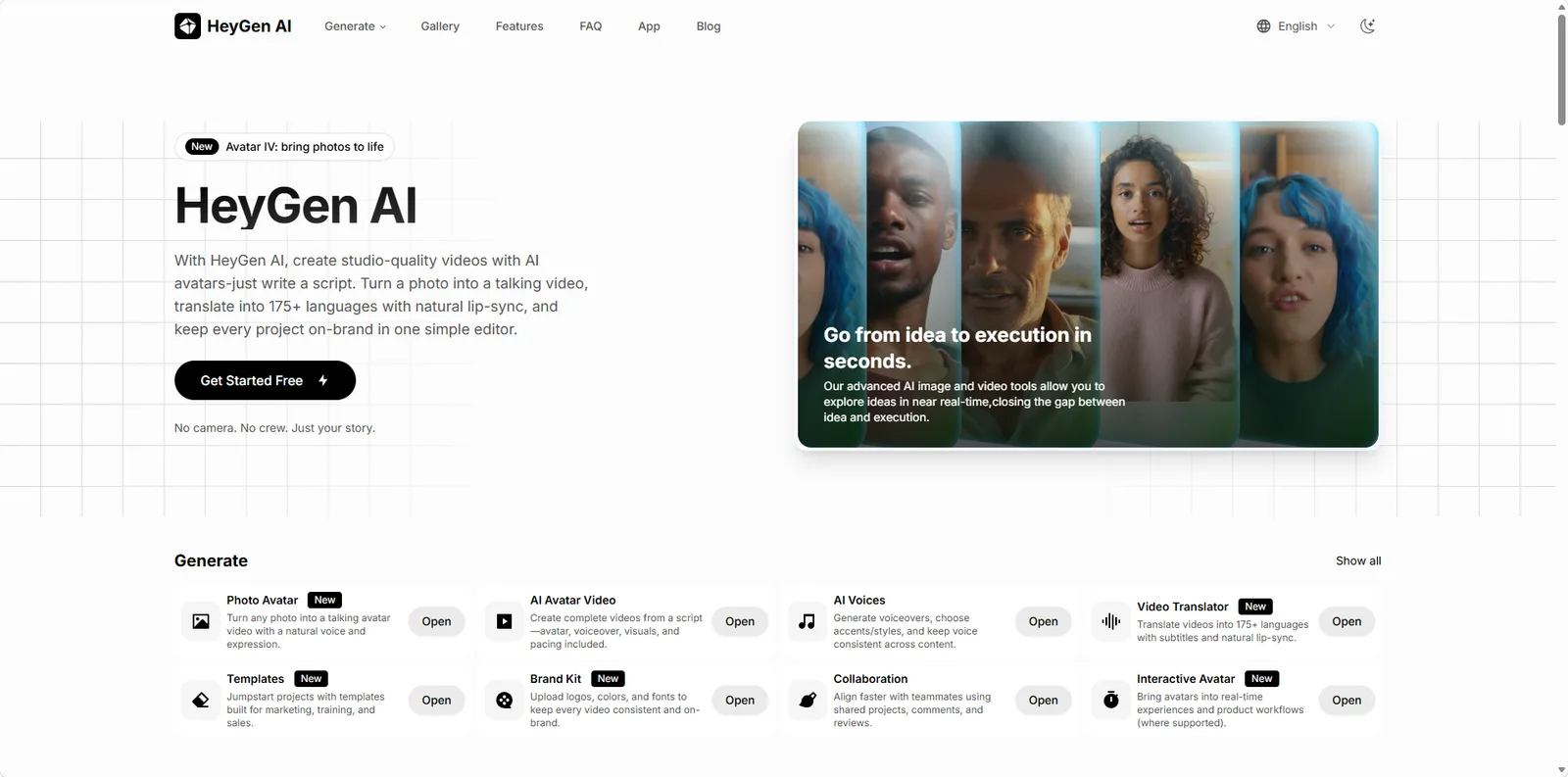
Real-time conversations are handled by LiveAvatar, an independent HeyGen product with separate plans, credits, custom avatars, API access, and SDK integration. This distinction matters when comparing real-time products: HeyGen video-generation pricing and LiveAvatar streaming pricing are not interchangeable.
For additional background, see this HeyGen interactive avatar review, an overview of Avatar IV, and a broader comparison of real-time conversational AI video platforms.
Synthesia
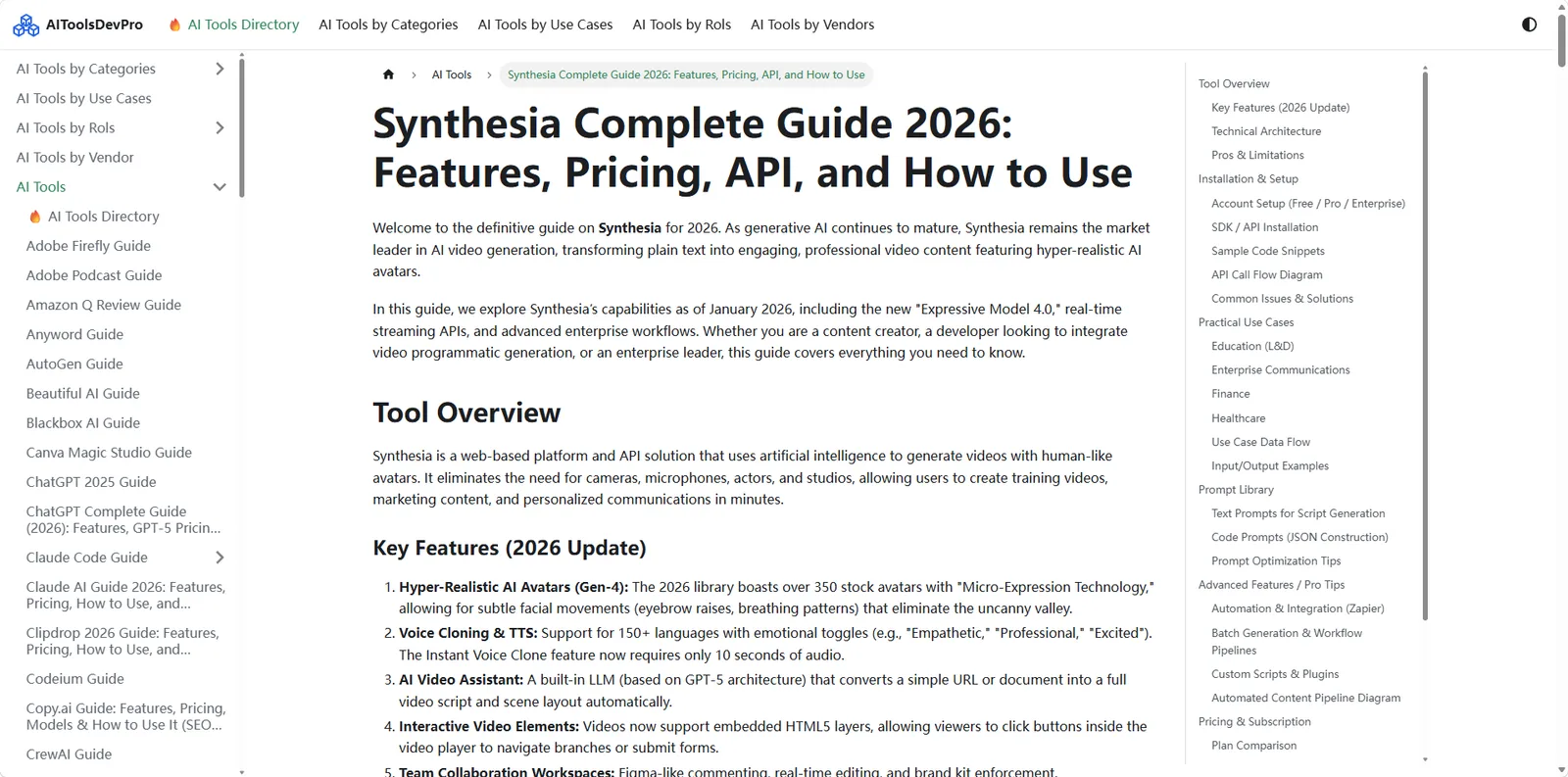
Synthesia focuses on generated video for learning and business communication. It offers a large avatar library, multilingual text-to-speech, voice cloning, one-click translation, a PowerPoint-like editor, shared workspaces, brand kits, quizzes, and branching. Teams can create personal avatars on paid plans and produce reusable training or onboarding content.
See this Synthesia guide and the detailed Spatius vs. Synthesia comparison.
Anam
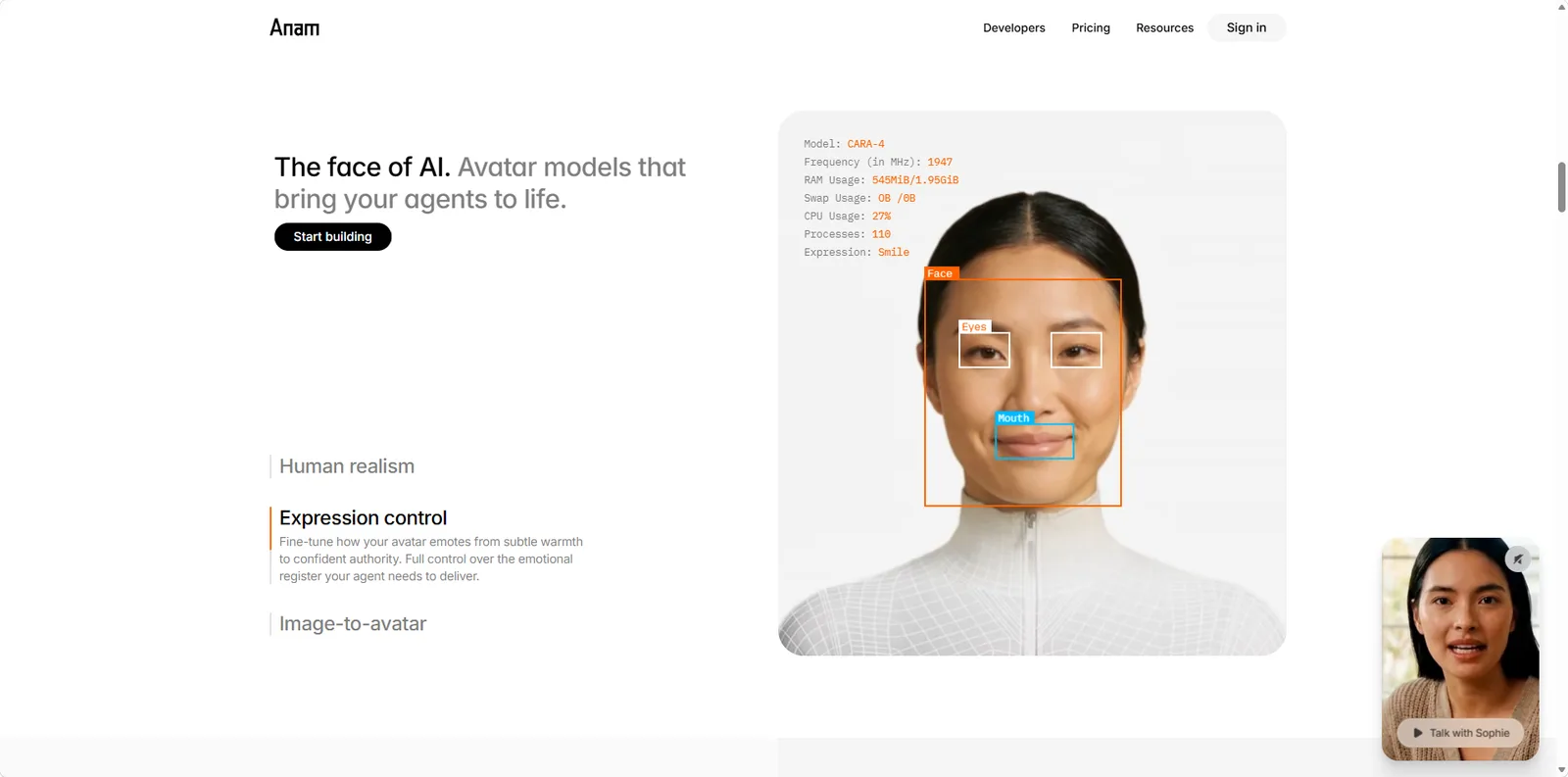
Anam is a real-time AI avatar API rather than a conventional offline video editor. It supports live interaction, custom avatars, and either a turnkey speech-to-text/LLM/text-to-speech pipeline or customer-supplied components. Its public plans include a free tier, and paid usage is priced by live session time.
Pricing and Value
For a deeper cost breakdown, use the AI avatar pricing comparison and the real-time avatar cost guide.
Spatius
Spatius starts at $0.007 per minute, or about $0.42 per hour, and includes approximately 6,667 hours per month. At those published rates, it is the most affordable real-time option among the four platforms compared here. Paid plans include monthly quotas for custom avatar creation.
Because avatars render on the device, Spatius works smoothly on consumer-grade PCs and phones without a dedicated high-end GPU. Its 10–20 KB/s streaming requirement can also reduce server and bandwidth costs.
HeyGen and LiveAvatar
HeyGen’s generated-video product has a free web plan and credit-based paid plans. Its API and LiveAvatar are billed separately. LiveAvatar offers a limited free plan for testing; paid plans use streaming credits, with the amount of time per credit depending on whether teams use Full or Lite integration.
Synthesia
Synthesia’s paid plans bundle video minutes, personal avatars, voice and translation features, editing, and collaboration. Enterprise plans add further data-compliance and administrative support, although compliance support is a standard expectation for enterprise offerings rather than a unique product feature.
Anam
Anam’s public pricing includes a free tier with 30 live minutes per month. Paid plans include monthly minutes, custom avatar slots, and per-minute overages; the published overage rate decreases from $0.11 per minute on Professional.
Pricing changes over time. Confirm current quotas, overages, and annual discounts on each provider’s pricing page before purchasing.
Unique Strengths
- Spatius: The lowest published real-time rate in this comparison, editable 3DGS avatars, on-device rendering, and resilience to network jitter under very low bandwidth.
- HeyGen: A mature generated-video workflow with Avatar IV, strong video translation, voice tools, and a broad template library. LiveAvatar adds a separate path for real-time interaction.
- Synthesia: Advanced business-video editing, interactive learning elements, team collaboration, and multilingual training production.
- Anam: A developer-focused real-time avatar stack with turnkey and bring-your-own AI options.
If your priority is long, cost-sensitive real-time sessions, Spatius is the strongest fit. Choose LiveAvatar when you want HeyGen-style real-time talking heads, HeyGen when you need generated marketing or localization videos, and Synthesia when training workflows and interactive lessons matter most.
Spatius AI Avatar Review
Key Features
Spatius allows teams to add lifelike AI avatars to a product in about 10 minutes through SDK integration. Its cloud-edge architecture is designed for low-latency interaction. The Direct Audio-to-Avatar Engine turns audio into lip-synced 3D facial animation, while editable custom 3DGS models and stock avatars give teams control over appearance.
The system runs at 1080p and 25fps on entry-level consumer hardware with integrated graphics. It supports phones, tablets, and laptops and uses about 10–20 KB/s of streaming data, helping playback remain stable during network jitter.
Pros and Cons
Pros
- SDK integration can take about 10 minutes.
- Monthly Scale pricing is $0.42 per hour.
- The monthly Scale plan includes approximately 6,667 hours.
- Avatars render on consumer-grade PCs and phones.
- Paid plans include custom-avatar creation quotas and commercial use.
- Playback is resilient to network jitter at about 10–20 KB/s.
- The free tier includes 1,000 credits per month.
Cons
- Custom 3DGS avatar generation typically takes three to four hours.
- SDK integration is required so the avatar can render on the device; this is less intuitive than a traditional service that simply streams video.
- Spatius currently follows a bring-your-own AI model. Budget estimates should therefore include speech recognition, LLM, text-to-speech, and engineering integration costs in addition to avatar rendering.
Comparison with Anam
| Feature | Spatius | Anam |
|---|---|---|
| Rendering | On device | Cloud-streamed live video |
| Bandwidth per session | 10–20 KB/s | Typically higher because video is streamed |
| End-to-end latency | Under 1.5 seconds | Varies by pipeline and configuration |
| Bring your own LLM | Yes | Yes |
| SDK platforms | Web, iOS, Android | Web and mobile-browser SDKs |
| Published price | $0.007/min | $0.11/min |
| Free tier | 1,000 credits/month | 30 minutes/month |
Read the related Spatius vs. real-time avatar comparison.
Best Use Cases
Spatius fits language learning, HR technology, mental-health support, virtual companions, and in-vehicle systems. It is especially useful when a product needs long real-time sessions, custom 3D appearance, or predictable bandwidth costs.
HeyGen AI Platform Review
Key Features
HeyGen creates generated talking-head videos with Avatar IV, natural gestures, multilingual lip sync, voice cloning, and translation. Its editor includes templates and tools for marketing, training, sales, and localized content. The output is a generated video, so bandwidth is a playback concern rather than a platform-comparison metric.
LiveAvatar is HeyGen’s separate real-time product. It supports live two-way interaction, custom avatars, SDK/API integration, and knowledge-base or LLM connections.
| Feature | Description |
|---|---|
| Avatar IV | Realistic generated avatars with expressive motion |
| Natural gestures | Timing-aware gestures and micro-expressions |
| Lip sync | Multilingual synchronization |
| Voice cloning | Custom voice creation and controls |
| Video translation | Dubbing and lip-synced translation in 175+ languages |
| LiveAvatar | Separate real-time interactive avatar platform |
| SCORM export | Support for corporate training modules |
| Template library | Reusable starting points for video creation |
Pros and Cons
Pros
- High visual realism and strong personalization.
- Mature video creation, editing, and translation workflow.
- Fast time to value for generated marketing and training videos.
- LiveAvatar provides a separate route to real-time conversations.
Cons
- Core HeyGen, API, and LiveAvatar plans use separate pricing and credit systems.
- Custom and premium models can consume credits quickly.
- Real-time LiveAvatar performance depends on a stable internet connection.
- Teams remain dependent on the vendor’s hosted pipeline and regional availability.
Comparison with Anam
| Feature | HeyGen / LiveAvatar | Anam |
|---|---|---|
| Primary product | Generated talking-head video | Real-time conversational avatar |
| Real-time option | LiveAvatar, a separate platform | Native product focus |
| Translation | Video translation and dubbing | Conversational language support |
| Editing | Full video editor and templates | Limited compared with video editors |
| Best fit | Marketing, localization, training; LiveAvatar for live agents | Live support, coaching, and conversational agents |
Best Use Cases
HeyGen is a strong fit for marketing videos, product demos, sales outreach, HR onboarding, and localized training. Choose LiveAvatar instead of the core video product when the avatar must listen and respond in real time.
Synthesia for AI Avatars
Key Features
Synthesia converts scripts, links, or documents into generated business videos. Its avatar library, multilingual voice tools, translation, editor, collaboration workspace, and interactive layers make it suitable for repeatable workplace learning.
| Feature | Description |
|---|---|
| AI avatars | Large stock library plus personal avatars on paid plans |
| Voice cloning and TTS | Multilingual speech and personal voices |
| AI video assistant | Converts documents and URLs into scripts and scenes |
| Interactive elements | Quizzes, navigation, forms, and branching |
| Team workspaces | Shared editing, comments, and brand-kit controls |
Pros and Cons
Pros
- Fast text-to-video workflow.
- Strong multilingual and translation support.
- No on-camera presenter is required.
- Collaboration, LMS, and CRM integrations suit enterprise training.
Cons
- Avatar and voice customization may be limited by plan.
- Subscriptions can become expensive at higher production volumes.
- Lip sync can vary by language and source material.
- It is designed for generated video, not open-ended real-time conversation.
- Offline creation is not supported.
Comparison with Anam
Synthesia provides stronger video editing, collaboration, and interactive training tools than Anam. Anam is the better category fit for a live avatar that must hold an open-ended conversation. Synthesia is the better fit when a team wants to create, review, publish, and reuse structured training videos.
Best Use Cases
Synthesia works well for employee onboarding, sales enablement, compliance training, leadership practice, and multilingual learning content.
Choosing the Right AI Avatar Platform
Assess Your Needs
Ask these questions before choosing:
- Is your goal a live conversation or a generated video?
- How many live minutes or rendered video minutes will you need?
- Do you need a stock avatar, a personal avatar, or an editable custom 3D avatar?
- Must the platform connect to your existing ASR, LLM, TTS, LMS, or CRM?
- How important are latency, bandwidth, interactive lessons, translation, and editing?
Use the pricing comparison to model usage, then define your business goals before testing each shortlist candidate.
Decision Guide
- Choose Spatius for affordable, long-running real-time interactions and editable 3DGS avatars rendered on user devices.
- Choose HeyGen for generated talking-head videos, marketing, translation, and creative production.
- Choose LiveAvatar for real-time avatar conversations within HeyGen’s ecosystem.
- Choose Synthesia for structured training, onboarding, collaboration, and interactive business video.
- Choose Anam for a real-time, cloud-streamed avatar with turnkey or bring-your-own AI components.
You can also review the original Anam alternatives guide, explore more articles on the Spatius blog, and compare broader recommendations for AI content-creation tools.
FAQ
How much does Spatius cost?+
Spatius starts at $0.007 per minute—about $0.42 per hour—and includes approximately 6,667 hours per month. Additional usage is billed separately.
Can you create custom avatars with Spatius?+
Yes. Paid plans include monthly quotas for custom, editable 3DGS avatar creation. Custom generation typically takes three to four hours, and the fastest single-image workflow starts at about three hours. Commercial use is available on paid plans.
What devices and bandwidth does Spatius support?+
Spatius supports phones, tablets, and laptops with consumer-grade integrated graphics. Tested streaming uses about 10–20 KB/s (roughly 100–300 kbps) at 1080p and 25fps.
Does HeyGen support real-time avatars?+
Yes, through LiveAvatar. It is a separate platform from HeyGen's core generated-video product and has its own plans, credits, avatars, and API/SDK workflow.
Does Anam have a free tier?+
Yes. Anam's published free plan includes 30 minutes per month, one custom avatar slot, API access, a three-minute conversation limit, and one concurrent session.