

Anam vs D-ID for Real-Time AI Agents
Choose Anam if you want a hosted conversational-avatar product with public session-based plans and a clear LiveKit path. Choose D-ID if its broader digital-human and creative-video ecosystem fits the rest of your project. Neither choice removes the need to define the agent architecture behind the avatar.
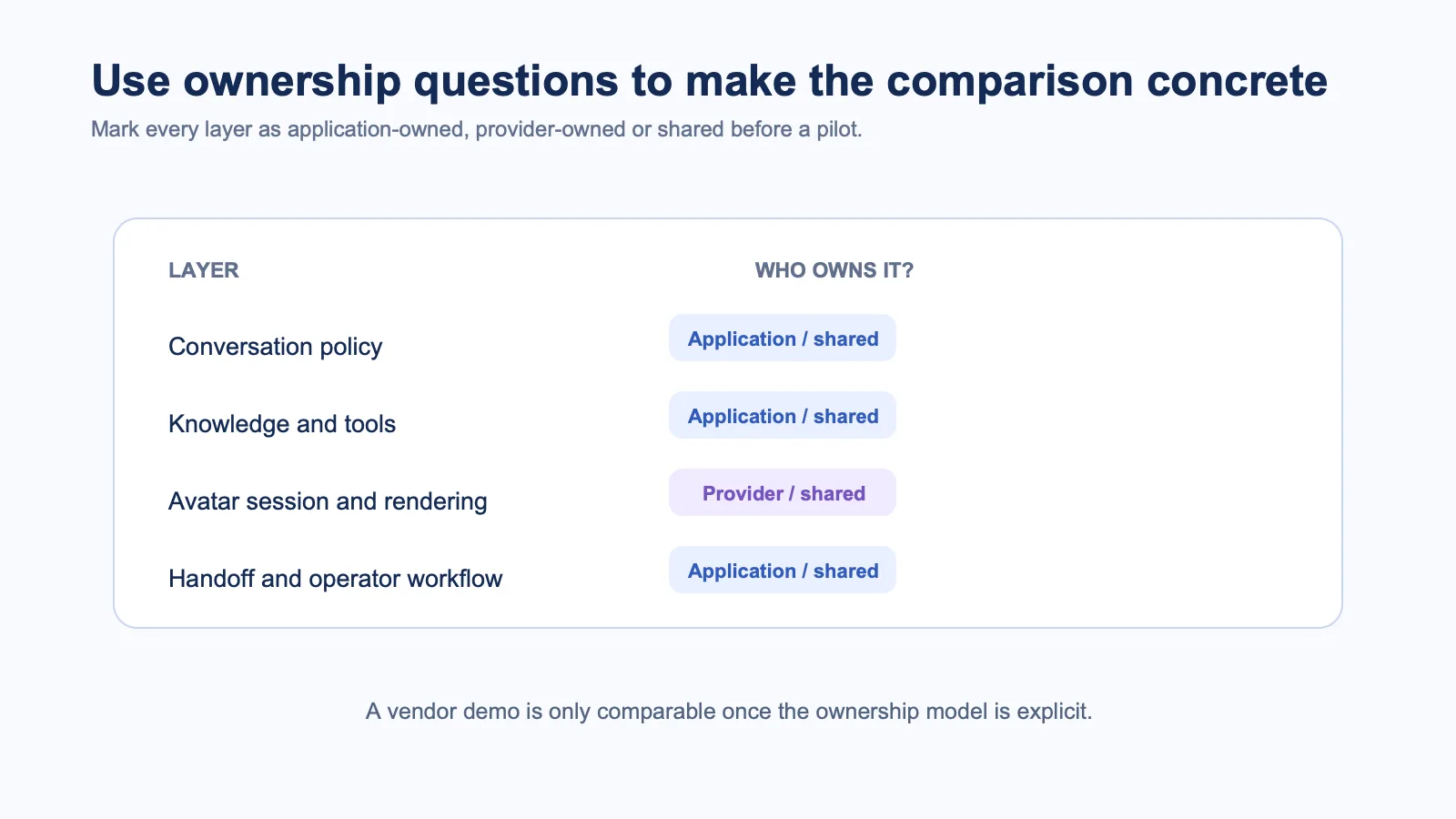
Anam and D-ID can both appear in a LiveKit voice-agent shortlist, and both can put a human-like visual participant into a real-time experience. That similarity is real. The mistake is to stop there. Your team still has to decide who owns the LLM, speech stack, session state, safety policy, user data, and the behavior when a user interrupts.
At a glance
| Criterion | Anam | D-ID |
|---|---|---|
| Public framing | Real-time conversational avatar platform | Digital humans, interactive avatars, and creative video workflows |
| LiveKit route | Anam publishes a LiveKit plug-in guide | D-ID publishes a LiveKit plug-in guide |
| Pricing signal | Public plans list included minutes, concurrency, and overages | API pricing is published, but product scope and credits need close review |
| Best starting point | A hosted persona inside a voice-agent experience | Teams that also value D-ID’s broader avatar/video ecosystem |
| Pilot question | Does the hosted session model fit your expected concurrency? | Which D-ID product path matches the intended real-time experience? |
How we compared them
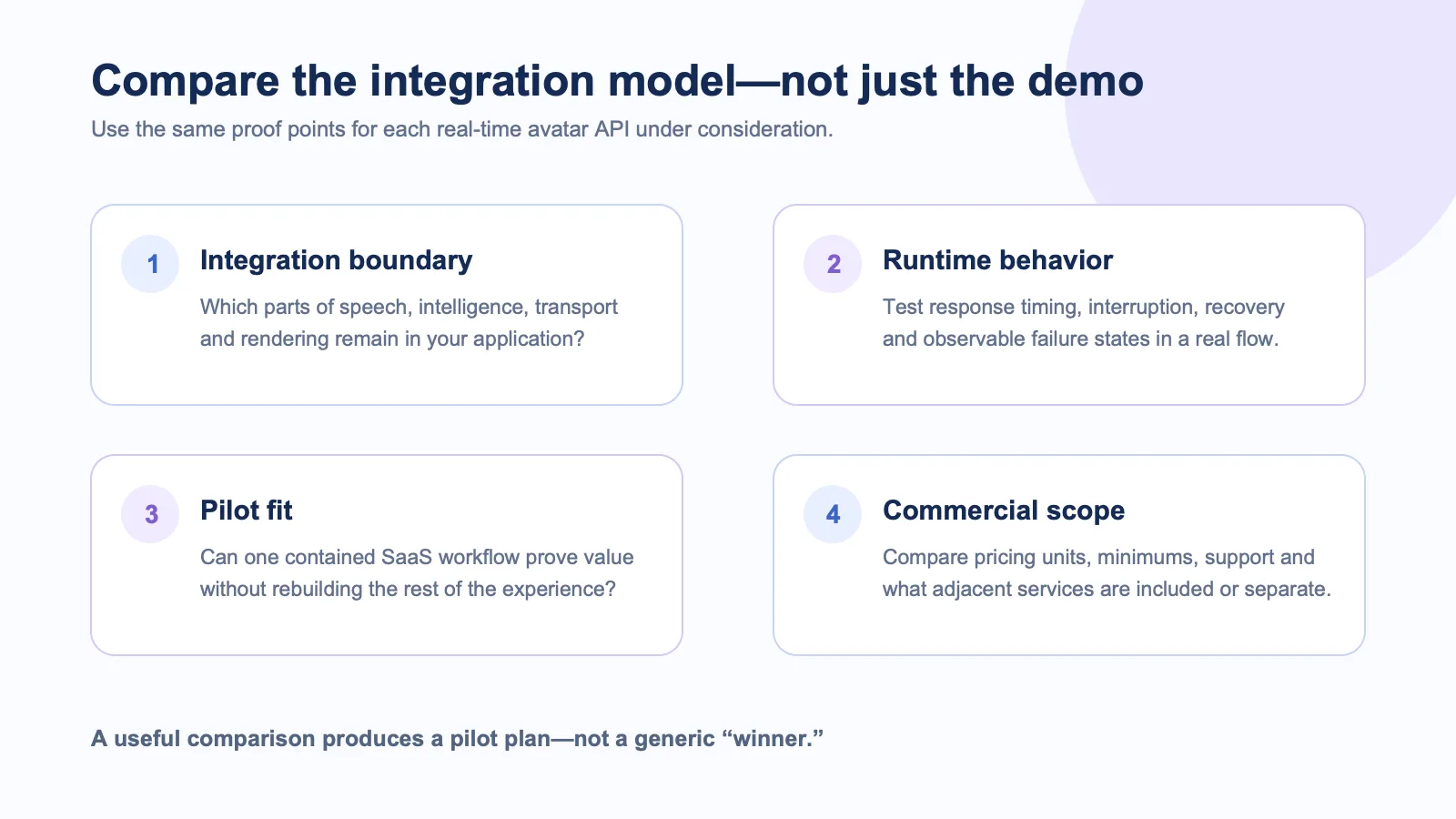
This is not a visual-realism beauty contest. It compares the facts a product team needs before committing engineering time: integration model, separation from the agent layer, usage mechanics, and how easy it is to run a real pilot.
Both vendors work in the ecosystem that LiveKit Agents documents for real-time voice, video, and physical AI. LiveKit’s virtual avatar model overview currently lists both Anam and D-ID as supported avatar providers. That tells you an integration path exists; it does not tell you whether the user experience, cost model, or production controls are interchangeable.
Anam: the more direct hosted-avatar comparison
Anam’s LiveKit guide describes its plug-in as a way to give an existing agent a face. The useful architectural signal is that a developer can keep the LLM and voice providers already chosen for the agent while inserting an avatar participant into the room.
That is a clean story for a team building an interactive tutor, support agent, onboarding assistant, or guided workflow. It also gives you a concrete pilot plan: run the same agent with and without the avatar, measure completion, handoff rate, session duration, and support burden.
Anam’s pricing page is relatively explicit about what changes as you move up: included minutes, session limits, concurrent sessions, custom-avatar allowance, and overage rate. Treat those fields as test constraints. A five-minute cap is not a footnote if your support conversations last ten minutes.
Choose Anam when
- You want a real-time, hosted visual persona rather than a local rendering layer.
- Your team values a documented LiveKit route and wants to test quickly.
- Public usage limits and overage rates are useful for forecasting a pilot.
Watch for
Your product still needs an answer for agent state, knowledge retrieval, data retention, escalation, and operator tooling. An avatar platform can improve the interaction surface; it does not define the business process behind it.
D-ID: broader digital-human and creative-video context
D-ID’s LiveKit plug-in article presents its avatar as a visual layer for agent pipelines. That is the relevant product path for this comparison. D-ID also has a broader set of avatar and video workflows, which can matter if the buyer wants both interactive experiences and creative content production under one vendor relationship.
Start the commercial review with D-ID’s current API pricing page. Don’t turn the displayed monthly figure into a fictional “cost per live minute.” Check the product tier, watermark rules, resolution, concurrency, and whether the quoted unit maps to the exact interactive endpoint your project will use.
Choose D-ID when
- The organization wants a supplier with interactive-agent and broader avatar/video capabilities.
- A web-embedded digital human is the initial deployment target.
- The team is willing to validate the exact API path in a proof of concept before setting a unit-cost model.
Watch for
“D-ID” can refer to several workflows. Make sure the team is evaluating the same one in demos, pricing, and implementation documents. A generated talking-head video and a live agent avatar should never share a single acceptance checklist.
What to test in the first week
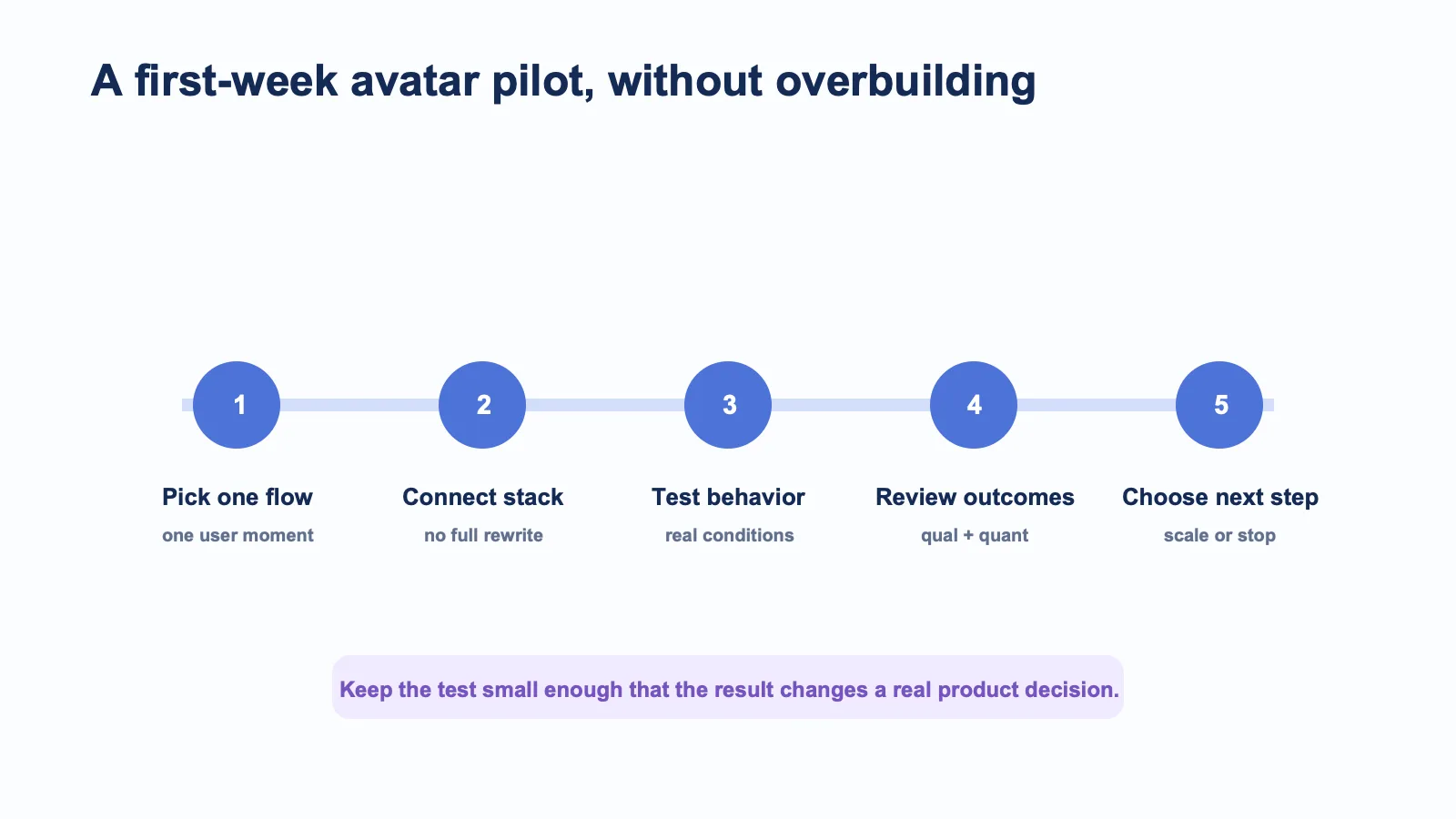
Use the same scripted voice-agent flow for both vendors. Give it a short answer, an interruption, a tool call that takes three seconds, a handoff to a human, and a network reconnect. Record:
- Time from a completed user turn to visible avatar response.
- How a barge-in stops or changes the previous response.
- What the end user sees while a backend tool is running.
- Session recovery after a browser reconnect.
- The unit that actually consumes paid usage.
This mirrors a point in LiveKit’s agent framework documentation: the agent is an active real-time participant, not merely an API call. Your acceptance test should be real-time too.
Final recommendation
Anam is the more straightforward pick for a team that wants to add a hosted conversational avatar to an existing LiveKit or voice-agent stack. D-ID is the better fit when its wider digital-human and video ecosystem is part of the purchase decision. If neither bundled model fits because your SaaS owns the intelligence and wants a separate real-time rendering layer, compare both with Spatius’s documented integration paths before you lock in an architecture.
Suggested CTA: Use the same pilot script with both platforms and keep the results in a one-page engineering scorecard.