

Best AI Avatar APIs for LiveKit Agents in 2026
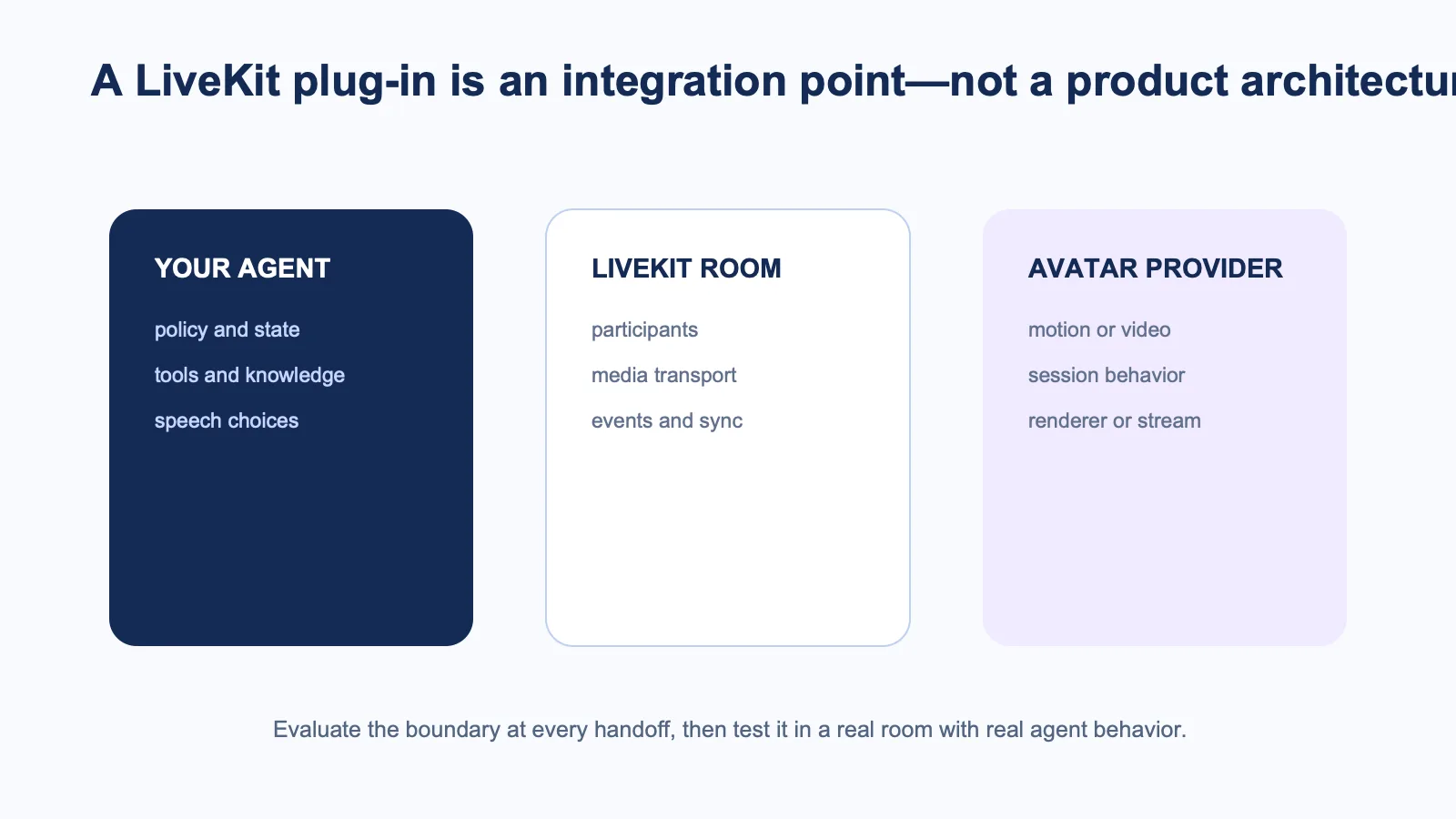
The best AI avatar API for a LiveKit Agent is the one that matches the boundary of your system. Choose a provider that bundles conversation when you want a managed experience. Choose a visual layer when your application already owns the agent. A plug-in is not enough information to make the call.
LiveKit Agents is a framework for real-time voice, video, and data participants. Its virtual-avatar documentation currently lists providers including Anam, D-ID, Protoface, Simli, Tavus, and more. That is a useful starting map, not a ranking. Each provider has a different delivery model, session policy, cost unit, and place in the AI stack. See LiveKit’s avatar model overview.
Shortlist at a glance
| Provider | Best for | What to validate first |
|---|---|---|
| Spatius | A LiveKit voice agent that needs a separate local-rendered visual layer | Web client path, AvatarKit rendering, and your existing agent boundary |
| Anam | A hosted conversational avatar attached to a LiveKit agent | Session duration, concurrency, and custom-avatar plan limits |
| D-ID | A digital-human provider with a LiveKit plug-in | Exact interactive endpoint and the selected commercial plan |
| Tavus | A bundled conversational-video experience | Whether CVI should own more of the voice stack |
| HeyGen LiveAvatar | Teams also using HeyGen’s video ecosystem | Lite vs Full integration and credit consumption |
| Protoface | A developer exploring a newer real-time provider | Actual production constraints, custom avatars, and contract terms |
1. Spatius: best for a composable LiveKit visual layer
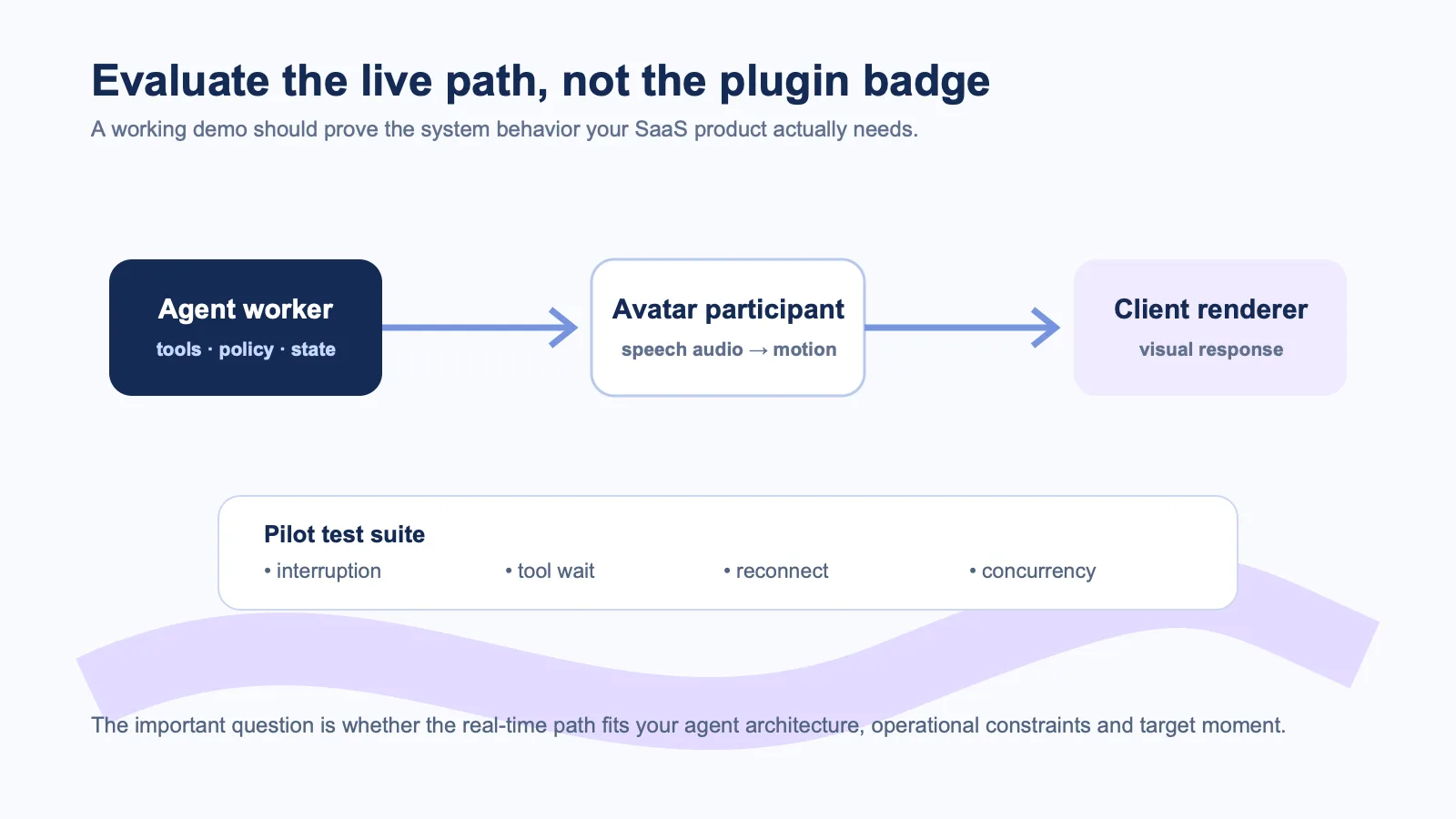
Spatius has a distinct implementation model. The official LiveKit Agents integration uses livekit-plugins-spatius in the agent worker. Agent audio is sent to Motion Server, which publishes synchronized audio and motion data into the LiveKit room. AvatarKit then renders the avatar in the client.
The important point is scope. Spatius does not claim to be the LLM, ASR, TTS, tool layer, or conversation policy. The docs map describes Motion Server as audio-to-motion infrastructure and AvatarKit as local client rendering. That is useful if LiveKit and your app already own the agent logic.
Use this route when your technical requirement is “keep our agent; add a face.” The documented LiveKit avatar client path is currently Web, so do not write a mobile promise into a product plan until the applicable official path is confirmed.
2. Anam: best for a hosted conversational avatar
Anam publishes a specific LiveKit plug-in guide, including a short install path for an existing LiveKit agent. Its positioning is straightforward: the visual avatar is added to the room while the developer can continue using selected LLM and voice providers.
This makes Anam a good option for a fast, hosted proof of concept. Its public plans expose usage dimensions that matter in a LiveKit deployment: free minutes, session limits, simultaneous sessions, custom avatars, and overages. Use those numbers as a pilot boundary, not as a substitute for a load test.
3. D-ID: best for teams evaluating a wider digital-human vendor
D-ID’s LiveKit plug-in announcement presents the product as a way to add real-time visual output to an agent pipeline. It deserves a shortlist spot if the company is also comparing D-ID’s creative video and avatar products.
The risk is evaluation drift. D-ID has several avatar and video workflows. Start with the interactive path you will actually ship, then check the current API pricing page for the exact tier, unit, watermark rule, and resolution terms that apply. Don’t let a generated-video plan stand in for a live-agent cost model.
4. Tavus: best for an end-to-end CVI approach
Tavus’s CVI overview frames the product as a real-time conversation with a Replica. Its pricing page says CVI includes the major elements of an end-to-end pipeline, from conversation models to WebRTC and rendering.
That can be a feature, not a flaw. If your team is starting from a blank page and wants fewer providers, Tavus may offer a faster first demo. If LiveKit already coordinates a mature voice stack, inspect what becomes duplicated or vendor-owned before you make the architecture permanent.
5. HeyGen LiveAvatar: best for a combined video and live-avatar stack
HeyGen’s LiveAvatar documentation positions the product as its real-time interactive avatar offering. For a team already using HeyGen’s broader video products, this can simplify vendor management.
There is a pricing catch worth testing, not guessing. The getting-started guide describes different LiveAvatar integration methods and different credit efficiency. Keep a separate line item for live streaming instead of importing the rate for asynchronous avatar-video generation.
6. Protoface: best for an additional developer-first benchmark
Protoface says it gives an AI agent a face and lists integrations across voice-agent products on its website. It is worth including when your goal is a current technical benchmark rather than a vendor familiar to procurement.
The right method is a small production-style test. Check audio handoff, interruption, reconnection, browser performance, custom-avatar workflow, support model, and commercial terms. A provider can look excellent in a static demo and still be wrong for your session lengths or customer environment.
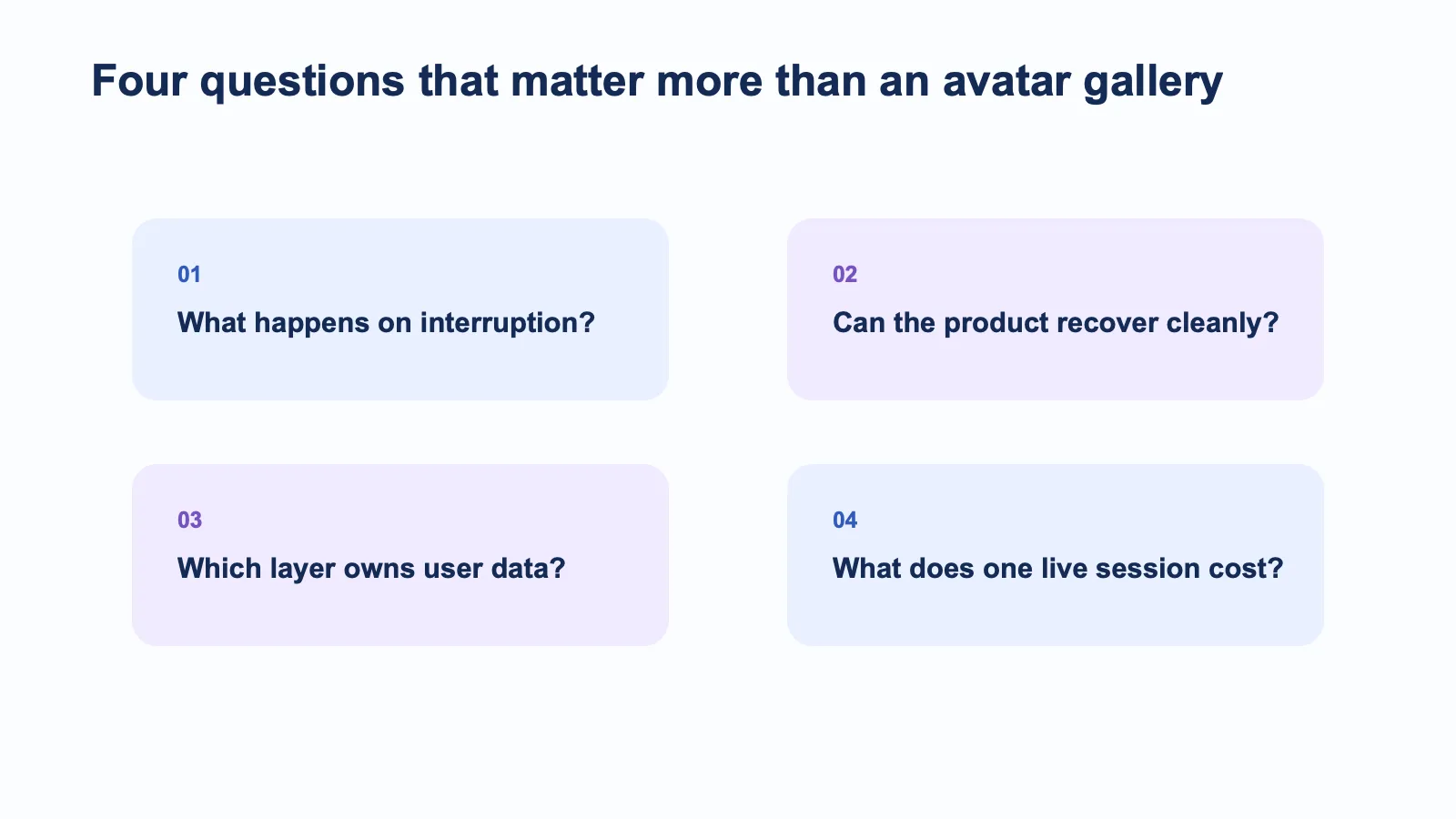
The four questions that matter more than the avatar gallery
- Where does the agent live? In your LiveKit worker, in a vendor platform, or in a split arrangement?
- What reaches the client? A finished video track, a media stream, or data that drives local rendering?
- What is billed? Connected session, streamed minute, rendered minute, credit, or bundled conversation?
- What happens in bad moments? Test a barge-in, delayed tool call, reconnect, and human handoff.
LiveKit’s model matters here: its avatar worker is a separate participant from the agent itself. That separation gives you a useful way to think about ownership, observability, and failure states even when the selected provider changes.
Final recommendation
For an existing LiveKit voice agent, start with Spatius or Anam if keeping your current intelligence layer matters most. Evaluate Tavus when you want a bundled conversational product. Include D-ID, HeyGen LiveAvatar, and Protoface when their broader workflow, video ecosystem, or commercial model is a genuine fit. Build the shortlist from your required architecture, then let a controlled LiveKit pilot decide the rest.
Suggested CTA: Read the Spatius LiveKit integration guide before deciding whether you need a local-rendered avatar layer or a bundled video participant.