

Real-Time AI Avatar API Pricing: What to Compare in 2026
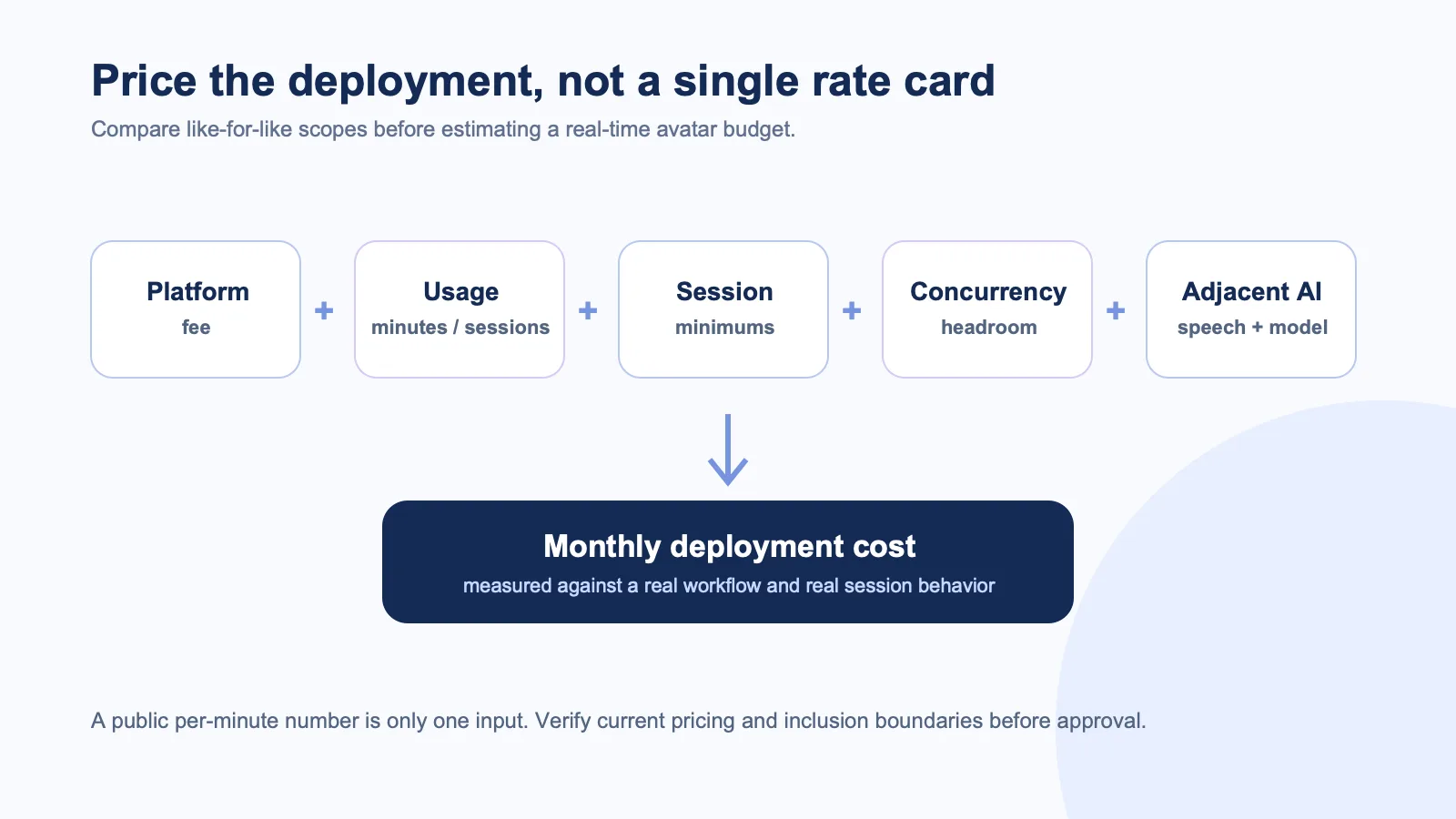
The cheapest real-time AI avatar API is rarely the platform with the smallest number on its pricing page. A minute may include only visual rendering, or it may include the LLM, speech, video transport, custom-avatar creation, and a minimum connection charge. Compare the same workload, not the same label.
This guide uses public pages checked on August 12, 2026. Pricing changes often, so treat the figures as a shortlist input and re-check each source before procurement.
The five pricing questions to ask first
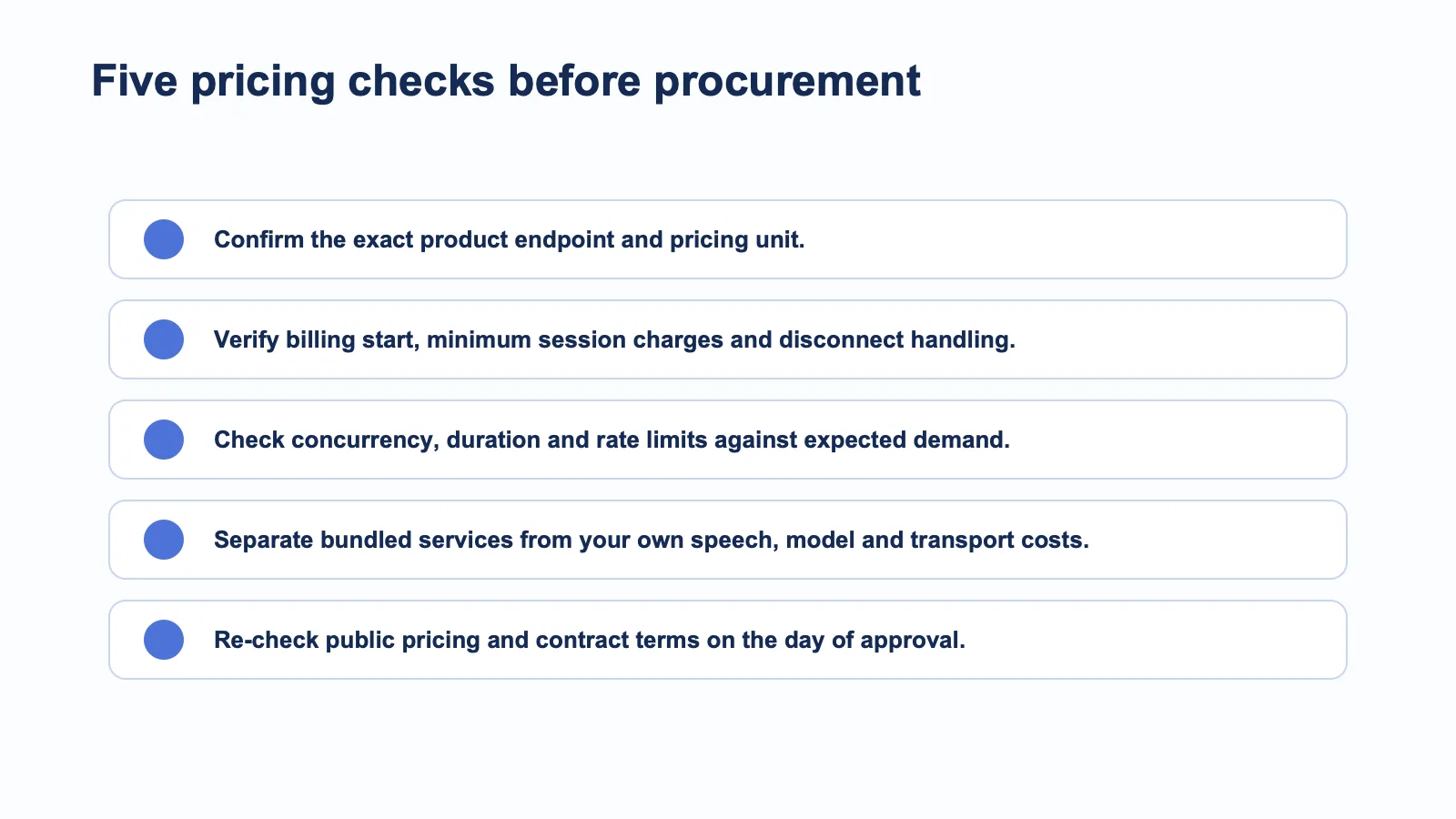
- What does a minute include? Rendering only, or the whole conversational stack?
- When does billing start? At session creation, participant join, first audio packet, or first rendered frame?
- Is there a minimum session charge? This matters for short, high-volume interactions.
- What limits a rollout? Concurrent sessions, maximum session length, API rate limits, or custom-avatar allowance?
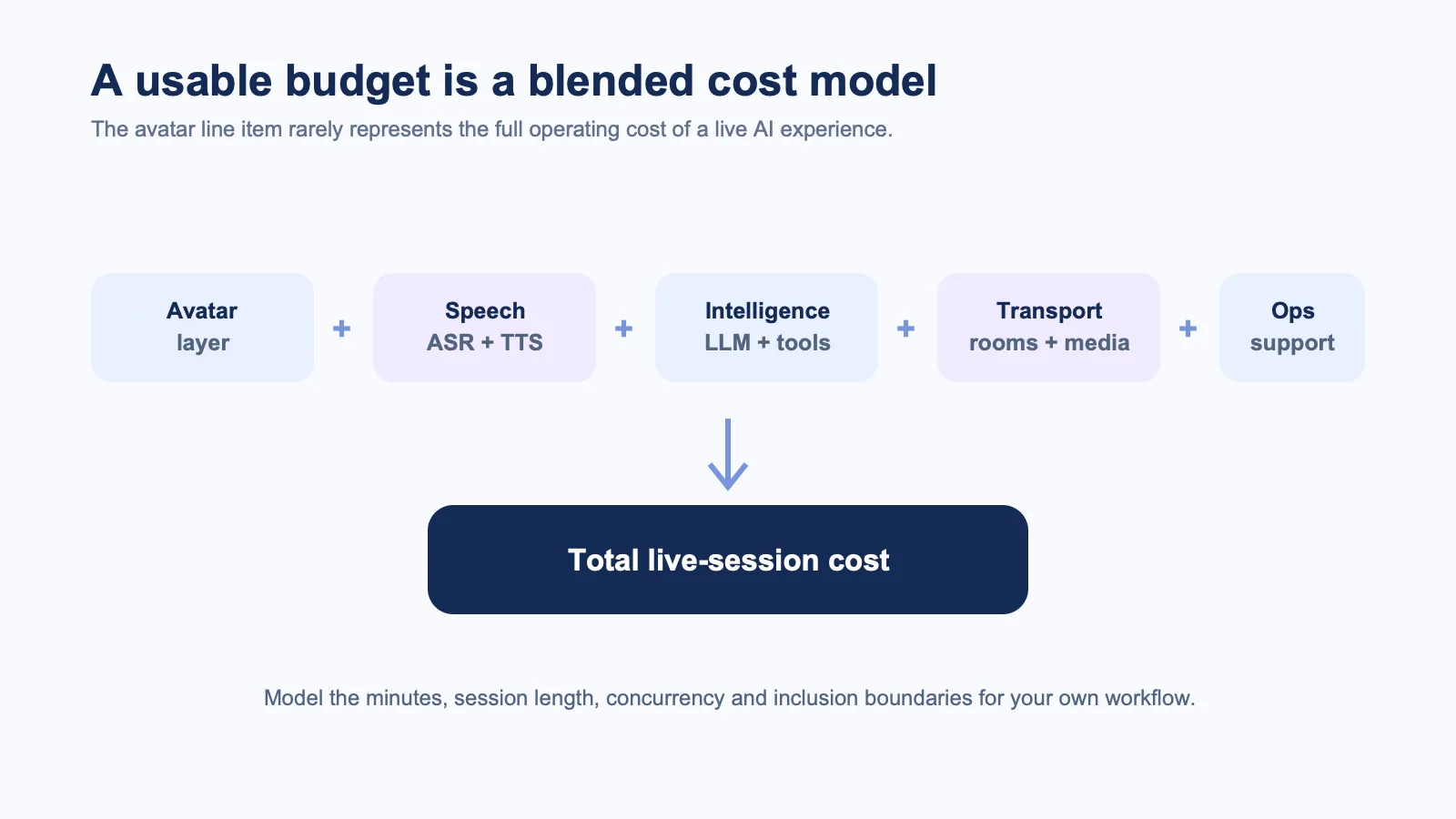
- What is outside the price? Your LLM, TTS, STT, storage, LiveKit usage, or the client device may still be separate costs.
Public pricing signals at a glance
| Provider | Public pricing signal | Scope to verify |
|---|---|---|
| Spatius | Homepage lists Scale at $0.007/min | This is the avatar motion/rendering layer; bring your own AI stack |
| Anam | Public overages range from $0.16/min on Starter to $0.11/min on Professional | Included minutes, session limits, concurrency, and hosted avatar scope |
| Tavus | Free, $59/month Starter, and $397/month Growth developer plans are public | Conversation minutes include Tavus CVI components; a 30-second minimum is stated |
| HeyGen LiveAvatar | Its help page gives Lite and Full effective streaming examples | Credits and integration method change the effective per-minute rate |
| D-ID | API plans are public, including plan-level features | Confirm the selected interactive endpoint and credit/unit mapping |
Spatius: price the visual layer separately
Spatius describes itself as real-time avatar infrastructure. Its official docs map says Motion Server receives speech audio and returns motion data, while AvatarKit renders the avatar locally in the client. Your application owns ASR, LLM, TTS, knowledge, tools, and turn-taking.
That boundary changes the spreadsheet. The Spatius homepage lists a public Scale rate of $0.007 per minute and describes the cloud-edge design. To calculate total cost, add the providers you use for speech, intelligence, and transport. Do not call it a full “agent cost” unless those services are included in the same scenario.
This approach is most comparable to a team that already runs its own voice or agent infrastructure and only needs the avatar-driving and rendering layer. If you want one vendor to supply most of the conversation, a bundled provider is a different product category.
Anam: price sessions, not only overages
Anam’s pricing page publishes a free tier plus plans with included minutes, custom avatars, concurrent sessions, team seats, maximum conversation lengths, and overage rates. Its stated overage ranges from $0.16 per minute on Starter to $0.11 per minute on Professional.
The important line item is not just the overage. A product with an average eight-minute support conversation has different economics from an onboarding assistant with thirty-second exchanges. Model the included minutes, expected session duration, concurrent traffic, and the percentage of sessions that end before a user joins.
Anam’s LiveKit integration guide also helps clarify scope: an existing voice agent can be given a visual participant. Budget the surrounding LiveKit and voice-AI services separately when they are not part of the selected Anam plan.
Tavus: price a bundled conversation minute
Tavus’s pricing page makes the bundle explicit. Its developer plans list included conversational-video minutes and say that a CVI conversation includes the underlying LLM, audio, speech, WebRTC, and rendering components. The page also states that live conversation is measured from connection to disconnection, rounded in short increments, with a 30-second minimum.
That is a meaningful difference from a rendering-only rate. A higher number may cover more infrastructure. A lower visual-layer price may leave you responsible for several services. Neither is automatically cheaper until you model the full application.
For a fair pilot, track the number of sessions started, total connected seconds, the rate of abandoned sessions, average concurrency, and how much work the vendor-managed pipeline replaces in your own stack.
HeyGen LiveAvatar: calculate from the actual integration method
HeyGen’s LiveAvatar getting-started page publishes a useful warning for anyone comparing credits: Lite and Full integration methods can produce different minutes from the same credit balance. The page currently gives examples of roughly $0.10 per streamed minute for Lite and roughly $0.20 for Full at one plan level.
HeyGen’s broader API pricing documentation also covers generated avatar video. Keep that asynchronous video price separate from live-avatar streaming. A vendor can offer both without one rate representing both products.
D-ID: map the price to the exact product path
D-ID publishes API pricing, including plan-level limits and avatar features. Before normalizing it, identify the exact workflow your product needs: a generated video, a streaming avatar, or a real-time agent integration. D-ID’s LiveKit plug-in page is useful for confirming the real-time direction, but it is not a substitute for endpoint-specific commercial terms.
This is where many comparison posts become misleading. A monthly plan can include credits or a quota whose effective unit rate depends on resolution, endpoint, session type, and usage pattern. If the mapping is not public, mark it as “requires quote or pilot measurement,” not as a made-up per-minute rate.
A simple cost model for your pilot
Use this formula for each provider:
monthly avatar cost = platform fee + usage overage + custom-avatar fees + minimum-session waste + required adjacent services
Then add the non-avatar line items that apply to your architecture:
- LiveKit or other real-time transport.
- TTS and STT.
- LLM inference and tool calls.
- Recording, analytics, storage, and support operations.
- Client hardware or cloud rendering capacity where applicable.
The LiveKit Agents documentation is a helpful reminder that real-time agents have a lifecycle, sessions, and media participants beyond a single model request.
The bottom line
Compare Spatius with other rendering-layer options when your team already owns the AI brain. Compare Anam, Tavus, HeyGen LiveAvatar, and D-ID when you are choosing a hosted or bundled avatar experience. Do not rank them by a naked dollar figure. First normalize what each paid minute actually contains, then run a one-week pilot with real session length and concurrency.
Suggested CTA: Use the Spatius pricing page as a starting point, then place every vendor’s current source URL and verification date in the same evaluation sheet.